
Reading the Future of the Oceans: China's LangYa 2.0 AI Unveils Ocean Secrets
Chinese scientists have introduced LangYa 2.0, an artificial intelligence system claimed to be capable of reading the future of the oceans. With the statement, “Version 1.0 only told us sea temperatures. Version 2.0 tells us where eddies will form and when storm surges will hit the coast,” researchers presented the new technology at the China Digital Earth Conference in Qingdao.
This latest AI system, launched by the Chinese Academy of Sciences (CAS), goes far beyond merely monitoring water temperature or current directions. It is now capable of predicting six marine phenomena that have long been nightmares for sailors, fishermen, oil rig operators, and coastal communities: typhoons, extreme rainfall, storm surges, internal solitary waves, mesoscale eddies, and sea ice movement. The leap in capability from its predecessor is significant. While LangYa 1.0, introduced in late 2024, could only forecast basic variables such as temperature, salinity, and ocean currents up to seven days in advance, LangYa 2.0 is designed to interpret much more complex phenomena. The AI views the ocean not just as an expanse of water, but as a living system that changes minute by minute.
The real-world implications are profound. Consider a coastal city that has only a few hours to prepare before a typhoon suddenly changes direction, or an offshore oil platform facing massive underwater waves invisible from the surface. According to the development team, LangYa 2.0 is designed to recognise such threats more quickly and accurately, allowing for life-saving decisions to be made before disaster strikes.
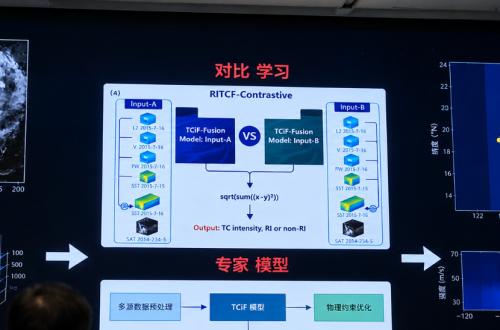
The secret lies in massive datasets. The LangYa 2.0 typhoon module integrates satellite cloud imagery, atmospheric data, ocean conditions, and the historical tracks of thousands of previous typhoons. The system then identifies patterns difficult for humans to detect, including two phenomena feared most by meteorologists: rapid intensification and sudden changes in direction.
Initial results suggest the AI may indeed outperform conventional methods. Even before its official launch, LangYa 2.0 was tested in predicting Arctic sea ice extent in September 2025. The model ranked first in independent validation conducted by the Sea Ice Prediction Network, an international network focused on Arctic sea ice forecasting. This achievement is critical because, in polar regions, an error of just a few kilometres can determine the safety of vessels navigating through ice floes. LangYa 2.0 is capable of producing monthly predictions with a resolution of up to three kilometres. Such precision is vital for Arctic navigation, climate change research, and navigating one of the most extreme environments on the planet. However, Chinese scientists appear not to be stopping here.