
Reading Saudi Arabia's Position as a 'New Regional Power'
Since the launch of Saudi Vision 2030 as a long-term national transformation programme, Saudi Arabia has continued to consolidate its position.
Economic and infrastructure development across various regions of the Kingdom has increasingly reinforced the assumption that the land of the Custodian of the Two Holy Mosques (Makkah and Madinah) will become a new geoeconomic and geopolitical power in the region.
Saudi Arabia’s Economic Vision 2030, launched by Crown Prince and Prime Minister Mohammed bin Salman in 2016, is now intertwined with a strategic geopolitical vision.
Its primary goal is to reduce the country’s structural dependence on oil and to build a more diversified, productive, investment-based and globally connected economy.
For decades, Saudi Arabia has often been portrayed as an oil-producing country with the stigma of being a strategic ally of the United States in the Middle East. However, that image is slowly beginning to shift.
Saudi Arabia is now moving towards a new form of power — not only economically, but also increasingly active in shaping the defence-security architecture, diplomacy, technology and regional politics. What are the indicators?
From Economic Vision to Politics
Vision 2030 was initially understood only as an agenda to reduce Saudi Arabia’s dependence on oil. However, in its development, the project has far greater and more strategic geopolitical consequences.
Economic diversification through investment, innovation, tourism development, strengthening of the financial sector, and overall infrastructure and security development has increased the capacity of the country of around 35,165,787 people (Worldometers, 2026) to act as a regional power.
In other words, Vision 2030 is no longer merely an economic vision, but is expanding into a geopolitical and strategic vision in line with the latest dynamics in the region.
So far, Saudi Arabia’s strength has rested on the oil energy sector. With its abundant oil reserves, Riyadh has gained at least three strategic advantages: a source of revenue, influence over the world energy market, and the ability to finance its foreign policy. However, dependence on oil can become a structural weakness of its economy.
Therefore, Vision 2030 is attempting to transform that source of power: oil, which generates influence, is being directed towards investment, technology, industry, innovation, tourism and finance that comprehensively become national strength.
Through the Public Investment Fund (PIF), Saudi Arabia is pushing economic diversification with a long-term mission to become a global investment partner of choice.
The PIF investment fund rose to fifth place among the world’s largest sovereign wealth funds, with assets under management reaching US$1.15 trillion (Arab News, 1/4/2026).
Through its economic diversification projects, Saudi Arabia has greater geopolitical room for manoeuvre. Saudi Arabia is not only selling oil, but is also becoming an investor, a global asset owner, a logistics hub, a technology and tourism centre, and a new economic growth centre in the region.
The PIF and a group of investors acquired Electronic Arts, the maker of video games such as The Sims, Madden NFL and Battlefield, for US$55 billion (The Guardian, 5/8/2026).
The Guardian described the acquisition of Electronic Arts as the largest acquisition ever recorded because EA Games was taken over as a private company, ending its 36-year history as a public company.
From a geopolitical perspective, the PIF can function as an instrument of investment statecraft across various sectors. The state creates a network of economic relations that in turn strengthens political ties.
The signing of a memorandum of understanding on the development of nuclear energy for peaceful purposes by Saudi Energy Minister Prince Abdulaziz bin Salman bin Abdulaziz and US Energy Secretary Chris Wright (22/7/2026) cannot be read merely as a short-to-medium-term effort to support Economic Vision 2030.
Behind the use of nuclear power to support economic diversification and development, there is a long-term strategic reach that cannot be underestimated, namely regional and global geoeconomics and geopolitics. Therefore, Saudi Arabia has an interest in maintaining domestic and regional security stability.
Deterrence and Diplomacy Strategy
Amid an increasingly escalatory regional security situation, Saudi Arabia, together with Pakistan and Turkey, is building defence and security cooperation.
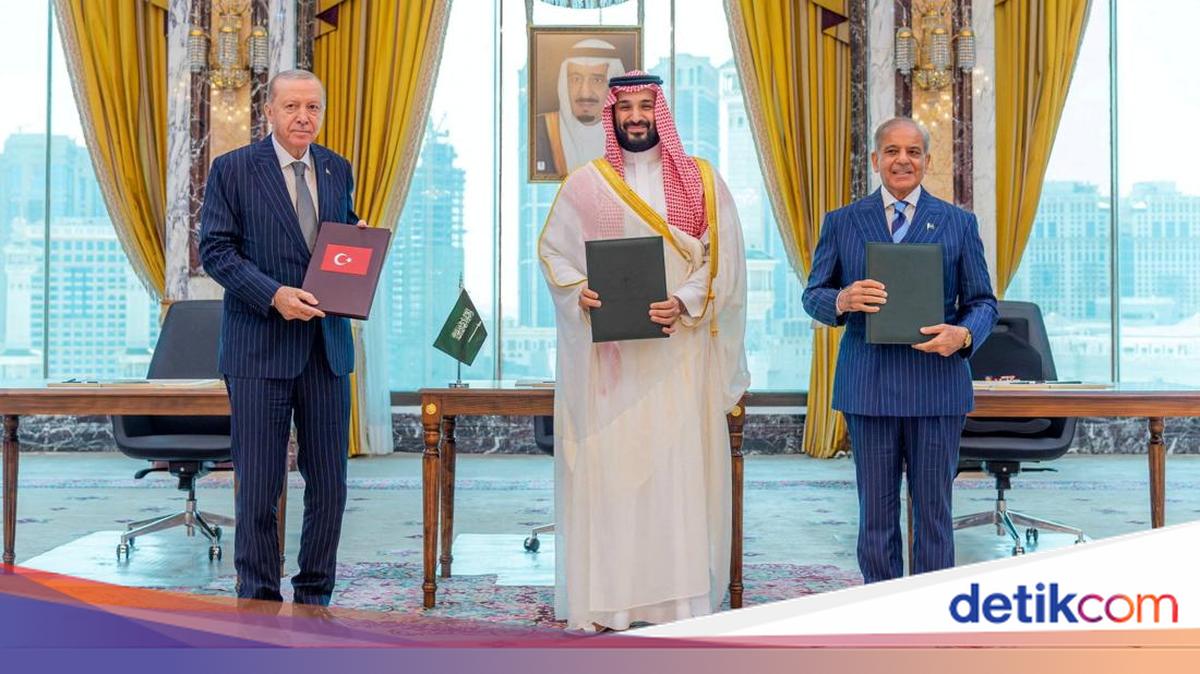
The trilateral defence cooperation agreement signed by Crown Prince Mohammed bin Salman, Turkish President Recep Tayyip Erdoğan and Pakistani Prime Minister Shehbaz Sharif (7/8/2026), subsequently dubbed the “Mecca Agreement”, has given rise to multiple interpretations and a series of provocative questions: Is Saudi Arabia building its defence strength to counter Iran? Is Saudi Arabia allying with the United States to contain Chinese-Russian-Iranian influence?
The answer to these questions is actually simple: Riyadh is now seeking to become an agenda setter through a combination of deterrence and diplomacy strategies. Saudi Arabia is not only a player, but is also seeking to take on the role of balancer.
In the regional geopolitical context, Saudi Arabia sits between influential power centres such as Iran, Israel, Türkiye, Egypt, Qatar and the United Arab Emirates. However, Saudi Arabia does not have to defeat all of these powers. The logic constructed as a rational strategy is to maintain a balance among them.
Saudi Arabia can compete with Iran while still building diplomacy. Saudi Arabia also maintains relations with the United States while simultaneously building strategic ties with China and Russia. This is a politics of balance through diplomacy without inter-bloc military confrontation.
Amid the intensifying rivalry between the US and China-Russia, Riyadh is not building a single alliance, but rather developing a multi-alignment balancing strategy: not abandoning the United States, but also not wanting to depend entirely on it.
Relations with all parties are built simultaneously: the United States, China, Russia, Türkiye and Pakistan in different spheres of interest.
Saudi Arabia’s diplomatic experience is very interesting. It should be noted that the normalisation of relations with Iran (2023) was carried out through Chinese mediation. This strategy shows that Saudi Arabia is willing to use diplomatic power outside Washington’s orbit.
As a result, Saudi Arabia’s diplomatic relations with Iran have shown a paradigmatic shift. Riyadh appears to realise that not all threats must be answered with confrontation.
During the Israel-US-Iran tensions, Riyadh’s foreign policy stance was very wise in not being provoked into confrontational involvement in a regional war situation. Indeed, well before the war peaked, Saudi Arabia, together with a number of key countries in the region such as Qatar and Türkiye, firmly rejected the planned US-Israeli military attack on Iran.
It appears that the combination of deterrence and diplomacy strategies has become an inevitable choice, with the awareness that stability is sometimes far more advantageous than mere tactical victory.
In responding to the situation in the region, Saudi Arabia has not been provoked into igniting the flames of war, but rather has used diplomacy as a lifeline to avoid a wider and protracted war.
Through a soft power and economic statecraft approach, Saudi Arabia is now building economic strength while reinforcing its position not merely as a player, but as a balancer of regional power.
With substantial capital, Saudi Arabia is actively building infrastructure, developing the sports, tourism, technology, energy and industrial sectors, and opening investment opportunities as new sources of economic growth.
As a friendly country with historical ties to the land of the Custodian of the Two Holy Mosques, it is time for Indonesia to map out productive cooperation opportunities before they are seized by other parties.