
Reading Prabowo's Move to Russia
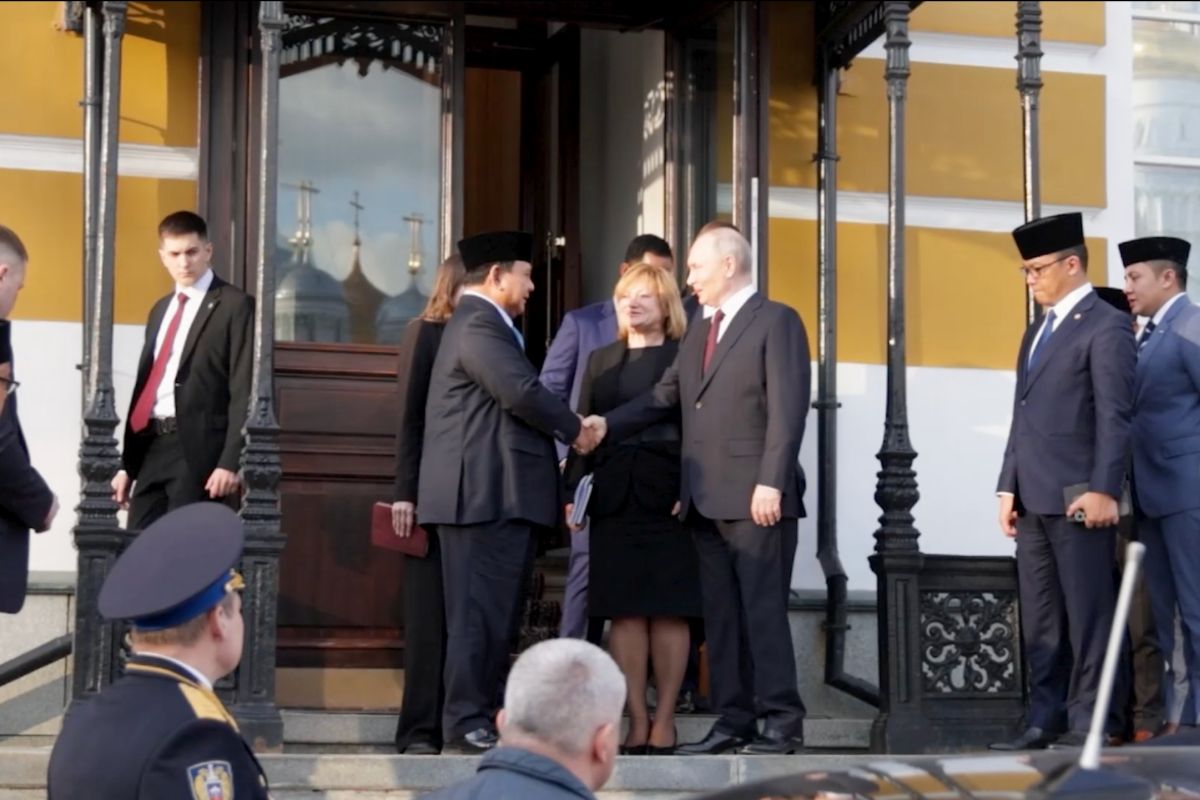
This move is more aptly interpreted as a strategy for diversifying risks rather than a shift in political blocs.
Jakarta (ANTARA) - President Prabowo Subianto’s recent strategic working visit to Moscow, Russia, has raised one question regarding Indonesia’s position on the map of increasingly sharp global rivalries.
This question arises from the new reality where energy is no longer merely an economic commodity but has transformed into an instrument of foreign policy.
At present, oil and gas carry strategic weight equivalent to military alliances in some cases. Countries are no longer just purchasing energy but also acquiring political stability from their suppliers.
During President Prabowo’s visit to Russia, the Minister of Energy and Mineral Resources (ESDM), Bahlil Lahadalia, accompanied him. This signifies that the energy agenda is now present at the centre of our diplomacy.
In other words, energy is no longer discussed after the political agenda is complete but is addressed alongside it.
It is no secret that energy stability is part of political stability. Even minor disruptions in energy supplies can impact inflation, industrial operations, and purchasing power.
History shows that energy has often been used as a tool of pressure in international relations. Therefore, every supply contract also carries geopolitical significance.
In the context of energy supplies, Russia is not merely a potential supplier. The Red Bear nation is a symbol of a power pole directly confronting the West in the post-Ukraine War geopolitical landscape.
The economic sanctions imposed by the West following Russia’s attack on Ukraine have altered Russia’s interactions with the world. As a result, Russia is seeking partners outside its traditional circles.
On the other hand, Indonesia is not in a position to fully side with one party. Its economic structure, global trade, and foreign investments remain closely tied to the West. The United States (US), the European Union, and OECD partners continue to be important sources of technology and markets for Indonesia. Therefore, severing ties is not a realistic option for Indonesia.
It is in this context that Indonesia’s concept of active neutrality regains momentum, particularly in concrete decisions such as energy cooperation. Active neutrality has thus far been understood as a flexible non-aligned principle. However, that flexibility now faces pressure from intensifying global polarisation.
The art of maintaining distance