
Reading Prabowo's Move to Gather the Elite Amid the Middle East Conflict
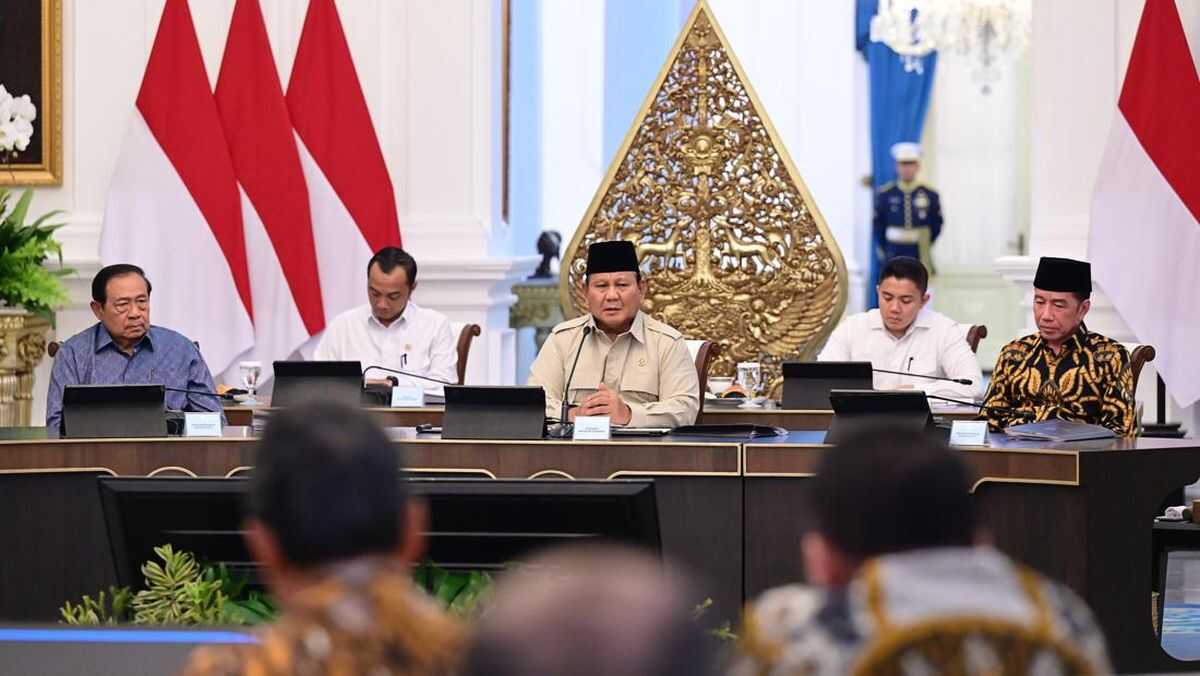
President of Indonesia, Prabowo Subianto, invited former presidents and vice presidents, the chairs of parliament parties, and a former Foreign Minister to the Presidential Palace in Jakarta on Tuesday (3 March). The four-hour meeting discussed the Middle East conflict that is heating up. After the meeting, Indonesian Foreign Minister Sugiono said he had communicated with Iran’s Foreign Minister Abbas Aragchi. Sugiono stated in his communication with Aragchi that Indonesia’s position upholds respect for the sovereignty of each nation. In addition, he reiterated Prabowo’s intention to act as a mediator in this conflict.
The meeting occurred amid Indonesia’s pressure to withdraw from the Board of Peace (BoP). NasDem Party chairman Surya Paloh said Indonesia remains in BoP despite the intensifying conflict. Nevertheless, Paloh indicated Prabowo is not closed to reevaluating Indonesia’s membership in BoP under these conditions. Meanwhile, PKB chairman Muhaimin Iskandar emphasised that the discussions highlighted the importance of national interests amid the conflict.
Consolidation of legitimacy: Arifki Chaniago, Executive Director of Aljabar Strategic, argues that Prabowo’s move to gather those leaders is a consolidation of legitimacy. In high-stakes global issues, he says Prabowo does not want to be seen as a single actor. ‘By inviting elder statesmen, any decision—whether a firm stance, neutrality, or active diplomacy—will appear to be a state decision, not a personal one. That strengthens political resilience if the situation worsens,’ Arifki said.
Arifki noted geopolitical situations always affect the economy, such as energy prices, fiscal pressures, inflation. He said the move signals to markets and the public that the country is vigilant and consolidated. ‘In politics, perception of stability is often more important than stability itself,’ he added.
From the meeting, he also views Prabowo as aiming to build a narrative that Indonesia is not passive, but also not rash. Additionally, inviting veteran leaders is seen as an effort to draw in centres of influence with political resonance. Elite opinion still shapes the direction of public discourse. Embracing them is safer than letting leaders outside the power structure speak out. ‘Thus, the political meaning is an effort to turn a global crisis into a momentum for national consolidation. Moreover, Indonesia has also joined BoP in the form of Trump, which is narratively also rejected by some groups,’ he said.
Coalition with the Elite: Trias Politika Strategis director Agung Baskoro regards Prabowo’s move as part of consolidation of elites amid uncertain global geopolitics. ‘But the hope isn’t limited to that; there are steps or solutions to address the situation so that we as a nation are prepared for any condition,’ he said.
Personally, Agung also sees the meeting as evidence that Prabowo’s relations with political elites are in good standing. ‘The hope is this can become a capital for the president to form a coalition with society after forming coalitions with elites, because at the end of the day, people must feel safe and comfortable,’ he said.
Meanwhile, Indikator Politik Indonesia researcher Bawono Kumoro sees the move as openness to advice and input from various parties regarding developments in geopolitics. ‘The dialogue meeting can be seen as a form of President Prabowo’s respect for the thinking and experience of former presidents, from which appropriate attitudes and policies can be drawn in response to the issue,’ he said.