
Reactivation of West Sumatra Railway Line Gets Under Way, Andre and Donny Thank Prabowo
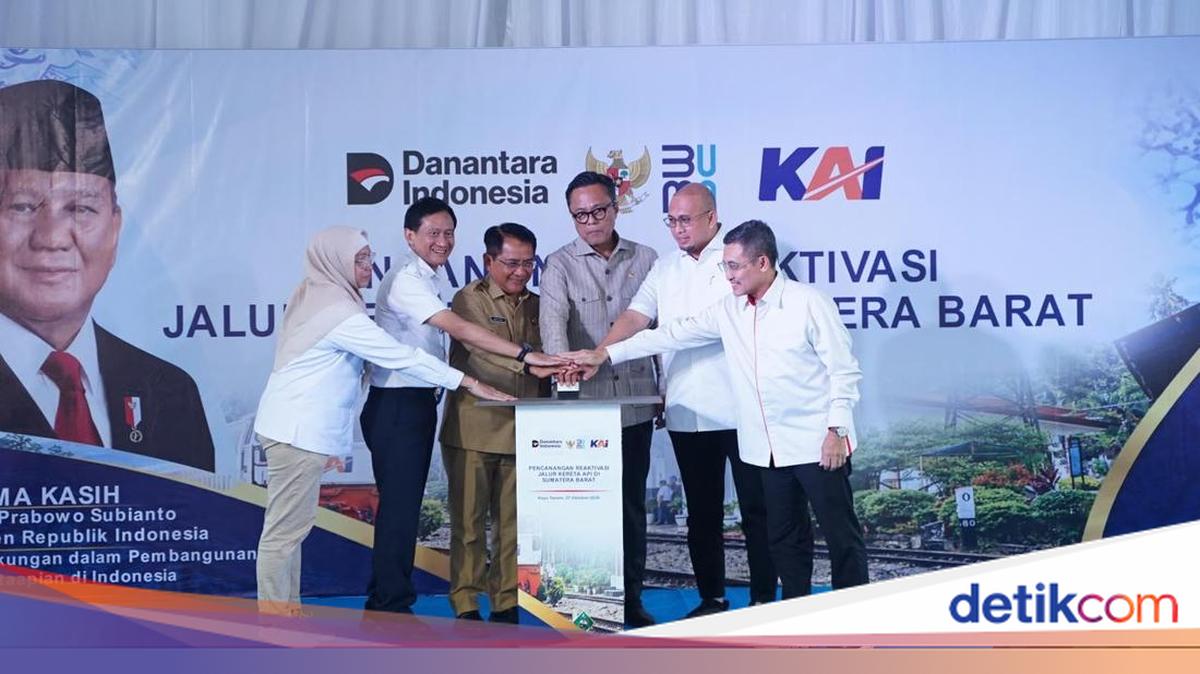
President Prabowo Subianto’s plan to revive railway lines in West Sumatra has entered a new phase. The reactivation was formally launched at Kayu Tanam in Padang Pariaman Regency.
The launch ceremony on Tuesday (27 October 2026) was marked by the joint sounding of a siren by Donny Oskaria, head of the State-Owned Enterprises Agency (BP BUMN) and chief executive of Danantara; House of Representatives Commission VI deputy chairman Andre Rosiade; PT Kereta Api Indonesia (KAI) president director Bobby Rasyidin; acting director of railway infrastructure at the Transport Ministry’s Directorate General of Railways, Rosita; Padang Pariaman Regent John Kennedy Azis; and other government officials and stakeholders.
The launch is seen as an important step towards restoring the glory of railways in Ranah Minang, while strengthening connectivity, improving the distribution of agricultural produce and supporting economic growth in West Sumatra.
Andre Rosiade said the railway reactivation was tangible evidence of President Prabowo’s administration’s commitment to developing West Sumatra through strategic infrastructure support that local communities had long needed.
“Once again, I would like to thank President Prabowo, who remains committed to developing West Sumatra. I also thank Mr Donny Oskaria, a son of the region who is overseeing this development, and Mr Bobby Rasyidin, who was instructed by the President to develop the railway network and pay attention to his home region,” Andre said.
Andre explained that the railway lines would be reactivated in stages. The first phase will cover the Kayu Tanam–Padang Panjang route, followed by extensions to Solok and Sawahlunto, with the aim of eventually continuing the connection to Sijunjung. Plans also envisage a link from Padang Panjang to Bukittinggi and Payakumbuh, and then to Limbanang in Lima Puluh Kota Regency, which borders Riau.
According to Andre, reactivating the lines is not simply about restoring an old mode of transport, but about building a more efficient logistics system for West Sumatra’s future. Trains are expected to carry agricultural produce, mining commodities and crude palm oil (CPO), making it more efficient to transport goods to Teluk Bayur and reducing the burden of heavy vehicles on roads.
“The hope is that coal and CPO trucks will be able to use the railway. That would help reduce road damage caused by heavy vehicles and make freight transport in West Sumatra more efficient,” said Andre, who is also chairman of the Indonesian Minang Family Association (IKM).
Andre said infrastructure development was one of the keys to accelerating economic growth in West Sumatra. Railway reactivation should therefore go hand in hand with faster toll-road construction and improvements to strategic road connections, including the Sitinjau Lauik Flyover. He said the central government had shown its commitment to resolving infrastructure problems that had long obstructed people’s mobility and the distribution of goods in Ranah Minang.
Andre also noted that large-scale development of this kind required funding and policy support from the central government. Such backing was essential, he said, for West Sumatra to catch up on infrastructure development and improve the region’s economic competitiveness.
Donny Oskaria said the reactivation was part of the Prabowo administration’s commitment to extending access to public transport more evenly, particularly beyond Java. He urged the public to view the project as a long-term investment whose benefits would be felt by future generations.
Donny said transport links played a vital role in driving the economy. West Sumatra had significant agricultural and natural-resource potential, but needed adequate infrastructure to ensure commodities could be distributed more smoothly to trading centres. Railway development, he said, would be an important means of strengthening market access and enabling more evenly distributed economic growth.
Donny specifically praised Andre Rosiade’s efforts to speed up infrastructure development in West Sumatra. Andre said improved connectivity by rail and road would help overcome distribution bottlenecks and create new economic opportunities for local communities.
Bobby Rasyidin said West Sumatra’s railway development had received special attention in line with Prabowo’s instructions to ensure rail services were not concentrated solely on Java. He said about 84 kilometres of track were currently active in West Sumatra, far less than the historical network, which once extended to around 284 kilometres.
For the first phase, KAI plans to reactivate about 15.3 kilometres of track between Kayu Tanam and Padang Panjang. Construction is targeted to begin in 2027, once technical studies and detailed planning have been completed.
Bobby said the project required comprehensive studies because of the challenges posed by West Sumatra’s geography. Some sections have steep gradients and will require suitable railway technology, potentially including rack rail. In addition, around 6,800 buildings along the railway corridor will need to be addressed through coordination, public outreach and support from local governments and regional leadership forums (Forkopimda).
Several bridges will also need to be upgraded to meet current railway operating standards. KAI is also considering the preservation of historical heritage, as West Sumatra’s railway lines form an important part of Indonesia’s transport and mining history.
Bobby added that potential passenger and freight volumes were key considerations in planning the project. In 2025, West Sumatra’s railways carried around two million passengers, an increase of 8.9 per cent on 2024. Passenger numbers in the first half of 2026 rose by around 22 per cent compared with the same period a year earlier.
“The potential for coal transport from the Ombilin area is also one of the factors being considered in the study of railway development. Reactivation is therefore expected not only to restore passenger services, but also to open up opportunities for freight transport that supports regional economic activity,” Bobby said.
The launch at Kayu Tanam marks the starting point of a long effort to revive West Sumatra’s railway network. With the support of the central government, Danantara Indonesia, KAI, the House of Representatives and local governments, the reactivation is expected to improve connectivity, strengthen commodity distribution, ease pressure on roads and promote sustainable economic growth in Ranah Minang.
For Andre Rosiade, the move underlines the need for collaboration and continuity in policy to develop West Sumatra. He hopes Prabowo’s instructions will be put into effect through clearly measured stages of work, so that people in the province will not merely witness the launch but also experience the tangible benefits of railway services returning to operation.
Source: jawawa.id (https://jawawa.id/newsitem/reactivation-of-west-sumatra-railway-line-gets-under-way-andre-and-donny-thank-prabowo-1793101966)
Originally published by detikcom (https://news.detik.com/berita/d-8726644/reaktivasi-rel-kereta-sumbar-dicanangkan-andre-hingga-donny-terima-kasih-ke-prabowo), translated from Indonesian