
Re-elected to Lead Perbarindo, Tedy Alamsyah Calls for Regulatory Relief for Rural Banks
JAKARTA — The rural banking industry, comprising Bank Perekonomian Rakyat (BPR) and Bank Perekonomian Rakyat Syariah (BPRS), needs regulatory relief to support sustainable operations and expand financing for micro, small and medium-sized enterprises (MSMEs). Any adjustment to the rules should take account of the different characteristics of BPR and BPRS compared with commercial banks.
Tedy Alamsyah, chairman of the central board of the Indonesian Rural Banks Association (Perbarindo), said the long-term viability of the BPR and BPRS sectors required improvements in capital, governance, staff skills and digital infrastructure. Regulation aligned with the industry’s needs was also important to preserve banks’ ability to serve micro and small businesses.
“One of the aims of the BPR-BPRS industry is to prioritise sustainable operations by providing financing to micro and small businesses in Indonesia. Achieving this requires improvements in capital, governance, human-resource skills and the infrastructure needed for digitalisation. And, of course, it requires regulatory easing or relief from the authorities,” Tedy said after being inaugurated as Perbarindo chairman for the 2026–2030 term on Wednesday (21 October 2026).
Tedy said regulatory requirements need not be identical for every banking group, given differences in business models and customer characteristics. BPR and BPRS need stronger governance and digital transformation, accompanied by regulatory flexibility.
He referred to Iwan J. Azis’s book Monetary Whispers Across Space, which discusses the differing needs of banking groups. State-owned banks, it says, focus more on digitalisation, while regional development banks need stronger governance and digitalisation.
“This shows that one regulation cannot be applied to every type of bank, including the BPR and BPRS industry,” Tedy said.
He explained that the circumstances of micro and small business owners were one factor to consider when regulating BPR and BPRS. Some run businesses as a livelihood because they have few other employment options, and owners generally manage their businesses themselves.
Business and household finances are also often not adequately separated. Family or regional economic conditions can affect business owners’ ability to meet loan repayments.
According to Tedy, these characteristics distinguish BPR and BPRS customers from those of commercial banks. Stronger governance and regulatory adjustments therefore need to go hand in hand to ensure financing continues to reach micro and small businesses.
The BPR and BPRS sectors continued to grow through July 2026. BPR assets rose 4.25 per cent year on year, while BPRS assets grew by 12 per cent.
Over the same period, BPR lending increased by 3.12 per cent and BPRS financing by 6.23 per cent. The growth indicates that lending activity continued amid economic shifts and challenges in the financial industry.
Deposits also increased. BPR savings deposits grew by 4.21 per cent and BPRS savings by 10.27 per cent, while BPR time deposits rose by 2.14 per cent and BPRS time deposits by 4.58 per cent.
Perbarindo said this growth gave the industry a foundation on which to further develop financial services, particularly for communities and MSMEs in regional areas. However, stronger capital, governance and digitalisation remain necessary to support sustainable operations.
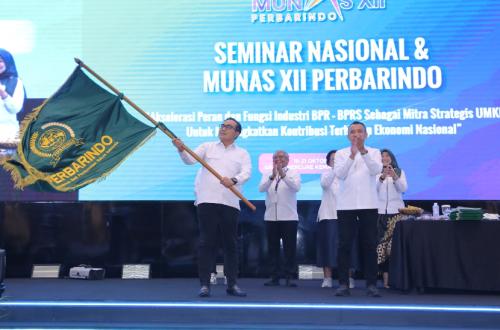
Tedy was re-elected unopposed as Perbarindo chairman for 2026–2030 at its 12th National Congress, held in Jakarta from 19 to 21 October 2026. He previously held the same position for the 2022–2026 term.
The congress was attended by 498 delegates from across Indonesia. Also present were OJK Chief Executive for Banking Supervision Dian Ediana Rae, Indonesia Deposit Insurance Corporation (LPS) Commissioner Doddy Zulverdi, and Business Competition Supervisory Commission (KPPU) Commissioner Budi Joyo Santoso.
As part of the congress, Perbarindo held a national seminar on the role of BPR and BPRS as strategic partners for MSMEs. Speakers included House of Representatives Commission XI chairman Mukhamad Misbakhun, economist Burhanuddin Abdullah, and OJK’s head of the department for regulating and developing MSMEs and Islamic finance, Ayahandayani.
Tedy said the new board would continue discussions with regulators and stakeholders on the industry’s development needs. He also pledged to carry out the mandate given by Perbarindo members over the next four years.
“I am ready to fulfil the mandate of all Perbarindo members as an advocate for the BPR and BPRS industry, as well as a strategic partner, particularly for regulators and other stakeholders,” Tedy said.
Under Perbarindo’s 2026–2030 leadership, Joko Suyanto is supervisory board chairman, Ahmad Ropik is secretary-general, and Evi Damayanti is treasurer-general. Perbarindo also presented awards to 29 strategic partners during the 12th National Congress.