
RCCC UI Calls for Data Synergy to Strengthen Air Pollution Control Systems
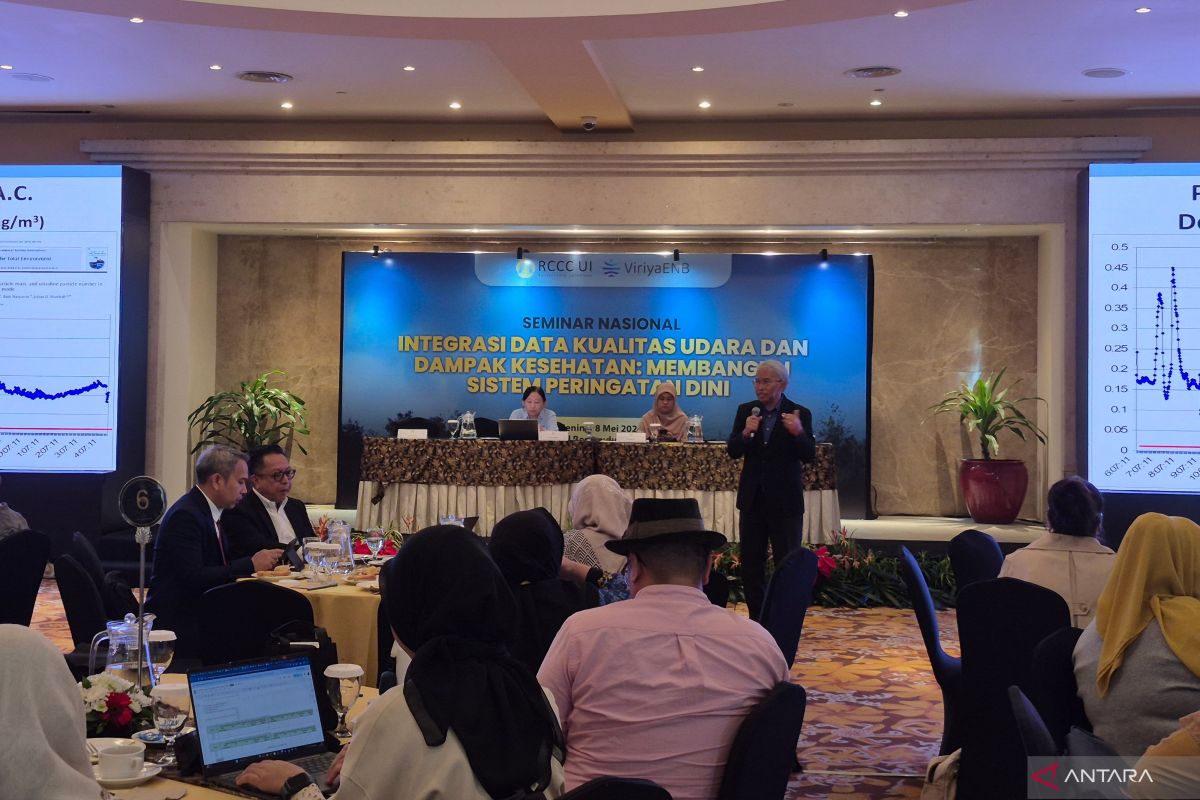
Jakarta (ANTARA) - The Research Center for Climate Change at the University of Indonesia (RCCC UI) is pushing for the integration of air quality and health data to create more precise pollution control and disease prevention policies.
During a seminar on the Integration of Air Quality Data and Health Impacts held in Jakarta on Monday, the Chair of RCCC UI, Professor Budi Haryostanto, explained that Indonesia currently possesses vast and real-time data regarding air quality and pollution-related diseases. However, this valuable information remains underutilised because it is scattered across various sectors and different institutions.
He emphasised that merging air quality, meteorological, and health data is absolutely essential for building an accurate early warning system. This integrated system is expected to be easily accessible to the general public to protect the most vulnerable groups.
“From our shared data, if integrated, many results could prove that humans—who cannot choose what they breathe—can actually be protected from air pollution. To achieve this protection, we must push for the acceleration of policies designed to safeguard the public,” said Budi.
Aligning with this view, the Director of High-Impact Innovation and Research at UI, Chairul Hudaya, asserted that air quality is not merely an environmental issue, but a pressing matter of health, economy, and the nation’s future. He noted that the primary challenge in data integration is not just a technical software hurdle, but a matter of governance. Cross-institutional coordination and a shared commitment are required so that data from various sectors can be consolidated into a solid public decision-making system.
“Air quality is a measure of the quality of our development. Good data will help us understand the problem. Science can help us formulate solutions, but shared commitment will determine whether those solutions are actually implemented,” said Chairul. He acknowledged that the availability of valid data is crucial in guiding the direction of government policymaking.
Rasio Ridho Sani added that the process of formulating environmental regulations often intersects with various political interests and power dynamics. In this context, scientific evidence and data integration play a vital role as an objective counterbalance.
“The process of building policy is not easy, as there is a process of power struggle involved. However, that power can be balanced if we possess the data,” concluded Rasio.