
RAPBN 2027: Safeguarding food security, igniting energy self-sufficiency
In the 2027 Draft State Revenue and Expenditure Budget (RAPBN) document, the rows of trillions of rupiah are not merely fiscal calculations on paper. These figures reflect the government’s policy direction in realising public welfare through priority programmes.
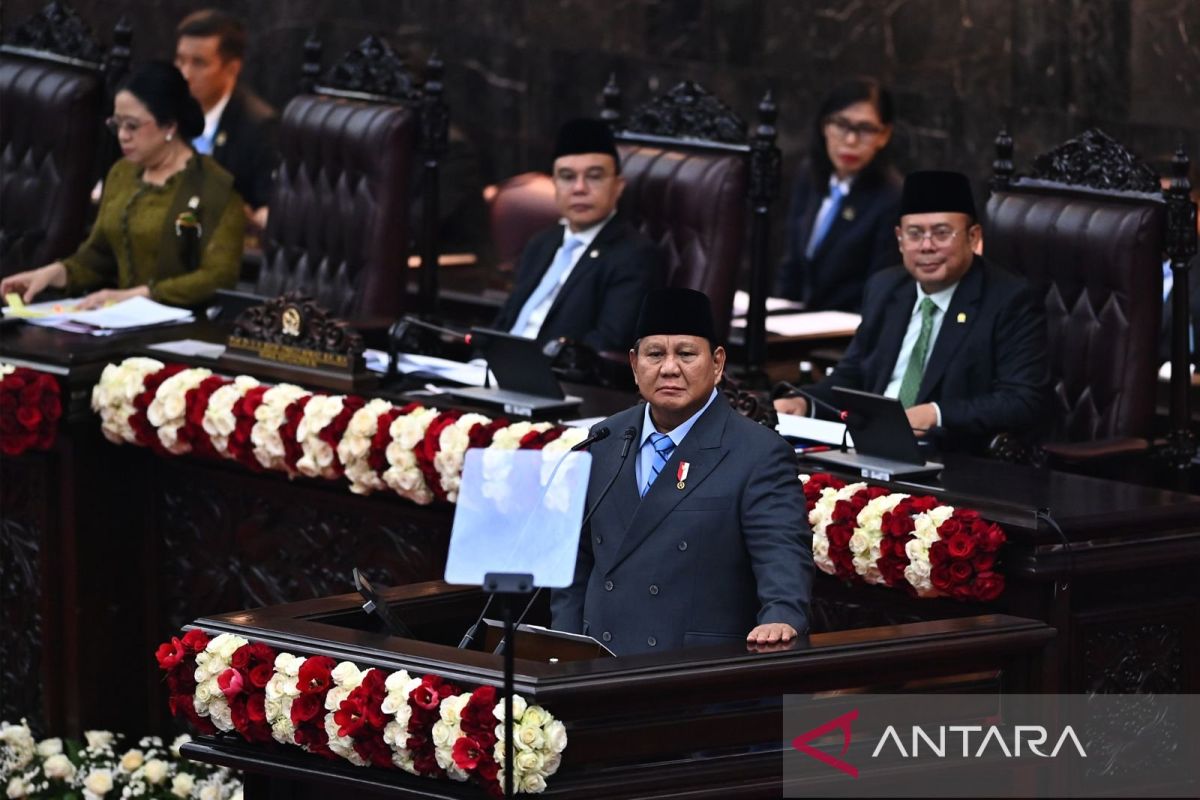
President Prabowo Subianto, in his Financial Note speech on Friday (14/8), stated that state expenditure in the 2027 RAPBN is designed at Rp4,097.2 trillion, while state revenue is targeted at Rp3,426.0 trillion. The government is also targeting economic growth in the range of 5.8–6.5 per cent.
“The state budget is not merely a state financial document. The state budget is our instrument of struggle. An instrument to protect the people. An instrument to strengthen the nation. An instrument to realise the ideals of independence in achieving a better life,” Prabowo said in the Government Statement on the Draft Law on the 2027 State Budget and its Financial Note.
The budget is directed towards implementing the National Priority Work Programme (PKPN), which includes food sovereignty; energy and water self-sufficiency; education; health; downstreaming and industrialisation; infrastructure, housing, and disaster resilience; strengthening the people’s economy and village development; and poverty reduction.
Two of these are strengthening food security and energy self-sufficiency, which form the front line of national defence.
For Indonesia as an agrarian country, food is not merely a commodity but also concerns the continuity of people’s lives. The food self-sufficiency programme is a vision that Prabowo has continued to promote in almost every speech. The government has allocated a food security budget in the 2027 RAPBN of Rp195.3 trillion, up 2.3 per cent compared with the 2026 state budget outlook of Rp190.9 trillion.
The budget is allocated, among other things, to increase food productivity through the development of 2.7 million hectares of rice-growing areas, the creation of 100,000 hectares of new rice fields, the optimisation of 200,000 hectares of agricultural land, and assistance of 23,528 units of pre-harvest agricultural machinery and equipment for the food crops sub-sector.
In addition, the government is disbursing funds for the revitalisation of 616 hectares of salt ponds, the development of 55,765 hectares of irrigation networks, the construction of 14 dams still in progress, and the improvement of facilities for 400 fishing villages.
The food security budget is also used for food assistance to control food insecurity for 5,000 people and the implementation of a cheap food movement for 38 community groups.
The size of the budget demonstrates the government’s efforts to strengthen domestic food production while reducing dependence on imports. Over the past year, Indonesia has achieved self-sufficiency in eight food commodities: rice, maize, large chillies, bird’s eye chillies, consumption sugar, chicken meat, chicken eggs, and shallots.
Nevertheless, several commodities have not yet achieved self-sufficiency, including garlic, beef, and buffalo meat.
Achievements in the food sector are also considered capable of strengthening Indonesia’s position in international economic relations. International relations observer from Budi Luhur University, Andrea Azzqy, assessed that Indonesia’s economic growth achievement in the first quarter of 2026 and food self-sufficiency could become an important foundation for Indonesia’s economic diplomacy.
“This achievement strengthens Indonesia’s bargaining position in trade negotiations with major countries, especially amid global tensions due to US tariff policies,” Andrea said.
According to him, the narrative of food and energy self-reliance can be projected as an instrument of sovereignty diplomacy that affirms Indonesia is not only a market but also capable of maintaining domestic stability and contributing to regional resilience.
However, Andrea reminded that the government needs to prove that these achievements can maintain domestic stability while providing sustainable contributions to regional resilience. He also assessed that economic self-reliance can provide additional legitimacy for Indonesia as an independent middle power in the Indo-Pacific region, especially in forums such as ASEAN, BRICS, and IORA.
Besides food, the government has placed energy self-sufficiency as one of the priorities in the 2027 RAPBN. In his speech, Prabowo touched on the paradox of Indonesia’s long-standing dependence on fossil energy and fuel imports, even amid great renewable energy potential.
One of the government’s future policy directions is to accelerate electrification, especially through the construction of solar power plants. Prabowo is targeting the construction of solar power plants with a capacity of 100 gigawatts while accelerating the retirement of diesel power plants. Based on calculations, the construction of 100 GW of solar power could save at least Rp73.9 trillion per year through reduced basic electricity production costs.
Meanwhile, in 2026, solar power plant construction is targeted at 30 GW and the retirement of 13 GW of diesel power plants. The President also mentioned that ideally every village should have a 1-megawatt solar power plant.
In addition, the government is encouraging the development of a national electric vehicle ecosystem, from providing EV incentives and building charging infrastructure to strengthening the battery supply chain. This step is considered capable of reducing dependence on fossil fuels and curbing the use of foreign exchange to meet domestic energy needs.
The government has allocated Rp272.95 trillion for energy subsidies in the 2027 RAPBN. Subsidies are used to suppress the selling prices of fuel and electricity.