
RAPBN 2027: Navigating growth, fiscal discipline, and welfare
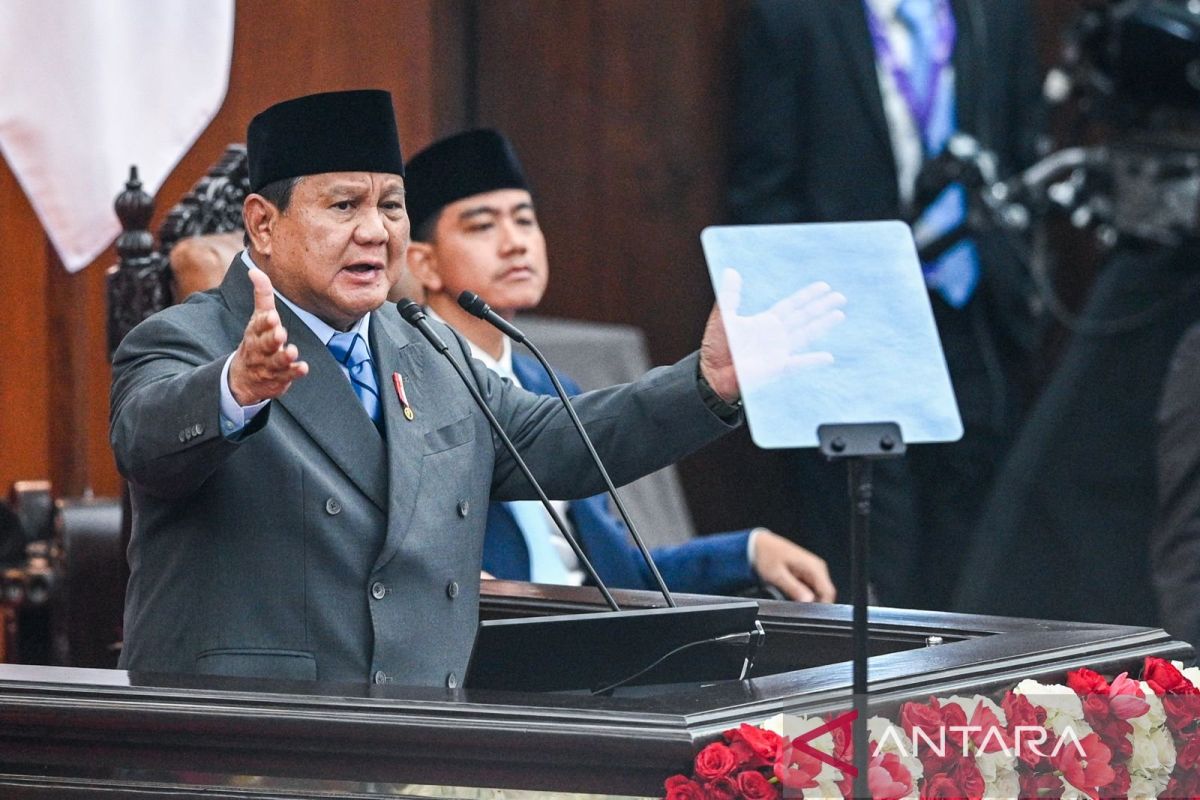
Every rupiah collected by the state must return as tangible hope for the people.
Jakarta (ANTARA) - If the Draft State Revenue and Expenditure Budget (RAPBN) is likened to a navigation map needed by the government as captain, it should not merely contain the fastest route to sail amid a global storm that has yet to subside.
The map must consider three balances simultaneously: the speed of the ship (economic growth rate), the resilience of the ship’s hull (fiscal prudence), and the guaranteed livelihood of passengers on the lower deck (achieving social welfare).
Therefore, captaining this ship requires a particular art. Balancing all aspects is not merely a matter of calculating figures on paper, but a test of precision in determining the course so that the ship and its contents can safely reach their destination.
The government has delivered the RAPBN for 2027 along with the Financial Note on Friday (14/8), marking the navigation picture that will guide Indonesia over the coming year.
For the government, as President Prabowo Subianto has emphasised, promoting economic growth while maintaining fiscal prudence can be pursued simultaneously. Likewise, helping the people while safeguarding the state budget.
This is certainly not an easy task. This is where the decisive moment lies; can growth acceleration and fiscal discipline proceed in harmony to safeguard people’s welfare, or will they instead become an approach that is difficult to achieve together?
Brief notes
As a foundation, the government has set basic macroeconomic assumptions in the 2027 RAPBN, with economic growth estimated to reach 6 percent year-on-year (yoy), inflation at 2.5 percent, an exchange rate of Rp17,500 per US dollar, and a 10-year government bond yield of 6.9 percent.
Indonesia’s economic growth realisation in the first half of 2026 reached 5.45 percent (yoy). The government believes this growth can continue until the end of 2026, with a chance of reaching 6 percent.
CORE Indonesia Director of Research for Macroeconomics, Fiscal and Monetary Policy A Akbar Susamto considers the growth target relatively optimistic, especially since historically Indonesia’s economic growth in recent years has almost never exceeded 5.5 percent.
Current global and domestic economic conditions, which have yet to show strong drivers, are seen as a particular challenge to supporting the belief that growth can reach 6 percent in 2027.
On the exchange rate assumption, the setting is viewed as more accommodative than the previous year. Compared with the 2026 state budget of Rp16,500 per US dollar, the assumption in the 2027 RAPBN shows that the government is beginning to anticipate the rupiah exchange rate at a lower level, although it remains at risk of missing the mark if pressure on the rupiah continues.
The government has also set the Indonesian crude oil price assumption in the 2027 RAPBN at 75 US dollars per barrel, with oil lifting of 610 thousand barrels per day and gas lifting of 954 thousand barrels of oil equivalent per day.
The Indonesian crude oil price assumption is considered quite optimistic. A rise in oil prices can indeed increase state revenue, but if the realisation exceeds the assumption, there is concern that the energy subsidy burden could swell, so this dynamic needs to be watched because it directly affects the fiscal condition.
On the revenue side, the 2027 RAPBN targets state revenue of Rp3,426.0 trillion, or around 12.25 percent of GDP.
This figure is relatively the same as the 2026 state budget of Rp3,153.6 trillion, or 12.26 percent of GDP, and slightly lower than the 2026 Outlook of Rp3,208.1 trillion, or around 12.45 percent of GDP.
Although the nominal revenue increases, Akbar highlights that the revenue-to-GDP ratio remains relatively unchanged, indicating that revenue optimisation efforts have not yet been significantly visible.
With a ratio almost the same as 2026, the 2027 revenue target is considered quite realistic and not too surprising, but it also does not yet show a highly ambitious step in strengthening state revenue. Moreover, achieving the 2026 target still faces risks due to various global economic and geopolitical challenges.
Spending side