
Ramos-Horta Shares Keys to Timor-Leste-Indonesia Reconciliation
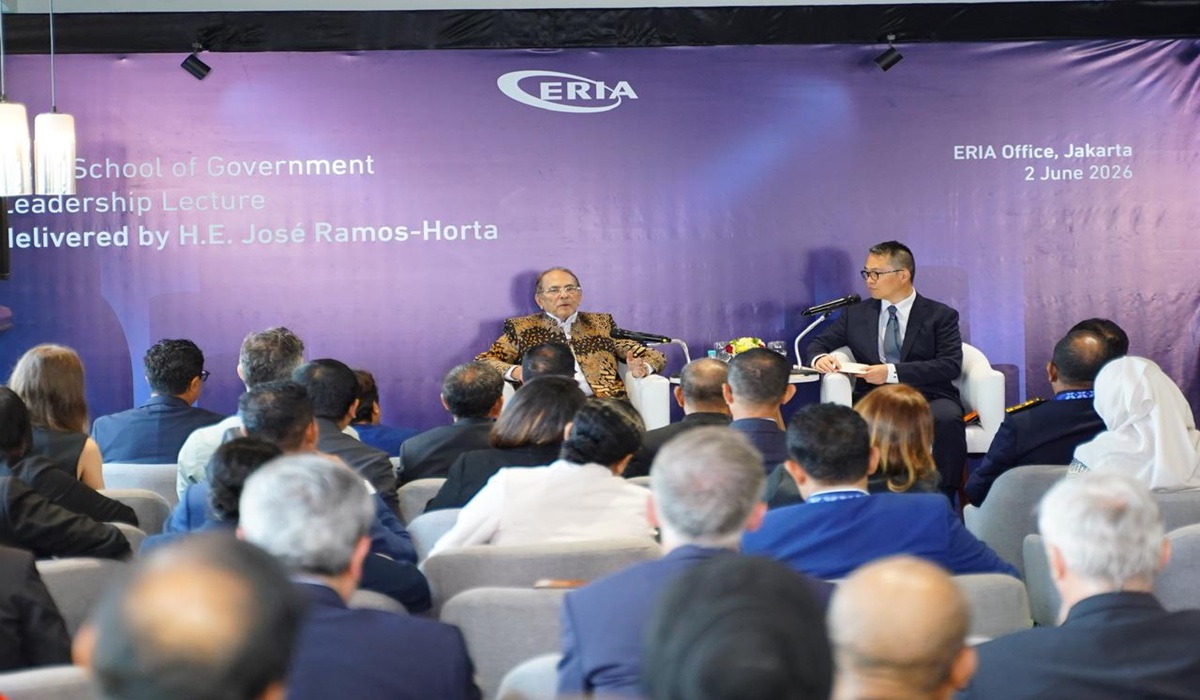
The President of the Democratic Republic of Timor-Leste, H.E. José Ramos-Horta, emphasised that the courage to forgive and a commitment to building dialogue are the primary keys to creating regional stability. He shared these insights as the keynote speaker during the fourth ERIA School of Government Leadership Lecture Series held in Jakarta on Tuesday.
Under the theme “Leadership in Dangerous Times: Human Rights, Nation-Building, and Regional Diplomacy”, the Nobel Peace Prize laureate reflected on Timor-Leste’s long journey from conflict and the struggle for independence to becoming a strategic partner in Southeast Asia. He noted that leadership amidst global uncertainty requires a strong foundation of trust.
During a warm dialogue session, Ramos-Horta described the relationship between Timor-Leste and Indonesia as one of the most significant success stories of reconciliation in the world. He expressed particular appreciation for Indonesian leaders who played roles during his country’s transition period.
“We chose the path of national reconciliation rather than being trapped in a cycle of revenge. It required patience to rebuild trust and a commitment to keep looking forward,” said Ramos-Horta.
He also affirmed that during the period of struggle, his side ensured that no Indonesian civilians were targeted, in order to prevent the growth of hatred between communities in the future.
Prof. Nobuhiro Aizawa, Dean and Managing Director of the ERIA School of Government, stated that Timor-Leste’s experience serves as a valuable lesson for policymakers in Southeast Asia. He assessed that the friendship between Timor-Leste and Indonesia is a pillar of current regional stability.
“It is this experience that makes us optimistic about Timor-Leste’s accession to ASEAN. President Ramos-Horta’s leadership demonstrates how a history of conflict can be transformed into a future full of collaboration,” said Prof. Aizawa.
Similarly, ERIA President Tetsuya Watanabe added that the best lessons in leadership come not only from textbooks but from figures who have shaped history directly. “The experience of building peace and driving diplomacy is highly relevant for future generations of leaders,”