
Radea Appreciates Community Service by KCK FEB Universitas Widyatama
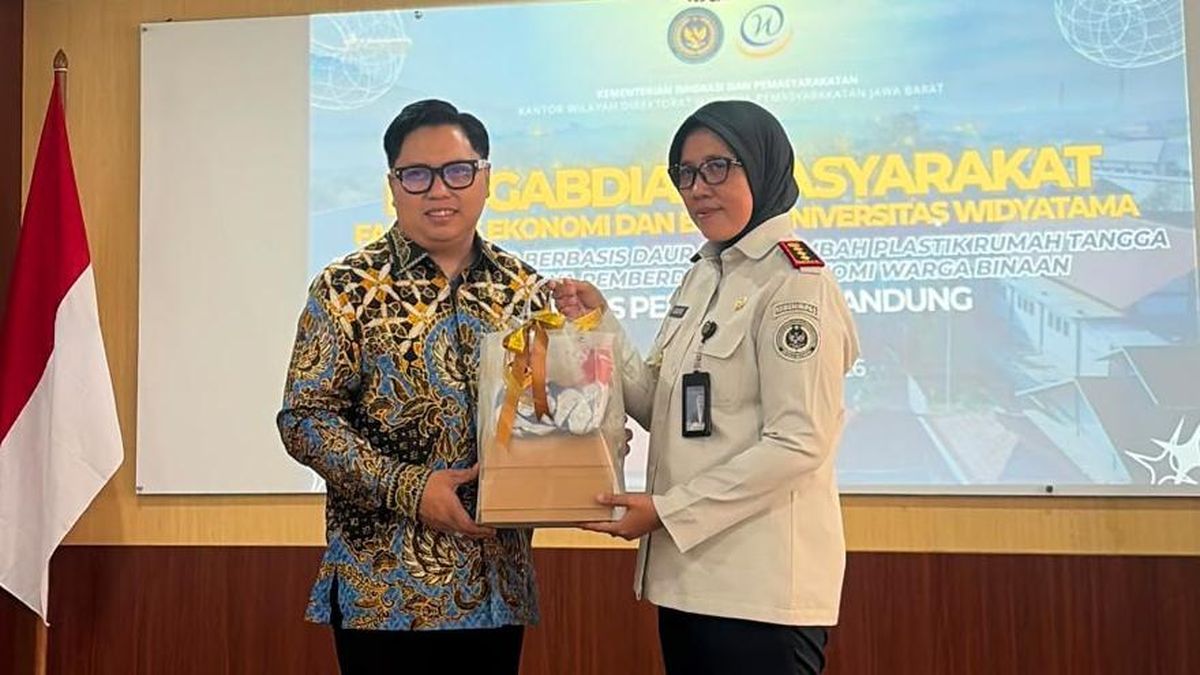
Chair of Commission I of the Bandung City Regional People’s Representative Council (DPRD), Radea Respati Paramudhita, has expressed appreciation for the Community Service Programme (PKM) carried out by the Scientific Branch Group of the Faculty of Economics and Business (KCK FEB) of Widyatama University at the Class IIA Women’s Prison in Bandung on Tuesday (18/8).
The activity, themed ‘Ecopreneurship Based on Household Plastic Waste Recycling as an Effort to Empower the Economy of Inmates’, was considered a concrete step to improve skills while encouraging the economic independence of inmates, particularly women.
The programme was implemented by the Widyatama University PKM team led by Dr. Rima Rahmayanti, SE., MM. Radea was also one of the PKM team members and attended in his capacity as Chair of Commission I of the Bandung City DPRD.
The activity was also attended by representatives of the Bandung City Government, including from the DPRD Secretariat, the Environmental Agency, the Trade and Industry Agency, as well as local sub-district elements.
Radea assessed that the activity was a concrete step in improving the skills, creativity and economic independence of inmates, particularly women, through the use of household plastic waste into products that are both useful and economically valuable.
According to him, empowering inmates cannot be achieved solely through the provision of technical skills. An ecosystem is needed that is able to connect the training process, product development and marketing, so that the work of inmates can provide real economic benefits.
“We certainly very much appreciate this activity. What is provided is not only knowledge and skills, but how inmates can see that something that has been considered rubbish can actually be processed into a product that has economic value,” said Radea in his statement quoted on Wednesday (19/8).
He explained that the ecopreneurship concept has a double benefit. Firstly, it helps reduce waste generation, particularly household plastic waste. Secondly, it opens up economic opportunities through creativity and skills in processing waste into products that have selling value.
Radea considered the approach to be in line with community empowerment efforts that are not only oriented towards solving environmental problems, but are also able to create business opportunities and increase economic independence.
Therefore, he emphasised the importance of collaboration between universities, regional governments, correctional institutions, the business world and the community. Cross-sector collaboration is needed so that similar programmes do not stop at training activities, but can be sustainable and provide long-term benefits for inmates.
“The most important thing is sustainability. After training is provided and products are produced, there must be further mentoring, including how the products are developed, promoted and gain market access,” he said.
In this context, Radea considered synergy with the Bandung City Government to also be important, particularly in opening marketing opportunities for products made by inmates.
The presence of representatives from the Environmental Agency and the Trade and Industry Agency in this activity was also considered a positive signal for the sustainability of the programme, given that both agencies have strategic roles, both in waste management and in opening market access for MSME products.
The regional government, according to him, can act as a facilitator by connecting these products with various marketing channels, MSME players, and available promotional spaces.
In addition to the economic aspect, this PKM activity was also considered to have a strong environmental dimension. The use of household plastic waste is expected to help reduce waste generation while providing added value through processing into creative products.
Meanwhile, from the economic side, improving product quality and marketing access is expected to provide motivation as well as provisions for inmates to build independence after completing their rehabilitation period.
Radea stressed that the success of an inmate empowerment programme is not solely measured by the number of products produced. More than that, success is also seen from the improvement of skills, the growth of self-confidence, and the readiness of inmates to live a more independent life.
Therefore, Radea hopes that the community service activity carried out by Widyatama University, under the leadership of Dr. Rima Rahmayanti, SE., MM as the head of the PKM team, can become the beginning of a broader and more sustainable collaboration.
According to him, universities have a strategic role in transforming knowledge, creativity and innovation into real solutions that provide benefits for society.
“Collaborative activities like this must not stop here and can continue to be synchronised with the Bandung City Government’s programmes, as well as developed in various regions, so that the knowledge possessed by lecturers and universities truly provides real benefits for society,” said Radea.
He hopes that the ecopreneurship-based empowerment model can continue to be developed as one approach in building the independence of inmates, while supporting efforts to reduce waste and strengthen the community economy.
“This is a very integrated form of empowerment. There is education, there are skills, there is a process of producing products, then there is an effort to open markets. If this entire chain can run well, then the benefits will be far greater for inmates,” he concluded.
The PKM members included Shinta Oktafien; Pipin Sukandi; Imanirrahma Salsabil; Nina Nurani; Darwis Agustriyana; Dwinto Martri Aji Buana; Indra Taruna Anggapradja; Nabila Tri Hapsari Najwar; and Isra Detia Haloho.