
Quo vadis: The future of legal education in Indonesia?
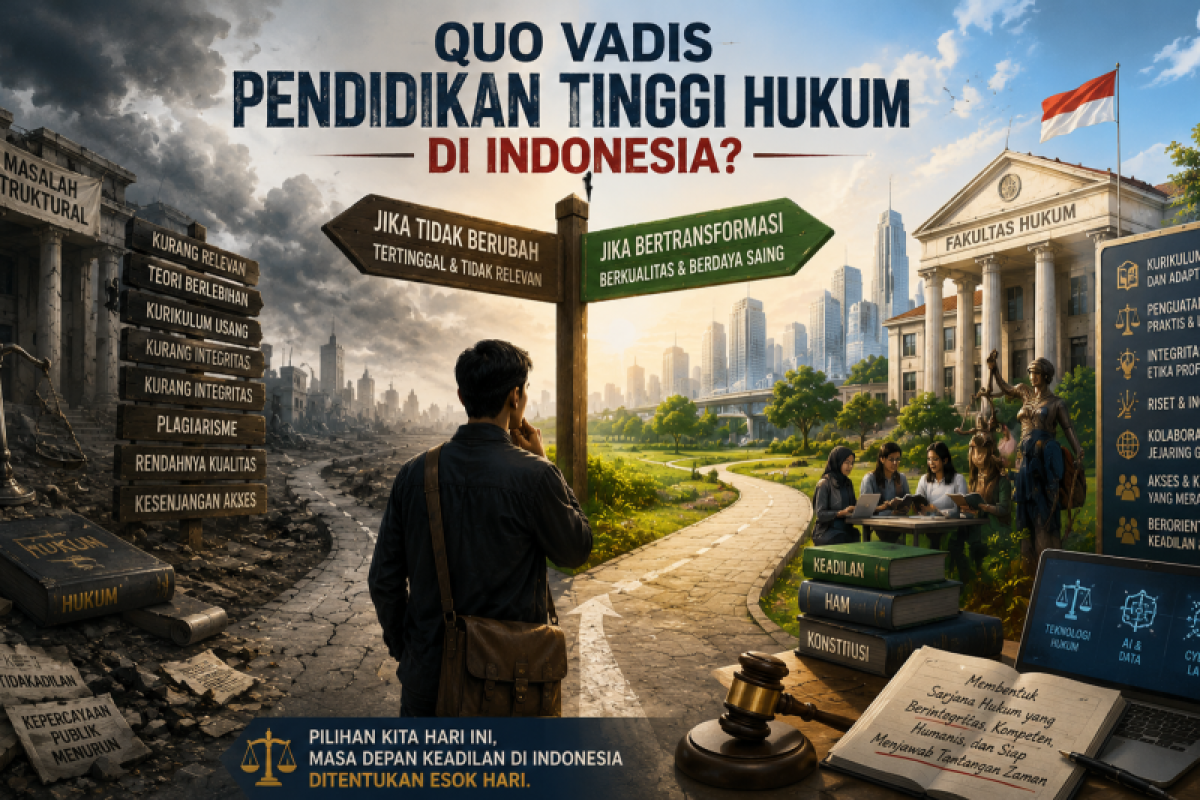
Bold regulatory action is needed to halt the commercialisation of degrees, align institutional egos, and inject technological literacy, formal legal updates, and moral integrity into the heart of the curriculum.
Jakarta (ANTARA) - This year, Indonesia is preparing to commemorate a century of legal education in the country. Since the establishment of Rechtsogeschool Batavia in 1924, legal education institutions have produced thousands of thinkers, lawmakers, and law enforcers who have guided the nation’s journey.
However, amidst this centennial celebration, a common reflective question emerges in academic circles: quo vadis, our legal education? Where is the position of law today when justice in courtrooms often seems distant from what is taught in lecture halls?
The reality on the ground shows a worrying paradox. Referring to the Bappenas’s end-of-2024 study entitled ‘Transformation of Legal Education in Indonesia’, the quality of legal education outputs correlates linearly with the stagnation of the national Rule of Law Index.
Law schools are trapped in a comfort zone as factories producing normative-textual graduates. Every year, thousands of new graduates are released into the job market equipped with memorised articles, but struggling when faced with the complexities of modern legal disputes and real demands for moral integrity.
The root of the problem lies in the upstream of our education system, which is severely disoriented. There is an oversupply due to the proliferation of Faculties of Law and Schools of Legal Studies in various regions without strict quality standardisation.
Law is no longer seen as a noble science (officium nobile) to uphold justice, but has shifted into an educational industry commodity. If the regulatory and curriculum governance at this upstream level is not immediately radically reformed, then demanding the birth of law enforcers with integrity at the downstream level is merely a futile utopia.
This chaotic situation is exacerbated by sectoral egos and acute dualism in regulations between the Ministry of Education, Culture, Research, and Technology and legal professional organisations.
As quoted from the academic manuscript of the Indonesian Law Consortium, high curriculum standards set out in the National Higher Education Standards (SN-Dikti) often operate independently without interconnection with the needs of the profession. As a result, campus curricula become very rigid and doctrinaire, forcing law students to ‘relearn from scratch’ when they take professional education after graduation, such as the Special Professional Advocate Education (PKPA).
This challenge becomes even more complex when we look at the portrait of postgraduate legal education. As quoted from the annual report of the Center for Indonesian Law and Policy Studies (PSHK), Master’s and Doctoral law programs in Indonesia are now experiencing a decline in quality due to the commercialisation of degrees.