
Quietness in Cimahi City Government After 75% of Employees Work from Home
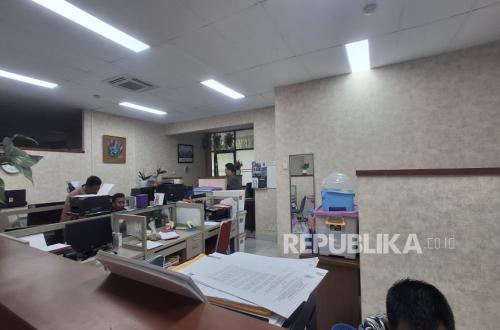
On the first day of implementing the work-from-home (WFH) policy for Civil Servants (ASN) every Friday, the environment around the Cimahi City Government offices was remarkably quiet. The policy is aimed at saving electricity and fuel (BBM).
Based on observations on Friday (10/4/2026), the sparse atmosphere at the Cimahi City Government Office Complex on Jalan Rd Demang Hardjakusumah was evident from the parking area. The rooms in each Regional Device Organisation (OPD) also appeared empty. Many chairs were unoccupied. However, some ASN were still required to work in the office according to the established schedule.
“We have toured to observe the implementation of the first WFH day in Cimahi City, and it looks quite empty and sparse. The parking area is also empty,” said the Secretary of Cimahi City, Maria Fitriana, after monitoring the WFH implementation.
She explained that WFH for ASN in the Cimahi City Government environment is set at a maximum proportion of 75%, with 25% continuing to work from the office (WFO) every Friday. This arrangement is adjusted by each regional device considering service needs.
The WFH policy does not apply to echelon II officials such as the regional secretary, regional assistants, and department heads, as well as echelon III such as secretaries, section heads, and subdivision heads. They are required to be present at the office to ensure optimal coordination and decision-making functions.
Maria also emphasised that for direct public service units such as the Regional General Hospital (RSUD), community health centres, Civil Service Police Unit and Fire Department (Satpol PP and Damkar), Regional Disaster Management Agency (BPBD), Environmental Office (DLH) especially cleaning services, Population and Civil Registration Office (Disdukcapil), Investment and One-Stop Integrated Services Office (DPMPTSP) including the Public Service Mall (MPP), Regional Revenue Agency (Bappenda), Transportation Office, and educational units, services continue to be provided directly.
“For attendance, the point is at home. We have arranged for those registered for WFH by their department to include their home address, so it will be visible. Attendance is three times. So they still work from home, with supervision by their respective OPD leaders,” Maria explained.
She continued that the WFH implementation is carried out to save energy such as fuel (BBM) and electricity. The Cimahi City Government is currently undertaking budget savings. “Then many lights are turned off, many computers are not used. So essentially, there are savings through this WFH,” she said.
The Head of the Regional Personnel and Human Resources Development Agency (BKPSDMD) of Cimahi City, Siti Fatonah, said that they already have an application system that can detect the presence of ASN. Thus, they cannot work from anywhere, let alone on holiday.
“We have an application where they must clock in at their domicile point. Then the superiors can check if they are indeed present during working hours at 07:30. They cannot clock in from anywhere; it must be from home,” she said.
If an ASN is caught outside the home during WFH implementation, it will be counted as absent from work, or truancy. Sanctions will range from written warnings to deductions in additional income allowances (TPP).
“If they do not clock in from home, they will be declared absent. But the TPP will automatically be deducted,” Siti stated.