
Questions Surrounding the Prosecutor
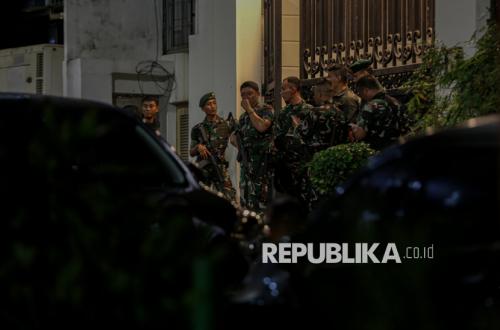
The night was not yet late when a convoy of enforcement vehicles stopped at several points far apart from one another. In South Jakarta, the doors of buildings were opened one by one.
In the corner of a room, a safe was inspected. Drawers were emptied. Documents were examined. Electronic devices were packed up. Large suitcases that had been hidden inside the buildings were then carried out under heavy escort towards the investigators’ vehicles.
At another location, a similar scene unfolded almost simultaneously. From Jakarta to Bogor, eight premises were searched in an operation that captured public attention.
Those who witnessed it may have seen only stacks of cash and suitcases being carried away. But in truth, that night, what was being opened was not merely the doors of buildings.
A number of big questions about law enforcement in this country were opened along with them. The search was too significant to be called an ordinary one.
Eight locations, from Jakarta to Bogor, were visited by joint teams of investigators with armed security from the military, the TNI.
Suitcases filled with cash, documents and electronic devices were brought out as evidence.
Money can indeed be put inside a suitcase. But question marks never fit inside one. They spilled out together with those suitcases, then spread into the public sphere.
The near-simultaneous operation immediately became a matter of national attention.
Yet precisely because the event was so significant, the questions multiplied. Some have been answered. Many more have not.
This column is not searching for answers. It is merely collecting question marks. And sometimes, in law enforcement, question marks are more honest than exclamation marks.
It is difficult to discuss the raid without mentioning the name Febrie Adriansyah.
Over the past few years, he has been one of the most prominent figures in the Attorney General’s Office’s special crimes division.
As Junior Attorney General for Special Crimes (Jampidsus) at the time, he led or supervised the handling of a number of major corruption cases that captured public attention, from Jiwasraya, Asabri, PT Timah, Garuda Indonesia, the Kominfo BTS project, to cases in the mining sector.
For many people, his name became synonymous with the face of a prosecution service energetically hunting corruptors.
Precisely because of that track record, the public is asking: where does Febrie stand in this raid?
As of the time of writing, there has been no official explanation from investigators stating that the search was carried out because Febrie has been named a suspect, or because of alleged criminal acts directly attributed to him.
What the public knows so far is limited to the existence of searches at locations that, according to various reports, were once owned by or associated with him.
The legal relationship between those locations and the construction of the case still awaits an official explanation from investigators. This is where the question marks proliferate.
Why was this operation conducted on such a large scale? Is the case under investigation genuinely so large that it required simultaneous operations across many locations?
Or is there an institutional message being conveyed to the public?
Equally attention-grabbing is the presence of TNI personnel around the search locations. What is the basis for their involvement?
Is it purely for security, or are there other considerations? As of the time of writing, the official explanation remains unclear. It is precisely this absence of explanation that has given rise to a variety of interpretations.
Why, moreover, were the chosen locations those that have long been linked in press reports to the former Jampidsus?
Are they merely storage sites for evidence, part of a flow of funds, or do they have a substantive connection to the case under investigation?
As of yesterday, no official explanation had been provided. Hence another equally intriguing question has emerged.
Does this raid have any connection with the polemic over the alleged surveillance of the Jampidsus in 2024?
At the time, the public was left puzzled after the Attorney General’s Office announced an alleged surveillance operation targeting the Jampidsus, while the National Police (Polri) stated that the matter had been examined and did not disturb the relationship between the two institutions.