
Questioning the Logic of Closing Study Programmes
PT DSI Persero will undertake full export functions starting January 2027.
There is unease reading the plan by Kemendikti-Saintek to shut down parts of study programmes to curb the mismatch between graduates and industry, and to optimise a university’s contribution to eight strategic industries (energy, food, health, defence, maritime, downstream development, digitalisation, and advanced manufacturing) and the recommendation to develop new programmes aligned with the strategic sectors.
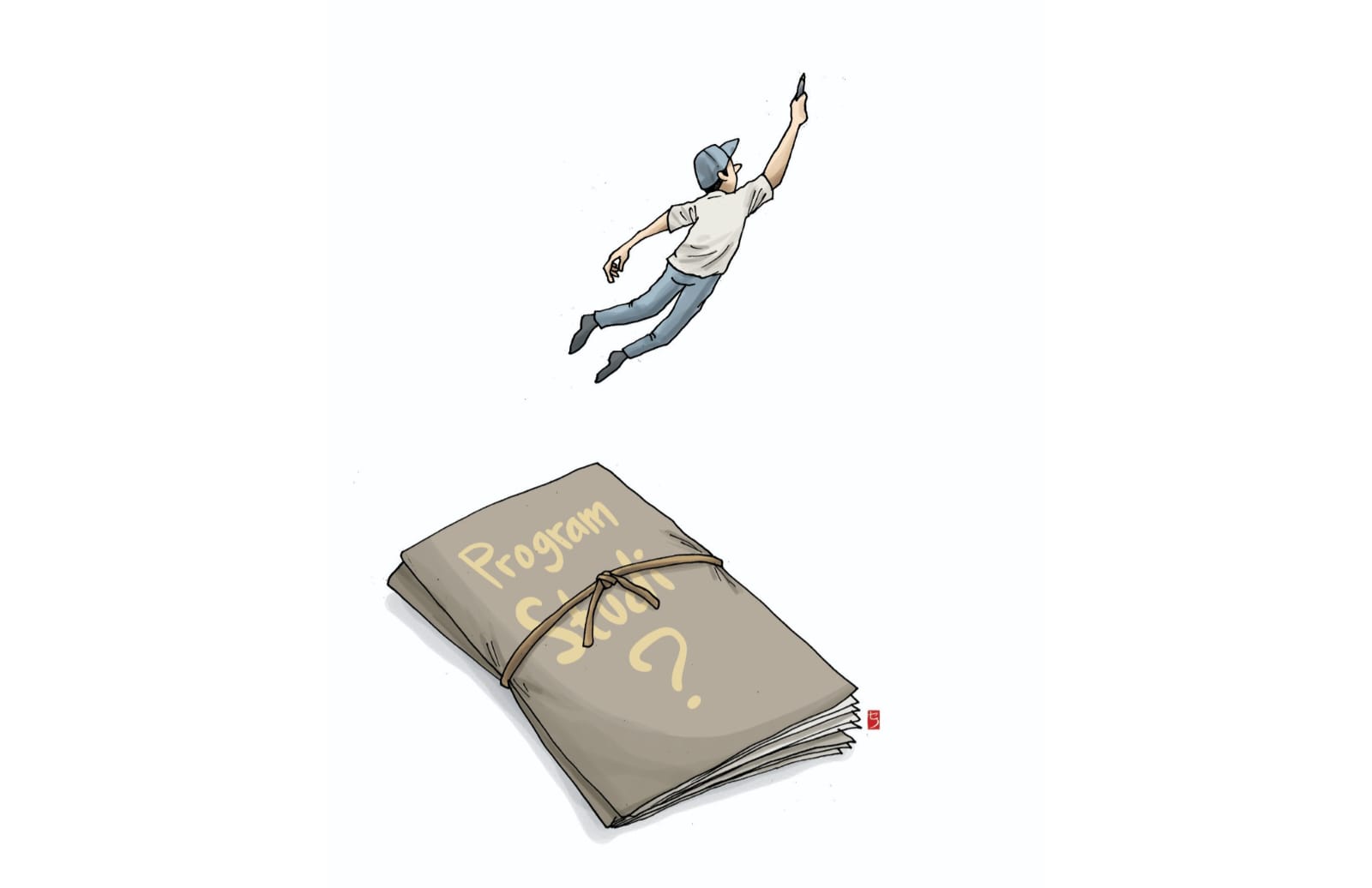
This is troubling. Universities are being reduced to mere suppliers of labour. So, what is the purpose of educating Indonesians? Should universities truly follow industry, or should industry be born by universities?
ARCHITECTURE OF CIVILISATION
In the tradition of development law, law and educational institutions are not merely tools serving the economy. They are the architecture of civilisation. They shape the trajectory of a nation, the values it upholds, the kind of people it produces. A university that merely follows eight strategic industries is a university that has released its architectural function. It no longer designs civilisation; it merely fills orders. Not an architect, but a contractor. As a contractor, we know it can never change the world.
In educational philosophy, the relationship between university and society can be conceived in three models.
First, a reactive model: the university answers current needs. The industry requires an energy engineer; the university opens an energy programme. The market requires digital labour; the university opens a digitalisation programme. The university becomes a mirror reflecting what already exists in front of it.
Second, an adaptive model: the university does not merely respond to present needs but also prepares people to be adaptable to needs not yet known. It does not just produce specialists for known slots, but forms people who are flexible enough to create their own slots when old ones become obsolete or unavailable.
Third, a generative model: the university produces people who are not only adaptive but also capable of leading change. Change that opens unimaginable horizons and determines the course of civilisation. Not a follower of the era, but a maker of the era.
We are being pushed toward the first model. Yet what Indonesia needs is not a university racing to chase industry. Rather, a university capable of generating industries that do not yet exist.
In learning strategic leadership, there is transactional leadership and transformative leadership. Transactional leadership operates within the existing system; it optimises, improves efficiency, and meets established targets. It answers needs that can already be formulated. Transformational leadership operates beyond the system. It questions, reimagines, and creates possibilities never before seen.
Policies that push campuses to align with eight strategic industries generate the transactional leadership type. Skilled people fill slots that are already available. People who are adept at working within the system. Not people who know how to change the system when it is already old or irrelevant.
PRUDENCE
Indeed, history shows that leaps in civilisation never come from those who follow the map already laid out. Global change always begins with those educated to question the world, not merely to serve it.
There is one principle in bioethics that underpins decision making in global health, the environment, and international law: the precautionary principle.
In simple terms, that principle says if you cannot prove that your action will be safe in the long run, do not act. In every case, the most costly thing is not the repair bill but the reality that some harm caused is irreversible, cannot be restored, and cannot be returned to the way it was.
Let us now apply the same principle to educational policy.
Will the damage caused by closing study programmes that do not align with the strategic industries be recoverable? Also, there is no guarantee that the eight strategic industries will remain relevant in coming decades.
Fossil energy is undergoing an existential transition. Advanced manufacturing is most vulnerable to AI automation. The industrial map changes faster than the education cycle. A programme opened today to meet industry needs could become irrelevant even before its first cohort graduates.
Here the precautionary principle speaks very loudly: when we cannot ensure the future of industry, but we can ensure that closing study programmes will produce irreversible damage, which risk will you choose?
BUILDING A NATION THAT IS SOVEREIGN
Let us reach the most fundamental question: what kind of nation do we want to build? If the answer is a highly efficient nation, whose campuses align with the eight strategic industries and whose education is measured by employment figures, the policy is consistent with its own vision. Go ahead and implement it.
If the answer is a sovereign nation, capable of determining its own path, producing transformative leaders, whose universities function as the architecture of civilisation, not contractors taking orders, the policy is not only philosophically mistaken. It is strategically dangerous.
History has never favoured a nation that only excels at reacting. Civilisation leaps always begin with institutions that are free enough to imagine what does not yet exist and brave enough to educate people capable of realising it.
When discussing the closing of study programmes, actions that in the framework of the precautionary principle are irreversible, we are talking about a choice of civilisation. A choice about the model of humanity.