
QR Code Payments Now Incur Fees in India, Sparking Public Outcry
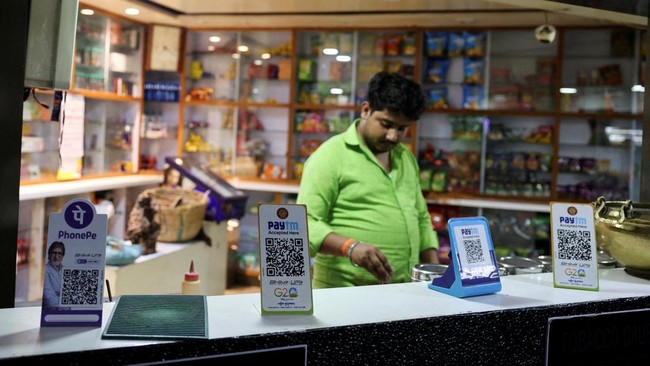
QR code transactions for shopping in India are now subject to fees. After being free for six years regardless of transaction value, the Indian government has finally decided to impose charges.
However, these fees are levied on merchants rather than consumers. This policy marks the end of the zero-MDR (Merchant Discount Rate) regime on their flagship domestic instant payment network, the Unified Payments Interface (UPI).
For context, charging merchants for QR transactions was previously implemented in 2016. However, those fees were abolished in 2017 when the Indian government withdrew a large portion of high-denomination banknotes.
The zero-MDR era, which began in 2017, was scheduled to end on 15 October 2026. Under the new regulations, merchants will be charged a fee of 0.4% or 40 basis points (MDR) for every transaction exceeding 2,000 rupees (approximately Rp368,000). Nevertheless, the government has provided several exemptions for peer-to-peer transactions, which will remain free.
New Profits for Banks and Fintechs
This unexpected decision was met with a positive response from the financial markets. Shares of various payment and banking companies in India rose during Wednesday’s local trading, as investors anticipated that the implementation of MDR would open new revenue streams.
Until now, banking institutions and payment applications have had to bear the massive operational costs of these transactions themselves.
The scale of UPI usage in India is immense. Official data shows that last August, UPI processed a total of 24.5 billion transactions with a value of 29,823 billion rupees (Rp5,500 trillion), involving over 550 million active users.
The Indian government even claims that UPI holds an 84% market share of the national digital payment volume and contributes 49% of the total global real-time payment volume.
A large portion of this transaction volume is controlled by Walmart’s PhonePe and Alphabet’s Google Pay, which held approximately 80% of the market share by transaction value last August.
The End of the ‘Zero-MDR’ Regime
History shows that the UPI pricing model when it first launched in 2016 actually included a nominal fee. However, that rate was temporarily abolished in 2017 during India’s large-scale demonetisation.
In 2020, all transaction fees were officially removed, ushering in the ‘zero-MDR’ era that the government has now brought to an end.
Despite the new regulations, the government has ensured that the tariff will not be applied uniformly. The specific details are as follows:
Small and regional transactions: Payments to small merchants and businesses in rural and semi-urban areas will be exempt.
Special sectors: High-volume categories such as telecommunications, railway services, and investments in mutual funds and stocks will be subject to a specific, lower rate.
Capped: The maximum fee is capped at 300 rupees (approx. Rp55,000) for transactions exceeding 75,000 rupees (approx. Rp13.8 million).
Public Protest and Opposition
Although the National Payments Corporation has strictly prohibited merchants from passing these costs directly to consumers, the policy has nonetheless triggered a wave of public concern. Many, including India’s main opposition party, the Congress, have levelled sharp criticism. Opposition leader Rahul Gandhi warned that the rule would ultimately disadvantage consumers, as merchants are predicted to covertly pass the costs onto goods prices.
On social media, users have also expressed fears that these additional costs might drive merchants back to cash transactions, while questioning the government’s previous commitment to promoting UPI as an inclusive