
Qodari Tests Digital Social Protection, Benefit Verification Now More Accurate and Data-Driven
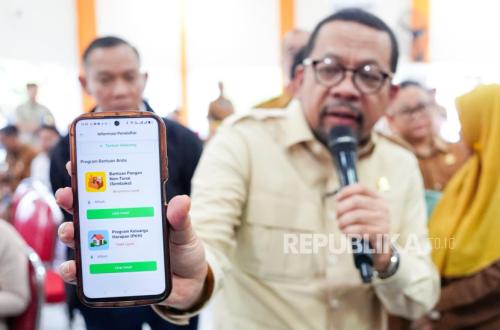
Head of the Government Communication Body (Bakom) of the Republic of Indonesia, Muhammad Qodari, experienced first-hand the registration process for the Digitalisation of Social Protection (Perlinsos) during a visit to Tambaksari District, Surabaya, on Tuesday (28/7/2026). Accompanied by the Committee for the Acceleration of Government Digital Transformation, district officials, and residents, Qodari observed every stage of verification that utilises digital technology to ensure social assistance is distributed to those who are truly entitled. The experience further strengthened his belief that the government’s digital transformation is a crucial step towards delivering a fairer, faster, and more transparent social protection system. “I tried it myself earlier among the residents present to see how the registration process is carried out. It felt extraordinary, very sophisticated. We can use current technology, face recognition,” said Qodari in his statement on Thursday (30/7/2026). In the simulation, officers entered the resident’s National Identity Number (NIK) from their ID card into the application. Subsequently, the system automatically matched the identity using facial recognition technology. The verification results were then compared with various government databases so that the validation process could be carried out quickly and accurately. According to Qodari, the main advantage of this system lies in its ability to integrate data from various ministries and agencies. Information such as electricity usage, vehicle ownership, and land ownership can be considered in determining the eligibility of social assistance recipients. “The data matched immediately. When a cross-check was conducted with data from the state electricity company (PLN) and other institutions, the information appeared instantly. This system is fairer because it uses machines, computers, and data originating from various ministries and agencies,” he said. He explained that this data-driven approach will reduce the potential for subjectivity in the distribution of social assistance. Decisions regarding eligibility are no longer solely dependent on individual assessment but are based on verified data. “From PLN, we can see the power usage; from the police, we can see vehicle ownership; from ATR/BPN, we can see land ownership. So, it is the system that provides the answer,” Qodari stated. In addition to ensuring objectivity, this digital system also provides room for the public to file objections if there is a data mismatch. The entire process is conducted digitally, so resolutions are expected to be faster and more transparent. “There is no more subjectivity. If there is an objection, the public can submit it directly through the system and it can be processed immediately. So, there is justice, speed of service, and efficiency, while also making the work of government officials much easier,” Qodari said. He added that the implementation of Digitalised Social Protection marks a milestone in reforming social protection governance in Indonesia. The system, which has been long in preparation, is expected to ensure that social assistance truly reaches those in need, while simultaneously strengthening public trust in government services. “Hopefully, the benefits can be felt by the wider community soon and further strengthen fairness in the distribution of social protection,” he concluded.