
Q3 Is Only the Beginning: Indonesia’s Economic Pressures Will Be Felt at the End of 2026
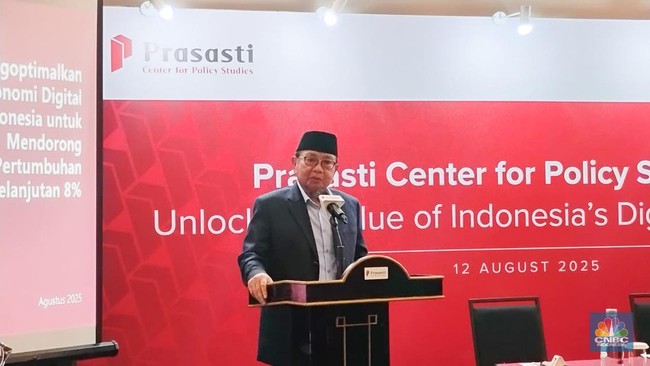
Jakarta, CNBC Indonesia — Prasasti Center for Policy Studies (Prasasti) expects Indonesia’s economic growth to remain steady in the third quarter of 2026, extending the stable growth seen in the second quarter.
For August-September 2026, Prasasti economists forecast growth of around 5.2%, a slight easing from the 5.29% recorded in the second quarter of 2026.
On the expenditure side, growth of more than 5% is being supported mainly by household consumption, the largest contributor to GDP, which has held up despite losing momentum.
Real retail sales returned to growth of 1.3% after contracting in the second quarter, but growth in card and electronic-money transactions slowed and consumer confidence fell, although it remained in optimistic territory. The distinguishing factor in the third quarter was manufacturing exports, which began to recover and helped curb the slowdown.
“Throughout the third quarter, the increase in manufacturing exports came mainly from palm-oil derivative products and electronics,” Prasasti Research Director Adhi N. Saputro said in a statement on Wednesday (4 November 2026).
Nevertheless, Prasasti stressed that the solid third-quarter figures do not reflect the full extent of the pressure. The heaviest effects of oil prices, El Niño and forest fires are expected to be felt in full only in the fourth quarter, while scope for additional stimulus is limited because energy subsidy costs could rise and national priority programmes are also drawing on the state budget.
Externally, conflict in the Middle East and a slowdown in the global economy have pushed oil prices higher, putting pressure on Indonesia as an energy-importing country. Indonesia Crude Price (ICP) averaged nearly US$92 a barrel between January and September 2026, well above the state budget assumption of US$70.
The effects are beginning to show: in October, transport—particularly petrol—contributed 0.59 percentage points to annual inflation. The impact is spreading to the external balance. A wider current-account deficit in the second quarter and the rupiah at around Rp18,000 to the US dollar mean policymakers must prioritise macroeconomic stability. Bank Indonesia has raised its benchmark interest rate by 100 basis points to 5.75% so far this year.
“Third-quarter figures look solid because some of the pressure has yet to pass fully through the economy. There is a lag between oil-price fluctuations, lower harvests and forest and land fires. Their full impact will only be felt in the fourth quarter, just when the economy is being asked to grow faster,” Adhi said.
In light of these conditions, Prasasti considers the state budget’s 5.4% growth target for 2026 difficult to achieve, although not impossible. To meet it, the economy would need to grow by about 5.5% year on year in the fourth quarter of 2026, against a high base of 5.39% in the fourth quarter of 2025.
The challenge is that this acceleration must come as three pressures peak at the same time. First, persistently high oil prices are feeding through to production and transport costs, squeezing business margins and increasing the import bill.
Second, El Niño is weighing on rice production, which fell by 18.3% in September and is forecast to decline by 16.3% in October-December 2026. This could push up staple-food prices while inflation is already above 3%. Lower-income households are most vulnerable because food accounts for the largest share of their spending and their savings have already dwindled.
Third, forest and land fires that continued into October in Kalimantan and Sumatra are disrupting economic activity and could cause substantial economic losses.
These pressures will be difficult to contain because fiscal and monetary headroom is limited. According to Prasasti, Bank Indonesia must also support the rupiah, leaving it unable to cut interest rates for now.
On the fiscal side, another surge in oil prices could raise energy subsidy and compensation costs in the fourth quarter, while the projected budget deficit is already close to the 3% of GDP limit. Forcing growth through spending, credit expansion or quasi-fiscal activity could therefore erode fiscal buffers and external stability.
“Interest rates are no longer merely a tool to boost growth; they are an anchor of confidence. Easing too soon could put pressure on the rupiah, and the resulting cost to growth would be even greater,” said Prasasti Board of Advisors member and former Bank Indonesia Governor Burhanuddin Abdullah, who served from 2003 to 2008.
Source: jawawa.id (https://jawawa.id/newsitem/q3-is-only-the-beginning-indonesias-economic-pressures-will-be-felt-at-the-end-of-2026-1793782268)
Originally published by CNBC Indonesia (https://www.cnbcindonesia.com/news/20261104144220-4-782291/q3-belum-ada-apa-apanya-tekanan-ekonomi-ri-akan-terasa-akhir-2026), translated from Indonesian