
Q1 2026 State Budget Acts as Buffer Against Turbulence, Spending Accelerated More Evenly
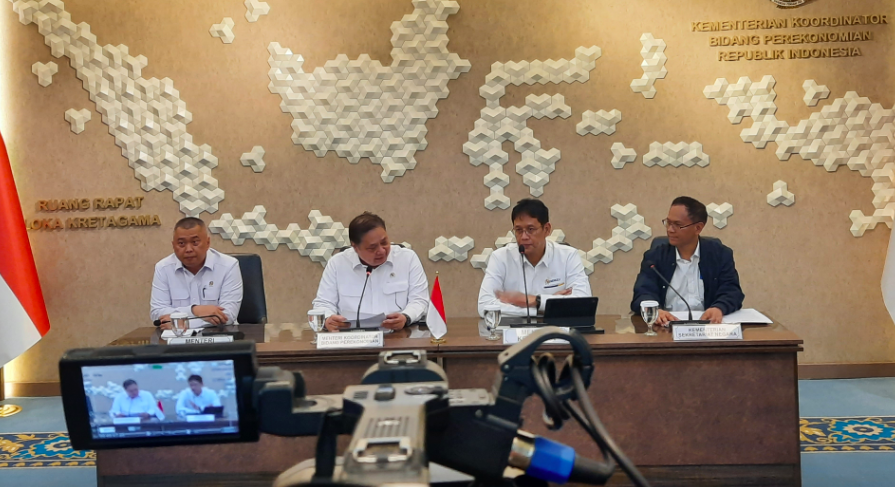
Finance Minister Purbaya Yudhi Sadewa stated that the performance of the State Revenue and Expenditure Budget (APBN) for the first quarter of 2026 remained solid amid global turbulence, while also functioning as a shock absorber for the national economy.
According to him, the APBN not only maintains stability but also actively drives growth through the acceleration of state spending designed to be more evenly distributed throughout the year.
“In the midst of global turbulence, the APBN is able to function as a shock absorber while supporting the development agenda with risks remaining under control,” he said during a Working Meeting with Commission XI of the House of Representatives, on Monday (6/4).
From the revenue side, tax performance showed strong growth of 20.7% year-on-year. Overall, state revenues for the first quarter of 2026 reached Rp574.9 trillion, an increase of 10.5% compared to the same period the previous year.
Meanwhile, state spending grew more aggressively, by 31.4% year-on-year to Rp815.0 trillion. This figure is far higher than the spending growth for the same period last year, which was only 1.4%.
Purbaya explained that the acceleration of spending is a government strategy to ensure that economic impacts can be felt more evenly throughout the year.
“We indeed want spending to be carried out more evenly, so that its effects on the economy can be more significant from the beginning of the year,” he said.
With this realisation, the APBN recorded a deficit of Rp240.1 trillion, equivalent to 0.93% of gross domestic product (GDP). He emphasised that this deficit is normal because the APBN is designed within an expansionary framework.
“If the deficit is larger at the beginning of the year, that is normal because we are accelerating spending. The important thing is that we continue to monitor the balance of revenues and expenditures throughout the year,” he explained.
From the absorption side, state spending in the first quarter of 2026 has reached 21.2% of the total APBN ceiling, higher than the historical average of around 17% for the same period. According to Purbaya, this acceleration shows that ministries and agencies are starting to execute the prepared budgets more quickly.
With cuts and savings here and there, he said, the government ensures that the APBN deficit can be kept around 2.9%.
Therefore, he asked the public not to worry about the potential widening of the APBN deficit.
Purbaya explained that although global conditions are full of uncertainty, domestic demand remains the main engine driving the economy.
He mentioned that the MBG Programme will be distributed again to recipients starting from 31 March 2026.
Purbaya assessed that this condition differs from the views of some observers who previously stated that traditional markets were experiencing a dead calm.