
PWI Central Highlights the Importance of Information Justice for Indigenous Communities
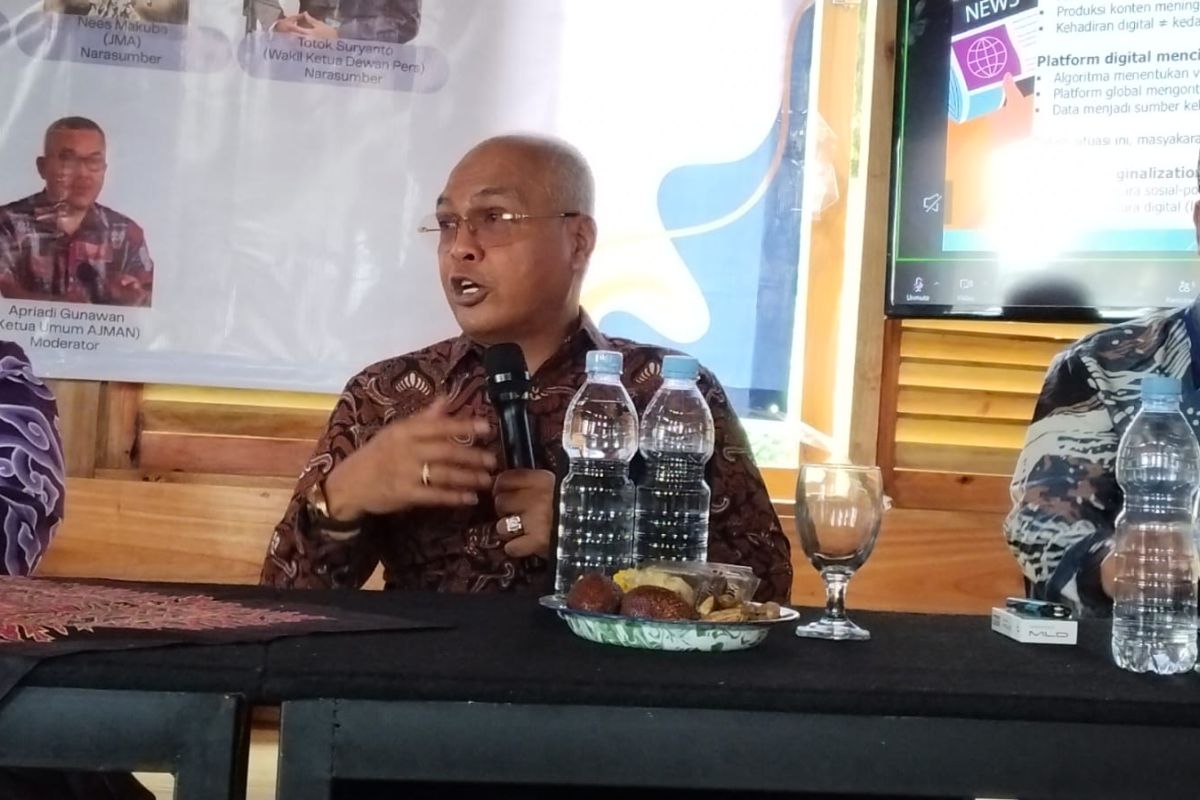
Jakarta (ANTARA) - Akhmad Munir, Chairman of the Indonesian Journalists’ Association (PWI) Central, stressed the importance of building a fairer and more inclusive information ecosystem for indigenous communities in Indonesia.
“So far, the main issue has not merely been the lack of coverage about indigenous communities, but the imbalance of power in knowledge production,” Munir said in his statement in Jakarta on Wednesday.
He delivered these remarks at the First National Working Meeting (Rakernas) of the Association of Indigenous Journalists of the Archipelago (AJMAN), held in Bogor, West Java, on 29-30 April 2026.
In his presentation titled “Indigenous Community Journalism: From Representation to Information Sovereignty in the Digital Platform Era”, Munir explained that the primary challenge is not just the scarcity of reporting on indigenous communities, but the power imbalance in the knowledge production process.
According to him, mainstream media has often positioned indigenous communities as objects of reporting, rather than subjects conveying their own stories and realities.
This has led to incomplete information, even tending to oversimplify the complexities of indigenous community life.
He noted that in the digital transformation era, this issue does not simply disappear. Instead, new dynamics emerge because digital spaces operate on platform logic driven by algorithms, engagement levels, and the attention economy.
“Digital spaces are not neutral; they are controlled by platform logic. This makes the challenges for indigenous community journalism even more complex,” he stated.
Munir then emphasised the importance of understanding information sovereignty more holistically, not limited to mere access or production of information.
“Information sovereignty is the collective right of indigenous communities to determine how information is produced, disseminated, and interpreted according to their own values and interests. This cannot be reduced to just the ability to access or produce information,” he said.
He explained that information sovereignty encompasses three main layers. First, production sovereignty, namely who creates the stories and from whose perspective they are told. In this regard, indigenous communities must become producers of narratives grounded in their own experiences and knowledge.
Second, distribution sovereignty, which is the extent to which content produced by the community can reach a wider public. Third, meaning or interpretation sovereignty, namely who determines the meaning of an event.
“Without all three, indigenous communities remain in a subordinate position, even if active in digital media. Stories will still be created by outsiders with their own perspectives and interests,” he added.
In his closing remarks, Munir also called on all parties to reposition their perspectives on indigenous communities in the media and information landscape.
“We need to shift our viewpoint: from indigenous communities as objects of coverage to subjects of knowledge production. From mere access to information to information sovereignty, from digital participation to mastery of digital spaces,” he said.
He affirmed that indigenous community journalism is not merely a communication practice, but part of a broader struggle.
“Indigenous community journalism is part of the struggle to preserve living spaces, identities, and the future of communities. Information is power. Information sovereignty is the future. Let narratives grow from their own soil,” Munir stated.
The First AJMAN Rakernas serves as a strategic forum to strengthen the position of indigenous journalists in the national media landscape, while also driving transformation towards information sovereignty.
The event was attended by several national figures, including Special Staff to the Minister for Communication and Mass Media Affairs at the Ministry of Communication and Digital, Molly Prabawaty; Secretary General of AMAN, Rukka Sombolinggi; Chairman of AJI, Nany Afrida; senior Kompas journalist Ahmad Arif; and representatives of indigenous journalists, Nees Makuba.