
PV & ESS Safety Industry Summit 2026: Charting a New Path for Safe and Reliable Industry Development
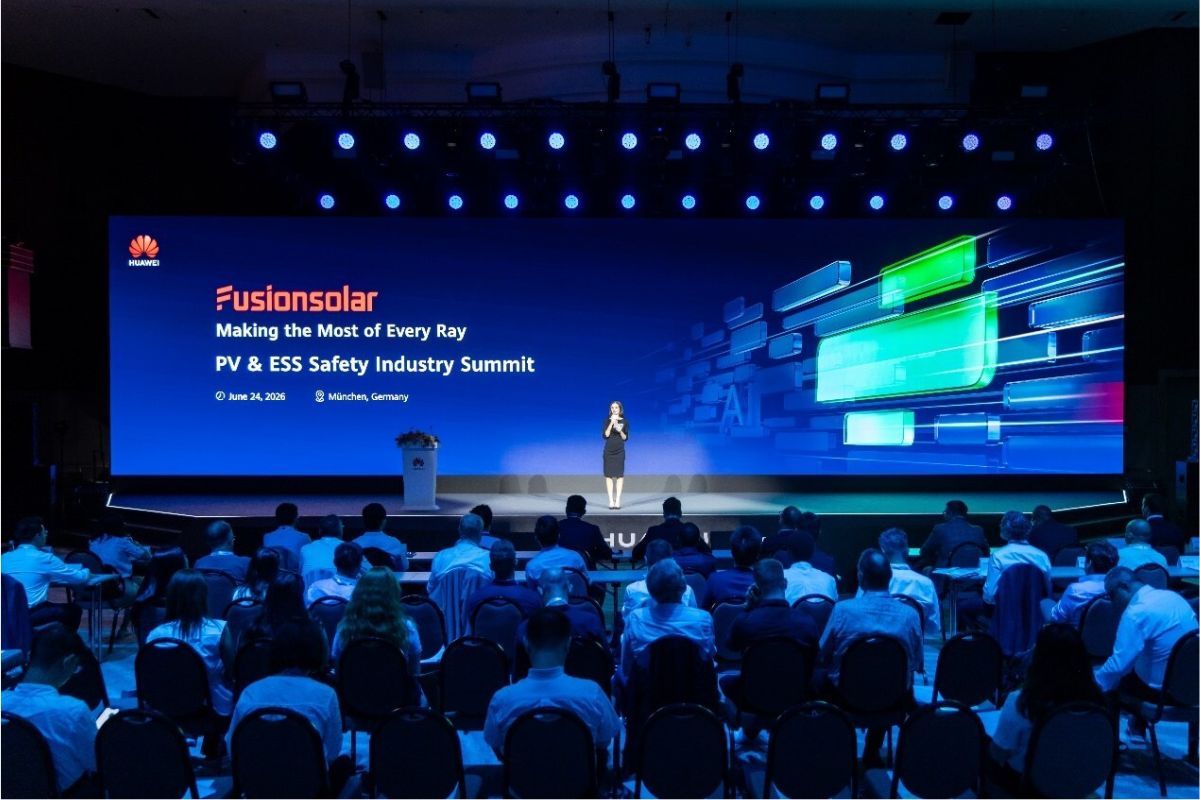
The inaugural PV & ESS Safety Industry Summit 2026, hosted by Huawei Digital Power and global partners at Intersolar Europe in Munich on 24 June 2026, addressed emerging safety risks and insurance coverage gaps accompanying the rapid expansion of large-scale solar and energy storage (PV+ESS) projects. Bringing together leading experts, industry association heads, and insurance sector representatives, the event examined strategic issues ranging from energy storage safety standards and firefighting challenges to developments in testing procedures and insurance industry innovation. Through these discussions, stakeholders sought to formulate new approaches to support the safer and more reliable development of the renewable energy industry.
Xia Hesheng, Vice President of Huawei Digital Power and President of Huawei Digital Power Strategy & Marketing, stated that PV+ESS system safety is no longer an option in new energy system development projects but a necessity. He explained that system safety cannot be achieved through a single technological breakthrough, requiring instead the integration of multiple disciplines, including electrochemistry, thermal management, power electronics, digital technology, and artificial intelligence. Huawei, he continued, has always prioritised quality and continues to invest in PV+ESS safety technology innovation to protect the entire system chain. The company will keep collaborating with industry players and strengthening the integration between quantitative safety assessment methods and insurance mechanisms to promote higher-quality renewable energy development.
Gerrit Lührung, Head of System Infrastructure and BESS at Bundesverband Energiespeicher Systeme e. V. (BVES), assessed that the industry is now facing challenges from policies limiting renewable energy production due to grid constraints. Consequently, energy storage systems have evolved from mere commercial arbitrage tools into strategic assets within the power system. Total Battery Energy Storage System (BESS) capacity in Germany has now reached 19 GW, with industry growth driven by the utility, commercial, and industrial sectors. Over the next three years, the industry must overcome various regulatory hurdles, comply with the latest safety guidelines, and maximise the economic value of owned systems.
Tom Hessels, Advisor on Energy and Transport Safety at the Netherlands Institute for Public Safety (NIPV), noted that battery fire incidents are showing an increasing trend. He explained that a key challenge is an ‘information gap’ or lack of data exchange between relevant parties. He urged the publication of UL 9540A test data, including information on thermal runaway duration, and 24-hour manufacturer support services to bridge the information gap between firefighters and manufacturers.
Mikel Arrese-Igor, Senior Energy Storage Engineer at DNV, said that approximately 70 per cent of BESS damage occurs at the system level. Full-scale testing, such as that conducted on the Huawei LUNA2000 system, helps validate device safety principles and a safety-by-design approach. Going forward, industry testing standards are expected to evolve to encompass the complete installation level, including fire propagation scenarios to various support facilities surrounding the battery system.
Bill Reaugh, Solar Executive and Principal Engineer at the German Electrical and Electronic Manufacturers’ Association (VDE), assessed that the energy system transformation also introduces new risks. He argued that the device safety approach needs to evolve from the component level to the ecosystem level by leveraging a Digital Trust Model. He stressed that user safety and device security aspects must be applied throughout the entire system lifecycle, from design and manufacturing to operation.
Zhu Jun, Product Director of Utility GFM ESS at Huawei Digital Power, explained that the industry currently faces four main challenges: failure to control thermal runaway, high-voltage insulation faults, grid disturbances, and low levels of digitalisation. He stated that the industry must build a quantitative assessment framework for device safety covering the entire system lifecycle, thereby elevating the risk level from a risk mitigation category to a tolerable risk category. Huawei has established a multi-layered protection system combining passive protection mechanisms and active early warning through the use of high-temperature resistant insulation materials, positive pressure smoke exhaust systems, dual-stage smart string architecture, and AI-based early warning technology, preventing the propagation of thermal runaway even under extreme conditions.
Alastair Nicklin ACII, Senior Director of Business Development Willis Natural Resources at WTW, encouraged the insurance industry to shift towards an approach that makes system design a risk control instrument. Through this approach, insurers can measure risk based on the probability of an incident and the magnitude of the resulting loss, building a closed-loop protection mechanism covering physical, financial, and environmental aspects. This approach also extends the distance between facilities to prevent fire spread to the surrounding environment, shifting the focus beyond mere remediation.