
Putting Books into Children’s Hands
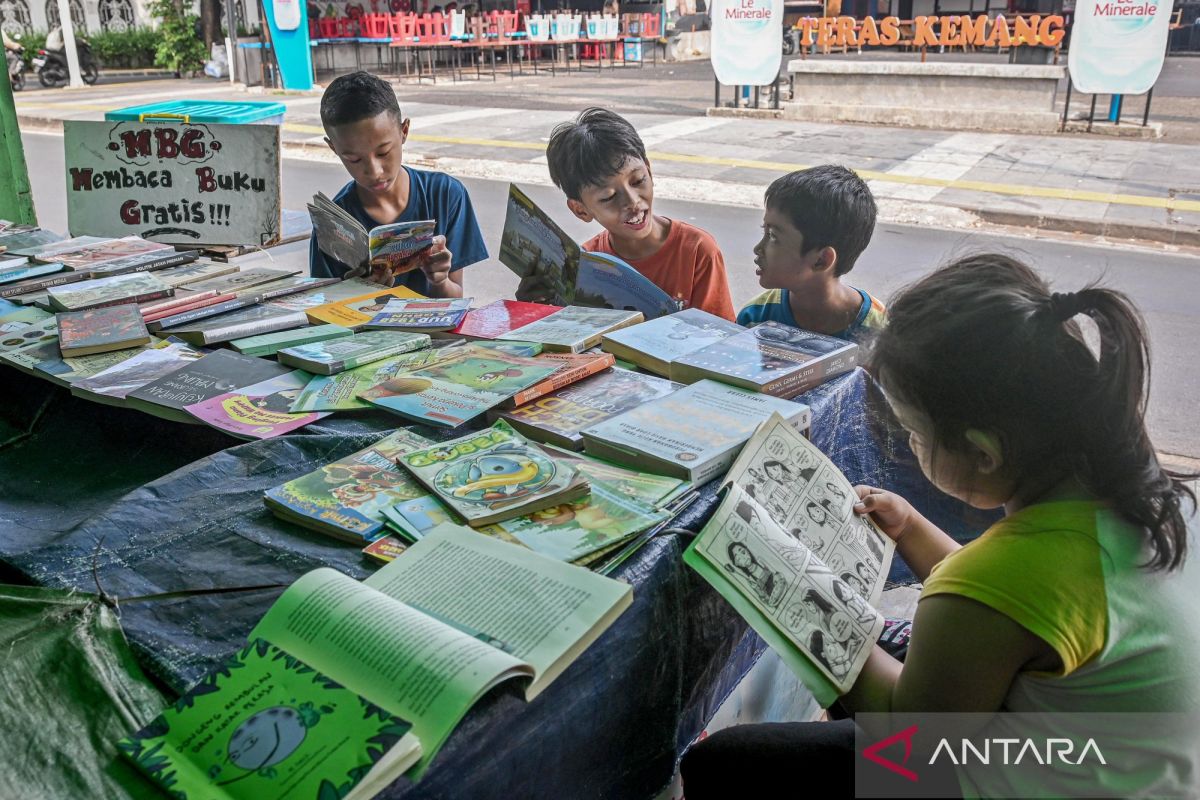
Jakarta (ANTARA) - Jakarta Library, in the Taman Ismail Marzuki complex in Cikini, offers a sight that is increasingly rare in public spaces. In one corner, children’s books are neatly arranged on a dozen or so shelves, like a bookshop. Elsewhere in the area, there is a spacious reading corner with a range of options: soft sofas, round tables, floor seating, rugs or even the bare floor.
“Deer didn’t lose its wits; it tried to think of a way to escape the wolf’s trap,” a mother read aloud from a book to her young son, who was still at kindergarten, like a skilled storyteller.
Nearby, older children, perhaps primary-school age, sat cross-legged and quietly. Their heads were bowed over the pages of illustrated stories. Some read in pairs, occasionally giggling softly, with a pile of books beside them waiting to be devoured. Another child stood motionless for a long time in front of the shelves, unsure which title to choose.
Outside the building, the scene is entirely different. In waiting rooms, food stalls and on home terraces after school, children are often absorbed in their devices, playing online games with friends or scrolling through short videos without pause. Statistics Indonesia (BPS) research found that 42.25 per cent of young children in Indonesia used a mobile phone in 2025. That figure covers only children aged zero to six. Older children are, of course, even more familiar with screens.
This is the backdrop against which Jakarta Deputy Governor Rano Karno’s remarks resonate with everyday life. At an event marking the 130th anniversary of writer Aman Datuk Madjoindo, he said Indonesia was losing many children’s story writers at a time when children were vulnerable to the harmful effects of technology misuse.
Rano recalled encountering Si Doel Anak Betawi, a book published in 1932, when he was about eight years old. He found it at the bottom of a pile at Balai Pustaka. The book would later take him to the silver screen and television, and, by his own account, ultimately to the deputy governor’s office.
That history illustrates how far-reaching a children’s story can be. The problem is that such stories are now finding it increasingly difficult to reach their youngest readers.
A wave of viral books
Those who came of age in the first decade of the 2000s know well how a book could become a talking point, much like trends that now circulate on social media. Tastes changed like the seasons. The teen romance Dealova once dominated, before being supplanted by Raditya Dika’s comic diary-style writing, followed by stories of struggle and ambition in Laskar Pelangi and Negeri 5 Menara, and then the religious romance Ayat-Ayat Cinta.
The books were passed from hand to hand, borrowed in turn and discussed in classrooms and university canteens. When they were adapted for the big screen, audiences flocked back to bookshops.
Almost all the titles that went viral at the time were aimed at teenagers and young adults. Children’s books were rarely swept up in the same wave. This is ironic, since children are the ones who most need stories close to their own world.
Today, Na Willa deserves attention as an example of how much effort it can take for a book to go viral. Reda Gaudiamo’s book Na Willa was first published in 2012 and only became widely known after it was adapted for the big screen by director Ryan Adriandhy and released during the 2026 Eid season. The story of a young girl in an alley in Surabaya in the 1960s drew more than one million cinema-goers.