
Putin Sets Hardline Conditions, Ukraine Faces Losing Territory
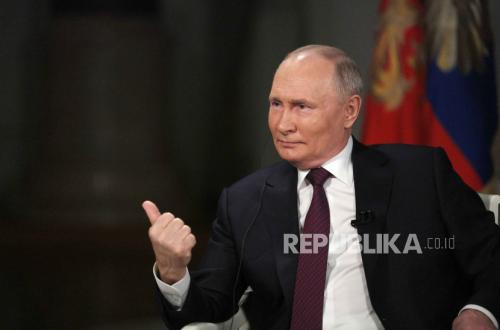
Russian President Vladimir Putin has ordered the creation of a 660-kilometre security zone inside Ukrainian territory bordering Russia. He said the zone would not be up for negotiation in peace talks with Kyiv, a decision that could further complicate efforts to end the war, which began in February 2022.
Putin announced the decision during a visit to a Russian military command post on Friday (16 October 2026). Wearing military uniform, the Kremlin leader said Russian forces were conducting operations to take control of territory deemed necessary to protect Russian border areas from Ukrainian attacks.
“Russia’s armed forces have been tasked not only with driving the enemy from our territory, but also with creating a security zone in adjacent territory. This task is being carried out successfully,” Putin said in a statement broadcast on Russian television, Reuters reported on Friday.
Putin said the security zone was a strategic interest that would not be compromised in diplomatic talks. He described it as part of efforts to ensure the long-term security of Russian areas directly bordering Ukraine.
“Our goal is to ensure the complete security of Russia’s border regions in the future. We do not plan to make this issue part of possible peace talks with Ukraine,” Putin said.
The remarks reaffirm Moscow’s position as the war enters its fifth year. Russia is not only seeking to hold the Ukrainian territory it has occupied, but also wants control of additional areas, citing border security.
A 660-kilometre security zone
Kremlin spokesman Dmitry Peskov said the planned security zone would stretch for 660 kilometres. He said Russian forces currently controlled about 70 per cent of the targeted area.
Peskov did not specify how far the security zone would extend into Ukraine. The figure of 660 kilometres therefore refers to the length of the area targeted by the policy, not the depth of a Russian military advance from the border.
Reuters reported that creating the zone would involve taking control of Ukrainian territory in Sumy and Kharkiv regions. Both border Russia and have strategic importance as routes for troop movements, logistics and cross-border military operations.
Sumy lies in north-eastern Ukraine and borders Russia’s Kursk region. Kharkiv is one of Ukraine’s important industrial areas and has also been the scene of heavy fighting since Russia’s invasion began in February 2022.
The two regions have a different status from Donetsk, Luhansk, Zaporizhzhia and Kherson. Russia declared the annexation of those four regions in 2022, although the claims are rejected by Ukraine and most of the international community.
Moscow has not formally declared the annexation of Sumy or Kharkiv. However, its plan to retain military control over parts of those regions through a security zone could add another territorial dispute to peace negotiations.
Military control of an area does not, in itself, change its sovereign status under international law. Occupied territory remains part of Ukraine unless there is a settlement that is lawful and internationally recognised.
Retaliation for Ukraine’s Kursk offensive
Putin linked the creation of the security zone to Ukraine’s military operations in Kursk in 2024 and 2025. The cross-border offensive was a significant development in the war, as Ukrainian forces entered Russian territory and temporarily took control of several areas.
Ukraine’s operation began in August 2024, when its forces crossed the border into Kursk. Kyiv sought to divert Russian military attention and resources while gaining leverage in possible negotiations to end the war.
Russia later launched an operation to retake the territory briefly held by Ukraine. The fighting caused extensive damage and forced some residents to leave border areas.
In his statement on Friday, Putin said the experience in Kursk showed that security could not rely solely on defending Russian territory. The Kremlin says threats to border areas must be addressed by creating a buffer zone on the Ukrainian side.
Putin has raised the concept of a military buffer zone on several previous occasions. The latest announcement was more explicit, however, because Russia specified the length of the targeted area and said its status would not be negotiable.
The move also highlights a fundamental difference between Moscow’s and Kyiv’s security positions. Russia frames its control of Ukrainian territory as part of its border defence, while Ukraine regards the presence of Russian forces on its territory as a violation of its sovereignty.