
Putin Ready to Help End US-Iran Conflict as Qatar Asks Russia to Intervene over Hormuz
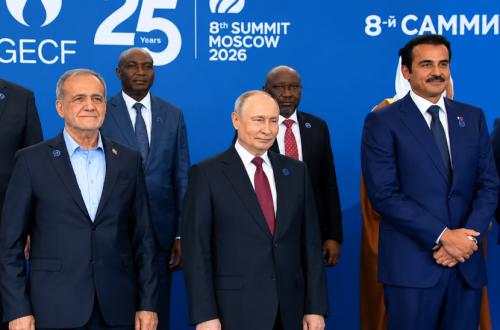
JAKARTA — Qatar has sought Russian President Vladimir Putin’s support in addressing the Strait of Hormuz crisis, which continues to disrupt international shipping and global energy supplies. The diplomatic effort came as Qatar’s Emir, Sheikh Tamim bin Hamad Al Thani, met Putin in Moscow on Tuesday (27 October 2026), while Russia also held separate talks with Iranian President Masoud Pezeshkian on regional tensions and relations between the two countries.
At the meeting, Putin said Russia was ready to help resolve the conflict between the United States and Iran through diplomacy. He stressed the importance of reviving the understanding previously reached by Washington and Tehran with mediation from Qatar and Pakistan, as the threat of renewed military strikes continued to loom over the Gulf region.
Anadolu Agency reported on Tuesday (27 October 2026) that Putin said the Islamabad Memorandum, agreed in June 2026, remained relevant as a basis for resuming negotiations. The understanding had paved the way for efforts to end hostilities, restore shipping through the Strait of Hormuz and discuss a broader resolution to the conflict.
“On our part, we are ready to do everything within our power to help resolve this complex and pressing issue,” Putin said at his meeting with the Qatari Emir, according to Anadolu Agency.
The statement amounted to a diplomatic commitment, not an announcement that Russia would deploy military forces to the Strait of Hormuz. By the end of the meeting, no new mechanism had been announced by Moscow, Doha and Tehran to ensure the safety of ships using the strategic trade route.
Qatar’s official news agency, Qatar News Agency (QNA), confirmed that Sheikh Tamim and Putin met at the Kremlin in Moscow on the sidelines of the eighth summit of the Gas Exporting Countries Forum (GECF). Their talks covered the Middle East, regional security, energy supply chains and the latest developments in the Strait of Hormuz.
Sheikh Tamim said tensions between the US and Iran had affected the Gulf region, including the security of shipping lanes and international energy markets. The Qatari Emir also praised Russia’s role in promoting a resolution to the conflict, while stressing the need for diplomatic efforts to address regional crises, including the Palestinian issue and the humanitarian situation in Gaza.
The meeting was significant because Qatar is directly involved in mediating between Washington and Tehran. Russia, meanwhile, has close political, economic and security ties with Iran, while maintaining relations with Gulf Arab states, including Qatar.
This position gives Moscow an opportunity to support negotiations. However, Russia’s closeness to Iran also means that its ability to help resolve the crisis will depend on whether Tehran and Washington are willing to accept steps that can be implemented jointly.
Russia urges revival of existing agreement
Putin’s move was not a sudden initiative that first emerged at his meeting with the Qatari Emir. Russian Foreign Minister Sergey Lavrov had previously called for the Strait of Hormuz crisis to be resolved through diplomatic mechanisms based on the understanding reached by the US and Iran in June 2026.
Speaking at the UN General Assembly in New York on 26 September, Lavrov said the Islamabad Memorandum could still serve as a basis for reviving dialogue. He said the agreement provided a viable framework for overcoming the impasse, including on shipping security and ending hostilities.
Lavrov reiterated that position after attending a Russia-Gulf Cooperation Council (GCC) strategic dialogue meeting in Bahrain on 18 October. Russia urged implementation of the understanding reached by the US and Iran and offered a broader approach to regional security.
The following day, Lavrov held talks in Tehran with Iranian Foreign Minister Abbas Araghchi. They discussed the war involving the US, Israel and Iran, as well as the need to restore security in the Gulf region and freedom of navigation through the Strait of Hormuz.
After the meeting, Lavrov said Russia was ready to help find a solution through negotiations acceptable to all parties. Moscow also wants security guarantees to prevent armed conflict from again disrupting the region and the shipping route, which is vital to global energy trade.
So far, Russia’s preparations for concrete action have centred on supporting mediation, reactivating the existing framework for negotiations and coordinating politically with Iran and the Gulf states. There has been no announcement that Russia will send a fleet to escort merchant ships or take over security in the Strait of Hormuz.
Iranian president meets Putin: what is Tehran preparing?
On the same day as Putin’s meeting with the Qatari Emir, Iranian President Masoud Pezeshkian also met the Russian leader in Moscow. The separate talks took place during the GECF summit, bringing together three major gas-producing countries with an interest in the stability of international energy supplies.
Putin said regional security developments were a serious concern for Russia because of its extensive cooperation with Tehran. He also said Russia was fulfilling its obligations on various joint projects with Iran, including the construction of the Bushehr nuclear facility.
According to Anadolu Agency, Putin said bilateral trade between Russia and Iran had increased by 10.4 per cent in the first eight months of 2026. The figure was cited as evidence of the two countries’ growing economic ties amid geopolitical tensions and sanctions pressure.
Pezeshkian expressed gratitude for Russia’s political and economic support. He also called for closer cooperation among countries in the region, arguing that various regional security problems could be resolved without always relying on the United States.
The Iranian president linked the need for such cooperation to US military actions in the region. However, Pezeshkian’s remarks represent the Iranian government’s political position and do not mean that all Gulf states support a security approach that sidelines Washington.
After the meeting, Pezeshkian said his visit to Moscow had produced positive discussions on energy, trade, infrastructure, security and bilateral relations. He also expressed a desire to expand cooperation with Russia in industry, science, and the security and military sectors.
Nevertheless, available official reports show no new military agreement between Putin and Pezeshkian specifically to take control of or reopen the Strait of Hormuz. Security discussions took place in the broader context of Russia-Iran relations, while freedom of navigation remained part of regional negotiations.
Iran’s concrete step regarding the Strait of Hormuz so far has been a conditional offer to reopen the shipping route. Tehran wants the US to end its naval blockade of Iranian ports first, while Washington insists that resolving the nuclear issue must be a key part of any agreement.
The Associated Press reported on 24 October that Iran’s ambassador to Pakistan, Reza Amiri Moghadam, said Tehran had conveyed its willingness to reopen the Strait of Hormuz if the US ended its blockade of Iranian ports. The offer was conveyed through Pakistan, one of the parties helping to facilitate negotiations.
According to the Iranian official, Washington had not accepted Tehran’s terms. The statement showed that the prospect of restoring shipping still depended on resolving disputes over the blockade, sanctions and security guarantees.
Reuters also reported on 12 October that Iran was reviewing the US response to a proposal Tehran had submitted in September. Iranian Foreign Ministry spokesman Esmaeil Baghaei said communication through mediators was continuing, but differences over the sequence for resolving issues had yet to be overcome.
The US wants Iran’s nuclear programme discussed from the outset of negotiations. Iran, by contrast, wants talks to focus first on restoring security in the Strait of Hormuz and ending the blockade, before moving on to other issues.
That disagreement over sequencing is one of the main obstacles to diplomacy. An agreement to reopen the strait may not be implemented quickly if Washington and Tehran remain divided over security guarantees, nuclear activities and the lifting of economic restrictions.
Source: jawawa.id (https://jawawa.id/newsitem/putin-ready-to-help-end-us-iran-conflict-as-qatar-asks-russia-to-intervene-over-hormuz-1793152306)
Originally published by Republika (https://news.republika.co.id/berita/tnldhm451/putin-siap-bantu-akhiri-konflik-asiran-qatar-minta-rusia-turun-tangan-di-hormuz), translated from Indonesian