
Put on the Spot, Bahlil and Rosan Given New Heavy Task by Prabowo
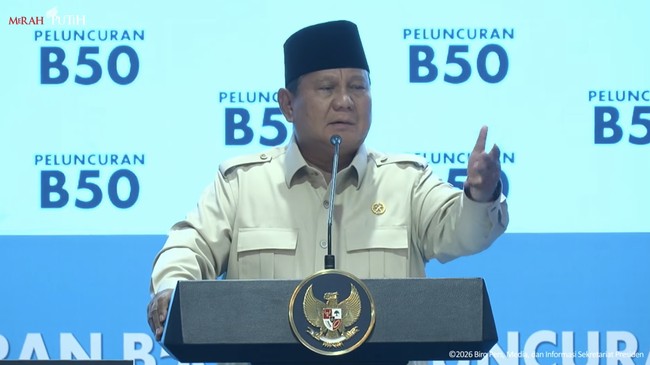
Karawang, CNBC Indonesia – President Prabowo Subianto has once again given a new assignment to several of his ministers. After his ministers successfully carried out his instruction to implement the mandatory 50% palm oil blending policy for solar (diesel fuel), known as B50, Prabowo has now handed down another weighty task in the energy sector to his government aides.
President Prabowo instructed Minister of Energy and Mineral Resources Bahlil Lahadalia, Minister of Investment and Downstream Industry as well as Danantara CEO Rosan Roeslani, and Coordinating Minister for Economic Affairs Airlangga Hartarto to realise 100 Giga Watts (GW) of installed solar power plant (PLTS) capacity within two years.
He made the remarks during his address at the launch of B50 fuel at a Pertamina petrol station, Rest Area KM 57, Jakarta–Cikampek Toll Road, Karawang Regency, West Java, on Thursday (09/07/2026).
“That’s just B50 — what about when the world also finds out that we will build 100 GW of solar power? This year PLN will start with 17 GW. 100 GW in 2 years, can it be done? Mr Rosan? Can it? Can it? Why so quiet. Minister for the Economy, can it? Minister of Energy, can it? I’m not asking you to execute it, I’m asking, can it be done? And we will be ridiculed. I’m telling you, be prepared, we will be criticised by clever experts who will say it’s impossible,” he said, pointedly directing his questions at his ministers.
Previously, the Ministry of Energy and Mineral Resources (ESDM) estimated that the funding needed for the 100 GW solar project could reach around US$100 billion, or approximately Rp1,811 trillion (at an exchange rate of Rp18,112 per US dollar).
The target for building the solar capacity is slated to be realised by 2029 at the latest.
Director General of New, Renewable Energy and Energy Conservation (Dirjen EBTKE) at the ESDM Ministry, Eniya Listiani Dewi, explained that the government is currently aligning all national electricity planning to support the achievement of this target. The enormous funding requirement will need cross-sector collaboration, particularly involving international parties and private companies.
“International collaboration and the private sector are certainly much needed. Investment from the private sector is projected to be very large, but we will require more than US$100 billion in investment,” Eniya explained in May 2026.
The government is targeting the majority of the solar project’s funding to come from private power producer schemes, or Independent Power Producers (IPP). Based on its calculations, private sector involvement is expected to support up to 70% of the total investment required.
“I believe 70% will come from IPPs, so the private sector will join this major programme,” Eniya continued.
The main focus of the 100 GW solar build-out is directed at reducing the use of diesel power plants, which have long dominated eastern Indonesia. This step is seen as economically crucial, as the cost of providing electricity from diesel fuel in remote areas is extremely high.
“So a large part of the 100 GW solar programme is about reducing diesel usage in eastern Indonesia. When we talk about diesel usage, there are costs of more than 1 dollar per kilowatt-hour in some locations in our country,” she explained.
Through this shift to solar energy, the government is optimistic it can reduce fossil fuel imports while strengthening the national energy resilience index, currently at 6.7. The ESDM Ministry is committed to continually simplifying regulations to make it easier for investment to flow into the renewable energy sector.
“We have strengthened our regulations to make investment easy, to make business easy, and there will be no more lengthy regulations and permitting,” she concluded.