
Puslitkoka: Cocoa research must connect farmers and markets
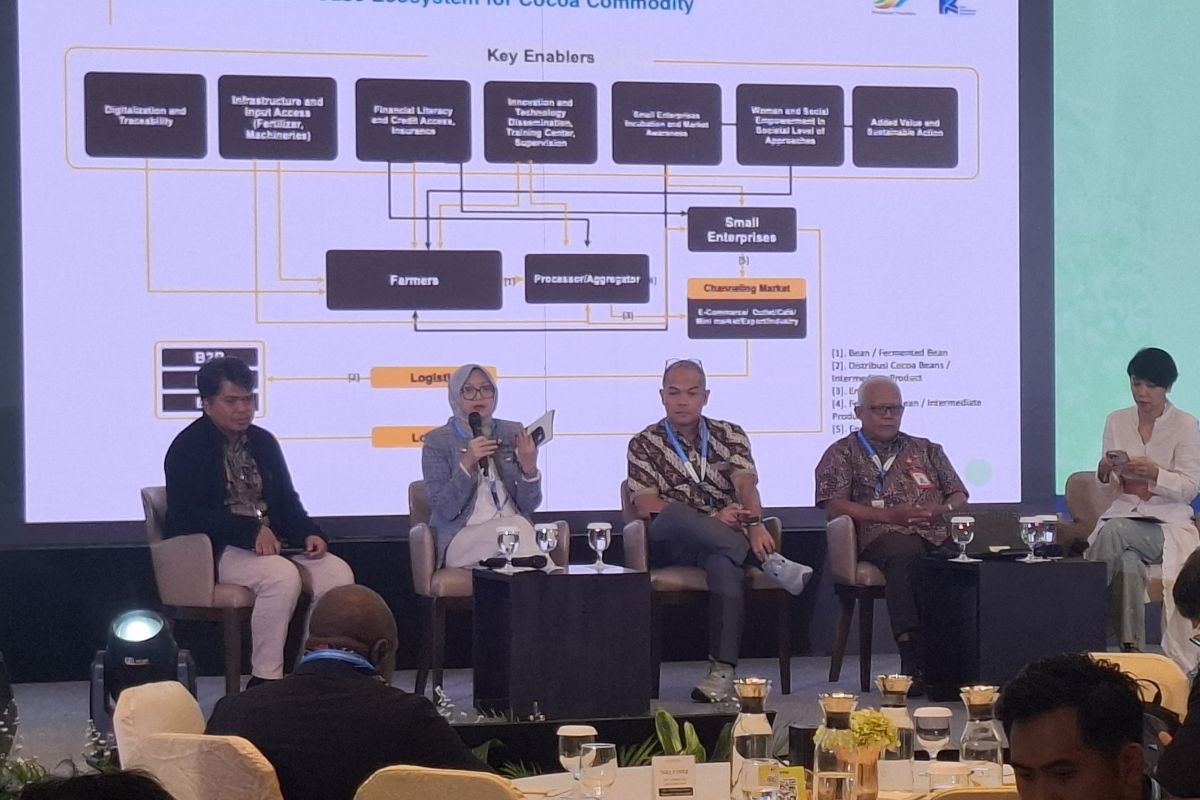
Jakarta (ANTARA) - The Indonesian Coffee and Cocoa Research Centre (Puslitkoka) believes cocoa research results need to be directly connected with farmers and markets so that technological innovations are easier to apply and add value.
Puslitkoka head Dini Astika Sari said this connection is needed through an integrated centre of excellence because cocoa issues involve not only productivity at the farm level, but also technology adoption, access to financing, partnerships, product standards, and market access.
“The Centre of Excellence must fulfil all of these elements,” Dini said at the Regional Learning Forum on Sustainable Commodities in Jakarta on Thursday.
Dini proposed the Centre of Excellence concept as a technology hub connecting research activities with the application of technology on farms, capacity building for farmers, financing, processing, and the needs of industry and markets.
“So we actually understand that the lack of adoption and implementation at the farmer level may be because the tech hub is not available,” Dini said.
According to her, research-based technology needs to be made easier to learn and apply. The hub should not only contain research activities, but also serve as a demonstration and mentoring site for cocoa businesses.
Puslitkoka explained that the concept includes demonstration plots, germplasm collections and seed gardens, cultivation and post-harvest training centres, laboratory and certification facilities, as well as business incubation and human resource development.
The technology hub is also directed at connecting farmers with industry through supply guarantees, standardisation and quality assurance, capital facilitation, mentoring, industry networks, and business meetings.
Dini said the technology approach needs to be adapted to the characteristics of each production centre because the problems faced by farmers in Lampung, Sulawesi, Sumatra, and Papua are not always the same.
Therefore, cultivation technology can be designed by considering genetic factors, environmental conditions, and the social character of communities, including in the selection of planting materials, agroforestry patterns, and water and nutrient management.
Puslitkoka has also mapped productivity problems, technology adoption gaps, limited capital and partnerships, and product standards as aspects that need to be addressed in an integrated manner.
“We can all be involved in producing a policy that is data-driven and market-driven,” Dini said.
The need to accelerate technology adoption is also evident from the condition of national cocoa plantations. Ministry of Agriculture data records a cocoa area of around 1.37 million hectares with around 1.54 million farming families and an average productivity of 715 kilograms per hectare per year.
As much as 99.59 percent of the cocoa area consists of smallholder plantations, so increasing productivity and the ability to adopt technology is directly linked to strengthening farmers’ businesses.
At the same forum, Ani Rahayuni Ratna Dewi, head of the Post-Harvest and Plantation Processing Substance Group at the Directorate of Plantation Downstreaming, Directorate General of Plantations, Ministry of Agriculture, said cocoa issues need to be handled as a single unit from upstream to downstream.
“We cannot think partially because they are an ecosystem, from upstream to downstream all require intervention,” Ani said.
From the government side, the Ministry of Agriculture is targeting the development of 174,260 hectares of cocoa area in 2026 as part of a 248,500-hectare development programme for the 2025-2027 period.
These efforts are accompanied by replanting old or damaged trees using superior planting materials, increasing farmer capacity in applying good agricultural practices and post-harvest handling, integrated pest management, soil health management, and strengthening an inclusive and sustainable cocoa supply chain.
The Ministry of Agriculture is also targeting the issuance of Cultivation Registration Certificates (STDB) for 5,800 cocoa farmers in 2026 in several production centres as part of strengthening plantation data collection and traceability.
In addition, the Indonesia Sustainable Cocoa (ISCocoa) framework will enter a pilot phase at the farmer level in four provinces in 2026 to identify gaps between sustainability guidelines and cocoa cultivation practices in the field.
The integration of research, mentoring, financing, and market needs is considered necessary so that innovation does not stop at the research stage, but can be widely adopted and develop into a business solution for cocoa farmers.
Source: jawawa.id (https://jawawa.id/newsitem/puslitkoka-cocoa-research-must-connect-farmers-and-markets-1788013241)
Originally published by Antara (Indonesian) (https://www.antaranews.com/berita/5714220/puslitkoka-riset-kakao-perlu-terhubung-pekebun-dan-pasar), translated from Indonesian