
Push to Reduce Air Pollution Impact in Satellite Cities
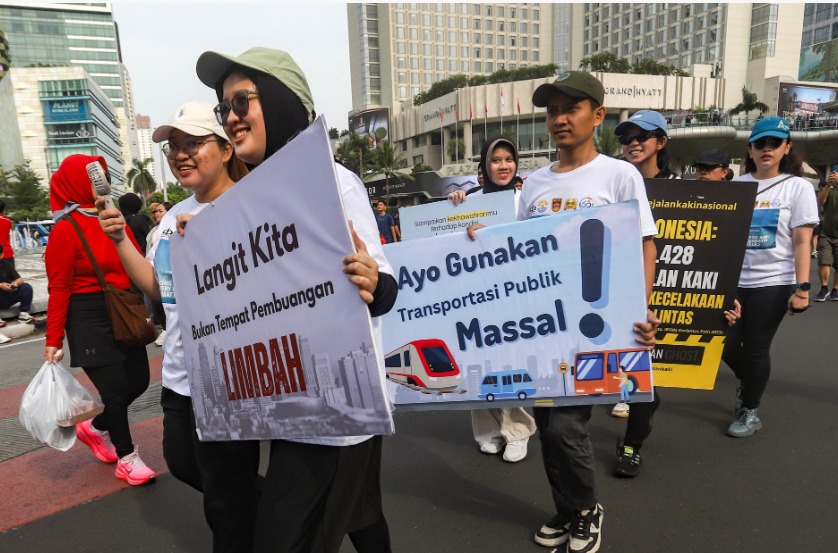
Air pollution in Jakarta’s satellite cities has once again come under scrutiny. The Center for Indonesia’s Strategic Development Initiatives (CISDI) raised the issue through a Health Inc community event titled ‘Breath in Satellite Cities: Living Amidst Tangsel Pollution’ held in South Tangerang, Banten, on Saturday (13/6). The activity brought together health practitioners, environmental activists, communities, and the general public to discuss the impact of air pollution on the physical and mental health of urban residents.
CISDI’s Urban & Environmental Health Lead, Wisya Aulia Prayudi, stated that South Tangerang remains an area with high levels of air pollution in Indonesia. This condition increases the risk of non-communicable diseases due to long-term exposure. According to Wisya, PM2.5 particles are a particular concern as they can enter the bloodstream and seriously affect health. ‘Air pollution is not just an environmental issue, but also a public health problem. Besides triggering respiratory disorders, it also affects the productivity of young people with high mobility,’ she said.
She explained that the growth in mobility in South Tangerang as a satellite city of Jakarta has contributed to increased vehicle emissions. Based on data from the Banten Central Statistics Agency (BPS), the number of motor vehicles in the region reached 1.63 million units in 2025. Wisya noted that high vehicle activity is directly linked to the rise in emissions, which is a primary cause of air pollution in the Greater Jakarta area. Furthermore, the concentration of PM2.5 in South Tangerang and its surroundings often exceeds the safe limit of 50 µg/m³, surpassing the World Health Organisation’s (WHO) highest interim target of 35 µg/m³. ‘The impact of air pollution is often unnoticed because it is invisible, making it a silent stressor in urban life,’ she added.
Through the Health Inc forum, CISDI aims to encourage the public to view air pollution not just as an environmental issue but also as a public health threat. During the same event, Bike2Work Indonesia Programme Director Dimas Gilang assessed that the government needs to build a healthier and more environmentally friendly transport system, especially in satellite cities like South Tangerang. ‘We advocate for an improved transport system where all modes are interconnected. We also push for the provision of bicycle parking so cyclists can comfortably access public transport. The current system makes us reluctant to move. Therefore, we can start making changes from small, simple steps, like walking short distances consistently,’ Dimas said.
Meanwhile, clinical psychologist from the organisation Noutrisi Jiwa, Winona Lalita, highlighted the psychological impact of air pollution on the community, particularly students and young workers with high daily mobility. According to Winona, long commutes, daily pressures, and exposure to pollution during activities can trigger stress and fatigue. She suggested that people take short breaks in their routines to maintain mental health. ‘From a psychological perspective, we can start by becoming aware of our breath. Taking a break can reduce anxiety. Anxiety caused by being in a polluted environment can also be lessened by starting the day looking at plants after waking up,’ Winona said.
Eco-friendly content creator Nada Arini also highlighted the environmental management system in Indonesia, which she feels does not yet support a healthy and environmentally friendly lifestyle. She cited the practice of burning household waste, which is still common due to suboptimal waste collection systems in several areas. ‘The problem is that burning waste is hazardous to health because the waste contains a mix of organic matter, plastics, and other materials. The smoke from burning waste produces air pollution,’ Nada stated.