
Pursuing Self-Sufficiency by 2027, Indef: Government Must Reform Salt Import Governance
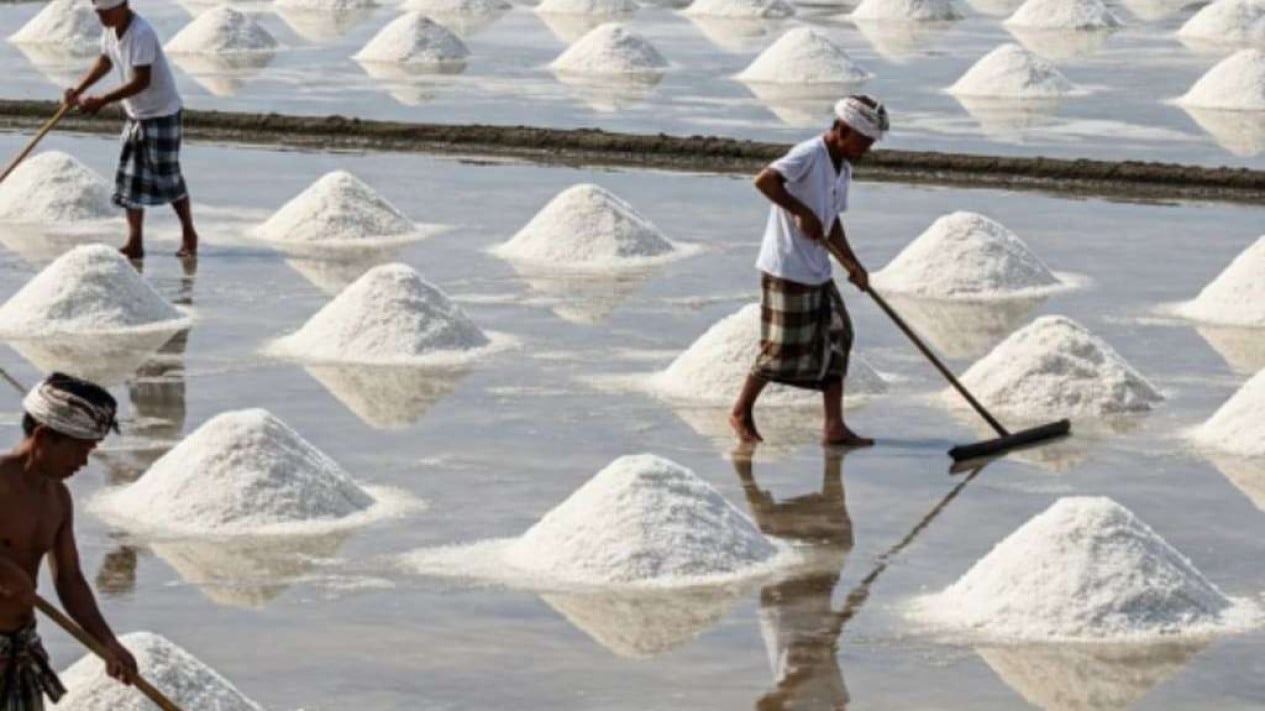
The Institute for Development of Economics and Finance (Indef) has stated that the government’s target to halt salt imports by 2027 is unlikely to be achieved as long as a national salt requirement balance sheet has not been established transparently and based on verifiable supply and industrial demand data.
The Head of Indef’s Macroeconomic and Finance Centre, Muhammad Rizal Taufikurahman, noted that without an accurate balance sheet, import policies are vulnerable to being set in excess of real needs, and their utilisation is often misused.
Consequently, he emphasised that import policies must be based on an accurate industrial requirement balance and conducted selectively, according to specifications that cannot yet be met domestically.
“Import policy must be accompanied by distribution oversight to ensure it does not enter the consumer market, and must be integrated with the obligation to absorb local salt that has met quality standards,” Rizal said in a statement on Tuesday, 30 June 2026.
By way of illustration, national salt production currently stands at approximately 2.5 million tonnes per year, while domestic demand reaches about 4.9 million tonnes and is projected to rise to 5.3 million tonnes by 2029. More than 55 per cent of salt requirements in 2024 are still met through imports, particularly for high-specification industrial salt. This deficit occurs primarily in the industrial salt segment, rather than the consumption salt segment.
To address this deficit, the Government has issued Presidential Regulation Number 17 of 2025 concerning the Acceleration of National Salt Development as the foundation for salt self-sufficiency by 2027. The private sector has also been invited to invest to support this programme.
However, challenges regarding quality and continuity of supply should not continue to be used as justification for expanding imports, let alone increasing salt import quotas. This is because several domestic salt industry players have successfully adopted purification technologies and quality standardisation that do not depend on weather conditions.
Furthermore, the Government is developing the National Salt Industry Centre (K-SIGN) in Rote Ndao, East Nusa Tenggara (NTT), which is a national priority programme of the Ministry of Marine Affairs and Fisheries (KKP) to support salt self-sufficiency by 2027.
Local capacity that already meets standards must be calculated objectively within the national requirement balance. Without a strong oversight mechanism, there is a risk that import requirements will be set too loosely, while genuine domestic production is not taken into account—one example being the food and beverage industry segment, which receives special treatment under existing regulations.