
Purchasing Power for Sacrificial Animals Slips, IDEAS: People Opt for Cheaper Goats
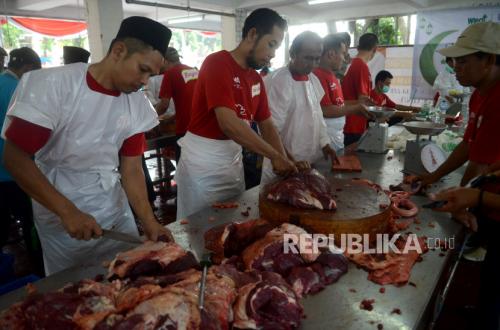
Institute for Demographic and Affluence Studies (IDEAS) estimates that the national economic potential of the sacrificial market in 2026 will reach Rp26.89 trillion. The figure comes from about 1.90 million pekurban households with an estimated total number of sacrificial animals of 1.59 million head.
Based on IDEAS projections, the number of sacrificial animals comprises 493,180 cattle and 1.09 million goats or sheep. Of that total, the potential distribution of sacrificial meat is forecast at about 99,290 tonnes.
IDEAS researcher Tira Mutiara said the estimate was calculated using the approach of counting the number of Muslim residents with expenditure above five times the poverty line at the district/county level as a proxy for households with the economic capacity to sacrifice.
‘The simulation also accounts for preferences in the type and weight of sacrificial animals, ranging from whole cattle to the 1/7 cattle pooling scheme and goats and sheep in various weight categories,’ Tira said in a statement on Friday (22/05/2026).
Although the figure remains large, the 2026 sacrifice economy projection shows a softness compared with 2025 which reached Rp27.10 trillion. The decline is expected due to a reduction in the number of sacrifice-holding households and a lower preference for heavier animals.
IDEAS notes the number of sacrificial cattle is expected to fall by about 10,170 head and goats/sheep by about 3,430 head compared with the previous year. This will also affect the potential distribution of sacrificial meat, which is expected to fall by around 1,850 tonnes.
According to Tira, the change in pattern indicates a shift in consumer behaviour amid domestic economic pressures.
‘MPeople still strive to observe the rite of sacrifice, but tend to choose animals at more affordable prices. This is seen in rising demand for goats and sheep with weights of 40 kilograms and 20 kilograms,’ she said.
She regards this shift as an early signal that purchasing power is starting to come under pressure due to rising food prices, living costs, and livestock prices in recent years.
On the other hand, IDEAS notes that the sacrifice ritual continues to have an important social function because it can widen access to animal-protein consumption for the poor and vulnerable.