
Purbaya's Notes on Semester I State Budget: Tax Revenue Grows, Deficit Remains Safe
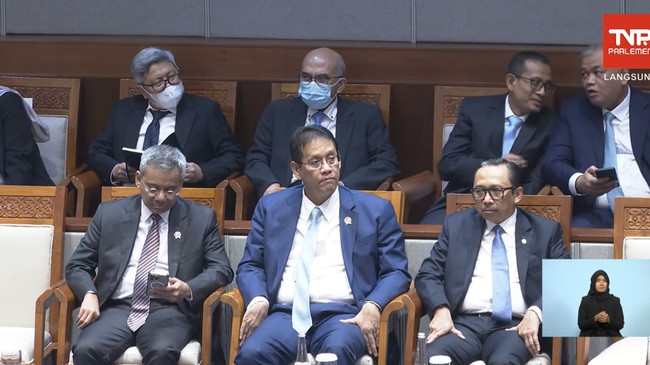
Finance Minister Purbaya Yudhi Sadewa stated that the performance of the 2026 State Budget (APBN) for Semester I remained healthy and well-maintained amidst global economic uncertainty. By the end of June 2026, state revenue recorded strong growth, supported by increased tax receipts, customs and excise duties, and non-tax state revenue (PNBP). “Overall, the Semester I achievements show that the momentum of state revenue is on a positive track,” Purbaya said during the Semester I Report meeting at the Budget Committee of the House of Representatives in Jakarta on Tuesday (7/7/2026). State expenditure for Semester I reached Rp1,656.0 trillion, or 43.1% of the APBN ceiling. Tax revenue in Semester I 2026 reached Rp1,035.7 trillion, a 24.6% increase compared to the same period last year, which was Rp831.3 trillion, although this is only 43.9% of the APBN target. Purbaya noted that this strong tax performance occurred across all tax types, from Income Tax to Value Added Tax. “This growth reflects a combination of maintained domestic economic conditions, the increasingly effective implementation of the Coretax system, and strengthened tax intensification and extensification measures,” Purbaya said. By the end of the year, state expenditure is estimated to reach Rp3,942.4 trillion, or 102.6% of the ceiling, indicating that government spending needs may potentially exceed the initial budget allocation. On the spending side, Purbaya explained that central government expenditure for Semester I was realised at Rp1,298.6 trillion, an increase of 29.4% compared to the same period last year. This spending was focused on supporting various national priority programmes, such as the implementation of the Free Nutritious Meals programme, distribution of social assistance including health insurance contribution assistance for the underprivileged, the Sembako Card, the Family Hope Programme, the Indonesia Smart College Card, and the payment of civil servant salaries including holiday bonuses and the 13th-month salary. “The increase in central government spending realisation in 2026 serves as a catalyst to support economic growth in the first half of 2026,” he said. Meanwhile, transfers to regions reached Rp357.4 trillion, or 51.6% of the budget ceiling, marking the highest realisation in the last five years. Consequently, Purbaya noted that the Semester I 2026 deficit amounted to Rp196.5 trillion, or 0.76% of GDP. “The APBN deficit is maintained within safe limits. If we use the same method, six months at 0.7% means a full-year deficit of 1.52%. They will still say the budget is in bad shape. This is the actual figure,” he said. For the full year, Purbaya estimates the APBN deficit will reach 2.85% of GDP, or Rp734.3 trillion. “The deficit outlook is Rp734.3 trillion, a percentage of 2.85% of GDP. I am confident we can push this deficit lower,” Purbaya stated. This deficit outlook considers state revenue forecast to reach Rp3,208.1 trillion, equivalent to 101.7% of the 2026 APBN target, and state expenditure of Rp3,942.4 trillion, or 102.6% of the target. “The role of the APBN is as a shock absorber when oil prices are high. We did not raise subsidised fuel prices; for the government, that is good for maintaining stability,” he explained.