
Purbaya: Whoosh Debt Restructuring Scheme Finalised, Announcement Imminent
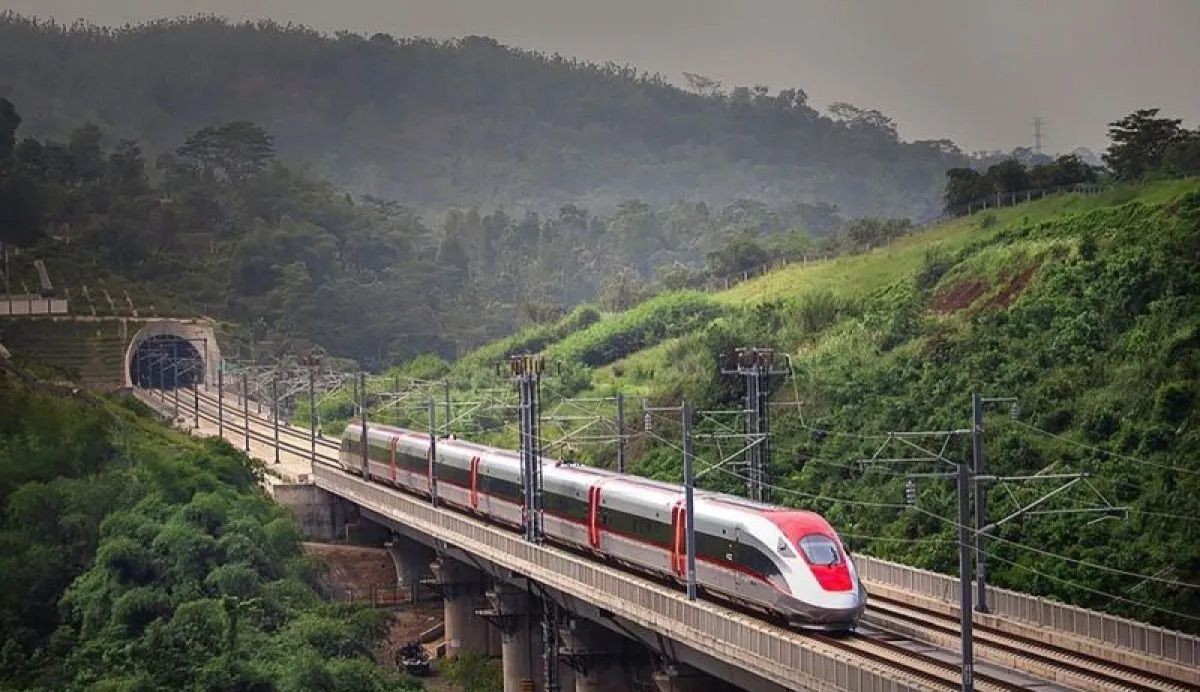
Finance Minister Purbaya Yudhi Sadewa has assured that the debt restructuring process for the Jakarta-Bandung High-Speed Rail (Whoosh) project has been finalised. The results will be officially announced in the near future alongside Coordinating Minister for Infrastructure and Regional Development Agus Harimurti Yudhoyono.
“It’s done; we just need to announce it,” Purbaya stated in Jakarta on Wednesday (22/4).
The Finance Minister revealed that he had communicated with Chinese Finance Minister Lan Fo’an regarding the decision. He emphasised that Indonesia remains committed to upholding its commitments and credibility in resolving the Whoosh debt.
The Whoosh high-speed rail is being developed by PT Kereta Cepat Indonesia China (KCIC), a joint venture between an Indonesian state-owned enterprise consortium through PT Pilar Sinergi BUMN Indonesia (PSBI) and a Chinese railway company consortium through Beijing Yawan HSR Co. Ltd.
“I conveyed that the decision has been made and is just awaiting announcement. So, the Chinese side need not worry. Indonesia never deviates or breaks promises. That’s the credibility we maintain on the international stage,” the Finance Minister said.
Regarding the potential involvement of Chinese authorities in the official announcement of the Whoosh debt restructuring, Purbaya described it as optional. According to him, as investors, China also shares the project’s risks, including losses, making the positions of both parties equal in the partnership.
“It could happen, or it might not (a joint announcement with China). We’ll decide later. But it’s equal. When we incur losses, they do too. So, we’re both suffering a bit,” Purbaya said.
Furthermore, he highlighted weaknesses in oversight of several major infrastructure projects in the country, including Whoosh and the Jakarta, Bogor, Depok, Bekasi Light Rail Transit (LRT Jabodebek).
The Finance Minister assessed that these projects are fundamentally sound, but a lack of supervision has led to various issues, including cost overruns.
“There was a cost overrun of around Rp100 trillion (for the Whoosh project),” he revealed.
In the context of the restructuring, the government also plans to transfer the management of PT Kereta Cepat Indonesia China (KCIC) to the Finance Ministry. However, Purbaya stressed that the details of the scheme will be officially announced by the government.
“What’s clear is that it has been decided, but it’s not yet time to announce it,” he said.
The project, initiated in 2015 and construction starting in 2016, has an investment value of approximately US$7.2 billion. Throughout its course, the project faced various challenges, particularly in the early construction phase, such as delays in land acquisition and unclear cross-agency project management.
Purbaya explained that in the early stages of the Jakarta-Bandung high-speed rail project, weak inter-agency coordination was a major obstacle. This situation caused confusion for the project implementers in making decisions, with no clear party responsible for project control, resulting in slow progress.
He recounted that the situation had been directly conveyed by the project leaders from the operator side. At that time, project progress was deemed very minimal, including land acquisition which, over one to two years, only reached about four kilometres.
Upon investigation, there was no clarity on the entity handling the project comprehensively. Inter-agency coordination was ineffective, with implementers frequently directed to shift between state-owned enterprises and relevant ministries without concrete solutions.
“At that time, we straightened it out and pulled the coordination to make it clearer, though the improvements are not yet fully optimal,” Purbaya said.
According to him, this experience serves as an important lesson for the government in handling large-scale projects. He stressed that in the future, the oversight and coordination system must be strengthened so that project implementers no longer face similar confusion. With better supervision, it is hoped that project implementation can proceed more effectively, in a coordinated manner, and avoid the same obstacles in the future.
“In the future, it shouldn’t be like that. For large projects, they must be properly supervised so that those running the project aren’t confused,” he concluded.