
Purbaya Showcases Indonesia's Economic Resilience to Chinese Students
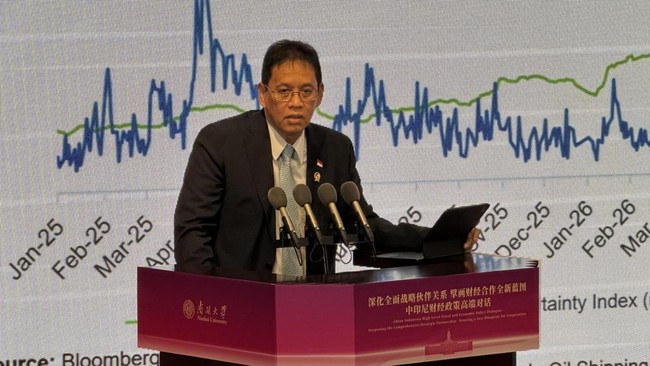
Indonesian Finance Minister Purbaya Yudhi Sadewa dissected the strength and resilience of the Indonesian economy in a scientific address during a public lecture before the academic community of Nankai University in Tianjin, China, last week (19/6/2026).
In front of Nankai University President Chen Yulu, Executive Vice President Chen Jun, Vice President Sheng Bin, Professor Xingmin Li, and hundreds of students, Purbaya asserted that Indonesia’s economic growth engine is currently in prime condition, underpinned by very healthy, prudent, and well-maintained fiscal management, with a budget deficit consistently below the statutory mandate of 3%.
Purbaya explained that amidst a stabilising global market situation, with easing volatility indicators and improving risk sentiment, Indonesia’s domestic economy has stood out prominently. This is evidenced by the realisation of economic growth in Quarter I-2026, which reached 5.61% year-on-year. This figure places Indonesia’s performance above the average growth of G20 countries and the ASEAN region.
This impressive performance is supported by well-maintained domestic price stability. As of May 2026, the inflation rate was recorded at a very manageable level of 3.08%. The combination of strong growth and controlled inflation further thickens global market confidence in the credibility of Indonesia’s macroeconomic management.
“Indonesia continues to stand out with Q1-2026 GDP growth of 5.61% yoy, outperforming many G20 and ASEAN economies. At the same time, we maintain price stability with May 2026 inflation at 3.08%. These developments prove that Indonesia entered this period with strong growth, controlled inflation, and credible policy resilience,” said Purbaya.
Furthermore, the Finance Minister explained that Indonesia is in a highly advantageous position to face the risks of global energy disruptions. Based on risk analysis, Indonesia’s position is in the low-exposure quadrant with strong buffers. The global energy resilience score assessment even places Indonesia at 77%, above China which recorded a score of 76% and only slightly below South Africa (79%). This resilience is inseparable from a healthy and prudent fiscal policy mix.
The deficit, strictly maintained below 3%, provides adequate space for the State Budget (APBN) to function optimally as a shock absorber in dampening external turmoil without sacrificing macro stability.
Purbaya stressed that all key indicators show Indonesia’s economic growth engine is increasingly powerful and moving inclusively. This dynamism is reflected in the Manufacturing Purchasing Managers’ Index (PMI) at an expansionary level of 50.0, economic liquidity growth (M0) of 14.8% yoy, and banking credit growth surging to 11.5% yoy.
In addition, according to him, Indonesia’s external position is strengthened by a trade balance surplus that has persisted for 72 consecutive months, accompanied by ample foreign exchange reserves of USD 144.9 billion (equivalent to 5.6 months of imports and government external debt payments).
Most crucially, this solid economic growth is directly translated into real improvements in the welfare of the broader community through labour market improvements. The creation of new jobs for approximately 1.9 million people successfully reduced the Open Unemployment Rate (TPT), bringing it down to 4.68% in 2026. On the other hand, the effectiveness of social protection programmes has consistently lowered the poverty rate, from 8.57% in September 2024 to 8.25% in September 2025.
Purbaya explained that, transitioning from new growth engines to the implementation stage, Indonesia now has eight clusters of national priority work programmes that will translate development strategies into tangible results. “These priorities encompass the foundations of national resilience: food sovereignty, energy and water independence, education, health, as well as infrastructure, housing, and disaster resilience,” the Finance Minister clarified.
At the same time, Purbaya said the government is accelerating structural transformation through downstreaming and industrialisation, strengthening the people’s economy and rural development, and deepening poverty alleviation through integrated social assistance and employment programmes. These programmes will be reinforced by the defence and security sector, law enforcement, governance, digitalisation, and economic diplomacy, to ensure that national development is not only growth-oriented but also inclusive, resilient, and well-coordinated.
“This proves that Indonesia’s economic growth is not only robust at the macro level, but is also tangibly transforming into job availability, reduced poverty rates, and broader and more equitable community welfare,” he asserted.
On this occasion, he also expressed gratitude for the opportunity to share Indonesia’s economic policy and fiscal management perspectives at Nankai University. “I hope this dialogue strengthens academic exchange, deepens mutual understanding, and further enhances the friendship between Indonesia and China,” the Finance Minister said.
Source: jawawa.id (https://jawawa.id/newsitem/purbaya-showcases-indonesias-economic-resilience-to-chinese-students-1782093067)
Originally published by CNBC Indonesia (https://www.cnbcindonesia.com/news/20260622074403-4-744456/purbaya-pamer-ketahanan-ekonomi-ri-depan-mahasiswa-china), translated from Indonesian