
Purbaya Presented with Cargo Cost Complaints, Now Exceeding Passenger Tickets!
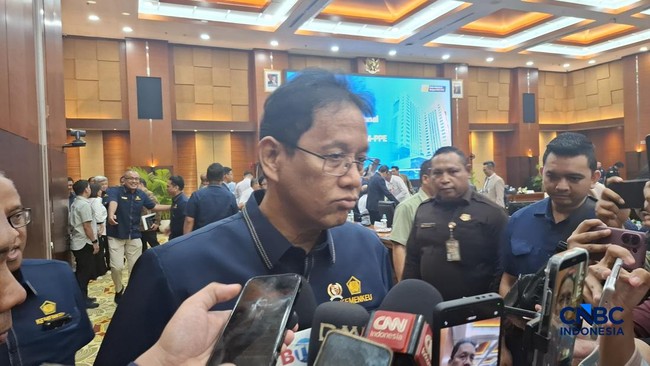
Jakarta, CNBC Indonesia - Finance Minister Purbaya Yudhi Sadewa again chaired a Debottlenecking session on Wednesday (26/8/2026). In this session, Purbaya heard directly complaints from airline and logistics companies. Representatives from the Indonesian Express, Postal and Logistics Service Companies Association (Asperindo) and the Indonesian Air Carriers Association (INACA) were also present.
During the session, Asperindo complained about the addition of new surcharges for Cargo and Postal Security Inspection Services (JASPER/JASTER) and Cargo Handling Charge (SGHA).
Asperindo Chairman Budiyanto Darmastono said express or logistics services are complaining about the additional JASPER/JASTER and SGHA charges.
“Our main problem is that cargo costs, which are now a burden on shipping costs, are quite large. Besides freight tariff costs, there are also delivery costs, and these delivery costs are numerous,” Budiyanto said in his presentation at the Debottlenecking Session on Wednesday (26/8/2026).
Budiyanto detailed that in delivery costs, besides freight tariffs, there are also additional charges such as freight tariff administration fees, fuel surcharge, regulated agent (RA) fees, warehouse fees, airport contribution, terminal handling service, cargo service, handheld terminal fee, and storage warehouse rental. Now they face additional charges, namely JASPER/JASTER and SGHA.
“Each region also has different delivery cost amounts, and if there is an airport that does not yet have a regulated agent (RA) or goods inspection, JASPER/JASTER and SGHA will be imposed,” Budiyanto explained.
His party simulated that additional cost components outside freight tariffs can reach around Rp8,117 per kg.
“The total cost of sending goods, excluding the ticket cost for goods, is Rp8,117 per kg. That is what is happening. We analyse here that the cost of shipping goods is far more expensive than passenger ticket costs,” he said.
Asperindo explained that the economic impact arising from layered additional costs directly affects the increase in shipping costs and disrupts the price feasibility of inter-island delivery.
“This increase affects e-commerce businesses, MSMEs, retail, manufacturing, food, fisheries, pharmaceuticals, medical devices, especially for distribution to archipelagic regions and underdeveloped, frontier, and outermost (3T) areas,” he explained.
On the basis of these complaints, Purbaya asked the Ministry of Transportation, which has authority at airports, to establish regulations so that logistics services are not burdened with additional costs that could be onerous.
“We hope the Ministry of Transportation can accelerate the process of drafting a Minister of Transportation Regulation, so that airport services can be clearer, so that logistics services are not burdened with excessive costs,” Purbaya said.
Purbaya explained that this handling is quite important to control logistics costs so they are not too expensive, especially for inter-island delivery to regions, particularly 3T areas.
“So this should be important because it is one of the processes to control logistics costs, especially since we have many inter-island routes. Otherwise, inter-island goods transport will become increasingly expensive,” Purbaya said.
Purbaya added that the resolution is also being carried out to curb the quite high increase in logistics costs.
“Especially if it is not controlled later. Usually if one cost rises and is not controlled, others will follow, so logistics costs become increasingly expensive. So we are trying to control logistics costs with appropriate policies so that the flow of goods is better, so that inflation can also be controlled,” Purbaya concluded.