
Purbaya Insists New Excise Layer for Illegal Cigarettes Must Be Introduced
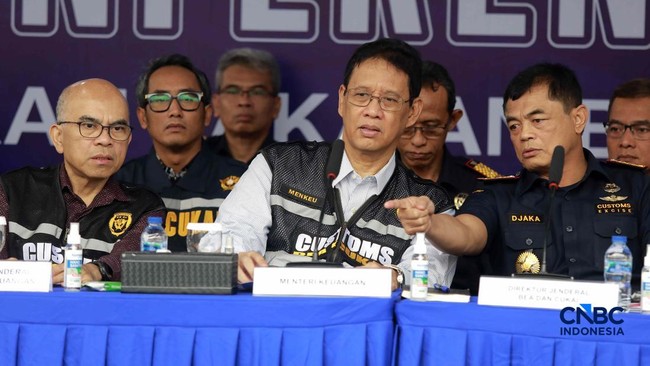
Finance Minister Purbaya Yudhi Sadewa is insisting on establishing a new tobacco excise (CHT) layer aimed at drawing illegal cigarette producers into the legal fold. He confirmed that an in-depth study will be conducted before submitting the proposal for the new cigarette excise layer to the House of Representatives (DPR), in line with the suggestions of council members. According to him, the Ministry of Finance has not yet held a consultation meeting with the DPR regarding the establishment of the new cigarette excise layer, as the study involving all stakeholders is still ongoing. “We haven’t gone to the DPR yet. So if we are told to study it, we will certainly study it,” Purbaya said when met at the Tanjung Priok Port area in Jakarta on Tuesday (23/6/2026). Nevertheless, Purbaya stressed that this new layer is needed to accommodate small cigarette producers who have been operating illegally because they have not yet entered the domestic excise system. “Most of them are illegal producers. We must find a way to give them room to become legal,” he said. If the government does not provide space for illegal cigarette producers to enter the legal business system, he believes an injustice will arise, especially if the government immediately eradicates their businesses. “If we want to shut down all illegal operations now, without giving them the opportunity to become legal, that’s not too fair for them,” Purbaya asserted. Purbaya said the policy of forming this new cigarette excise layer will certainly not be perfect immediately. However, he believes the new CHT structure will effectively combat the circulation of illegal cigarettes. “Even if it is not perfect later, it will definitely be better than the current system, where too many illegal cigarettes are circulating,” Purbaya stated. As is known, DPR members have insisted that Purbaya first study the proposal to add an excise layer to accommodate illegal cigarette producers in a mature and in-depth manner, involving the participation of various stakeholders. This is particularly because excise tariff policy must be formulated in a balanced way between the interests of state revenue and controlling public consumption. “It is not solely about pursuing state revenue, but also needs to consider its impact on consumption, health, and workforce sustainability. Therefore, this proposal must be able to maintain that balance,” said Commission XI DPR member from the Golkar faction, Puteri Anetta Komarudin, via a written statement on Monday (22/6/2026). The DPR also considers that this proposal could even add complexity to supervision, so it is necessary to ascertain the technical readiness of the Directorate General of Customs and Excise (DJBC) to conduct supervision and enforcement. “Of course, this proposal must be designed carefully so that its impact on consumption control and state revenue can reach an optimal middle ground,” Puteri said. Meanwhile, Commission XI member from the PDI Perjuangan faction, Said Abdullah, argued that the implementation of a new cigarette layer by Purbaya is actually needed by small and medium-scale manufacturers, by improving the Group III CHT structure through an affirmative policy. As is known, in the current CHT structure, layers up to Group III only exist for hand-rolled kretek cigarettes (SKT) and hand-rolled white cigarettes (SPT). Meanwhile, for machine-rolled kretek cigarettes (SKM) and machine-rolled white cigarettes (SPM), the layers only go up to Group II. “If the excise tariff groups are too simple, especially in Group III, it will make things difficult for small and medium-scale cigarette factory producers,” Said stressed. Said considers that a Group III excise tariff made with an affirmative policy is needed, especially to accommodate small and medium-scale cigarette manufacturers who also have the potential to contribute excise tariffs and employment. He said that in Madura, for example, the tobacco products industry is even capable of directly employing more than 186,000 people, not including the number of indirect workers and the economic impact in downstream areas. “With that affirmative policy, Group III cigarette manufacturers with various product types and production volumes can be legally covered by excise tariffs. The abundance of cigarettes with illegal excise stamps is because they cannot meet the Group III cigarette excise tariff,” Said asserted. Said also assessed that the current Group III tariff layer still burdens new cigarette producers, whose average age is under 20 years and who do not yet have a strong market segment. For producers at that level, the Group III excise tariff is still considered expensive and not commensurate with their business calculations. As a result, they instead choose to use fake excise stamps and collude with excise officers. “If they are given an affirmative excise tariff, for example, given an excise tariff incentive of 300 rupiah specifically for manufacturers under 20 years old, this policy will encourage them to be covered by legal excise, excise revenue will increase, and their business climate can operate without being chased by excise officers,” Said said. Based on input from that type of cigarette producer, Said stated that if the Group III excise tariff is given an affirmation policy, excise revenue from Group III could actually increase drastically, because having many excise tariff layers will not necessarily reduce the state’s CHT revenue performance. “If tobacco product production increases, excise revenue will automatically also rise, and the number of cigarette producers will grow, because the excise tariff for Group III with an affirmation policy will not burden them. They will choose to use legal excise stamps. Supervision will be easier, and law enforcement will also become increasingly minimal,” Said explained. For Said, the Ministry of Finance must be able to encourage cigarette manufacturers who use fake excise stamps to willingly use official excise stamps through an affirmation policy in Group III. He considers this policy not merely an addition.