
Purbaya Explains Why Regional Revenue Sharing Funds Are Not Fully Disbursed
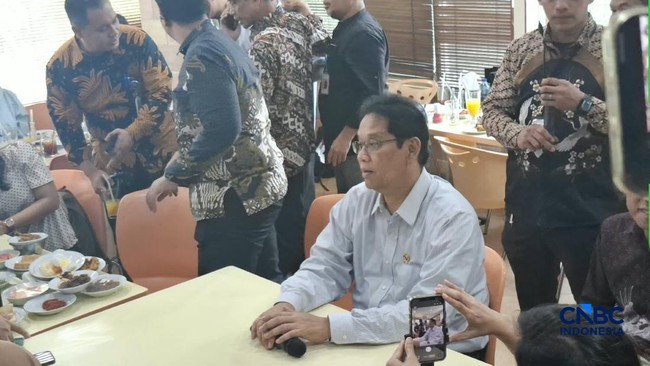
Finance Minister Purbaya Yudhi Sadewa has spoken out regarding complaints from regional governments (Pemda) stating that the Revenue Sharing Fund (DBH) from the central government has not been fully disbursed since 2024 or 2025.
Purbaya emphasised that the DBH is still being distributed to the regions. However, the amount provided is not as large as what the regional governments have requested.
“The DBH is not not being released; it is being released. But it is not as large as what was requested,” said Purbaya when met in Jakarta on Tuesday (8/9/2026).
According to Purbaya, this policy is part of the government’s efforts to ensure the overall condition of the State Budget (APBN) remains healthy.
“This is due to budgetary policies aimed at ensuring the overall condition of Indonesia’s APBN is better,” he said.
Purbaya explained that although the total Transfer to Regions (TKD) has experienced a decrease of approximately Rp200 trillion, the government has actually increased spending on various programmes whose implementation has a direct impact on the regions.
“It is like this: the money going to the regions has not decreased. The total transfer to the regions has decreased by Rp200 trillion,” said Purbaya.
“Meanwhile, we are spending additional funds from requests… through programmes spent in the regions, which has increased by Rp400 trillion,” he continued.
As such, according to Purbaya, the impact of government spending on the regions is actually greater than before. It is simply that a portion of those funds is no longer received and managed directly by the regional governments.
“So the impact is actually more significant in the regions compared to before. It is just that part of the money is no longer held for regional needs,” he explained.
DBH Can Be Used to Repay Infrastructure Loans
Purbaya also revealed a new policy currently being socialised by the government. Under this scheme, regional governments that genuinely require infrastructure development can apply for loans through PT Sarana Multi Infrastruktur (SMI).
These loans can later be repaid using a portion of the DBH received by the region.
“So, there is a new policy that I am currently socialising. If a region truly needs to build infrastructure, they can take a loan from PT SMI, which will later be repaid using part of that DBH. This ensures that the physical assets are actually built,” Purbaya stated.
He assessed that this scheme is necessary because there are still infrastructure needs in several regions that remain unaddressed.
“One of the complaints is that there is much infrastructure needed in the regions, but it is not being built. For example, there are no bridges and so on,” he said.
Purbaya cited an example of the government currently running a regional bridge construction programme involving the TNI (Indonesian National Armed Forces). This programme is intended to bridge the infrastructure gap that has existed in the regions.
“That is why the bridge programme was created. The regional bridge construction programme being built by the TNI is to cover the deficiencies that have existed all this time,” he said.
Nevertheless, Purbaya emphasised that the financing scheme through PT SMI does not mean the government will continue to increase fund allocations to the regions once the programme is running.
“But listen, this does not mean that once the programme through SMI is running and the regions are executing it, the allocations to the regions will be increased further,” he asserted.