
Purbaya Changes Strategy to Face Free Trade, Pursues 6% Economic Growth
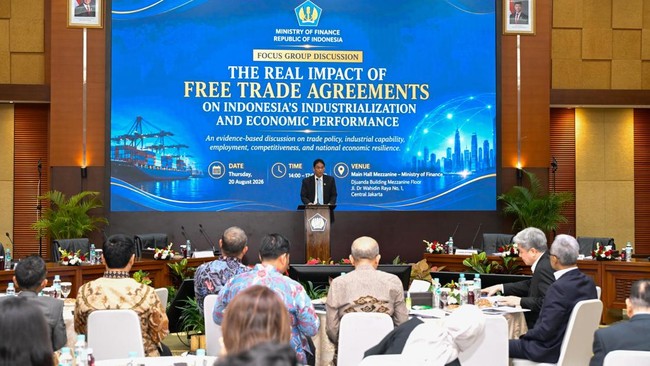
Jakarta, CNBC Indonesia - Finance Minister Purbaya Yudhi Sadewa is preparing a new approach to facing the era of free trade agreements (FTAs). Rather than only viewing the negative impacts on domestic industry, the government will map out sectors that can still be saved, supported, and developed into new engines of economic growth.
This step is part of the government’s strategy to accelerate national economic growth to at least 6% by the end of 2026.
“So next September we will change the Finance Ministry’s approach to economic potential, including free trade, so that economic growth can accelerate to at least 6% by the end of 2026,” said Purbaya while delivering a keynote speech at the seminar on Free Trade Agreements on Indonesia Industrialization and Economic Performance at the Ministry of Finance, Thursday (20/8/2026).
According to Purbaya, discussions about free trade have often focused only on the risks faced by national industry. In fact, the government needs to know which sectors are truly losing competitiveness and which sectors still have opportunities to grow.
For this reason, he asked the Ministry of Finance to conduct an in-depth analysis of the impact of FTAs on various industrial sectors.
“The analysis of which ones can still be saved, what our steps are for the last two options, what the Finance Ministry can do — that is what I need,” he said.
Purbaya explained that there are at least three possible fates for industries affected by free trade. First, industries that must ultimately be abandoned because they are no longer competitive. Second, industries that can still survive despite limited growth. Third, industries that deserve support and protection to develop again.
However, according to him, the government also needs to look at a fourth category, namely new industries that are not yet Indonesia’s main strength but have high growth prospects in the future.
One sector considered to have great potential is the data centre industry.
Purbaya believes Indonesia has the opportunity to become an investment destination for data centres in the region. However, this opportunity can only be seized if the government is able to guarantee an adequate energy supply.
According to him, energy needs will be a key factor in attracting technology and digital-based industrial investment to Indonesia.
Targeting Opportunities from Europe
In addition, Purbaya also sees great opportunities from Indonesia’s trade cooperation with the European Union, especially after the conclusion of the Indonesia-European Union Comprehensive Economic Partnership Agreement (IEU-CEPA).
He considers the trend of renewable energy use in Europe to be an opportunity for Indonesian industry to improve export competitiveness.
The textile and footwear sectors were cited as examples of industries that could potentially benefit from using green energy in their production processes.
To support this, the government is opening up opportunities to increase investment in the geothermal sector through PT Geo Dipa Energi.
“I have Geo Dipa, I can drill more geothermal wells, I invest there to provide energy to a textile industrial centre or existing textile industry, so that it can export to Europe more competitively,” said Purbaya.
Purbaya stressed that the government must not stop at the conclusion that free trade only brings threats to national industry.
According to him, FTAs should instead be utilised to identify sectors with growth potential, attract new investment, improve industrial competitiveness, and expand Indonesia’s export markets.
With this approach, the government hopes to turn the challenges of free trade into a new source of economic growth while accelerating the national industrialisation process.
Source: jawawa.id (https://jawawa.id/newsitem/purbaya-changes-strategy-to-face-free-trade-pursues-6-economic-growth-1787277089)
Originally published by CNBC Indonesia (https://www.cnbcindonesia.com/news/20260821071906-4-761127/purbaya-ubah-strategi-hadapi-perdagangan-bebas-kejar-ekonomi-6), translated from Indonesian