
Purbaya Aims for Robust Economic Growth Without Heavy Debt, Outlines Strategy
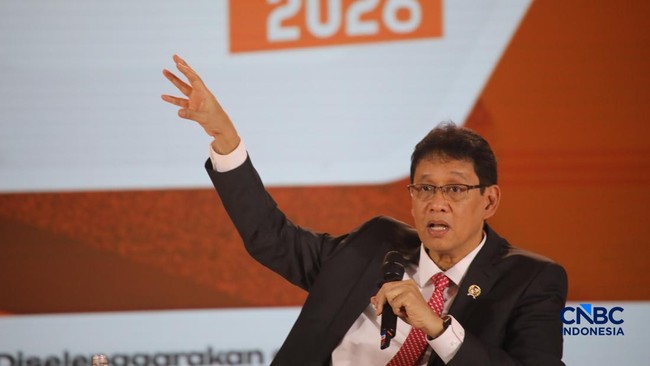
Jakarta, CNBC Indonesia – Finance Minister Purbaya Yudhi Sadewa has set a target for Indonesia’s economy to grow rapidly without relying heavily on borrowing.
He stated this approach proved effective during President Susilo Bambang Yudhoyono’s (SBY) administration, whereas under President Joko Widodo, GDP growth slowed due to debt burdens.
“If you look at the SBY era, the debt-to-GDP ratio consistently fell while growth accelerated to 6%. Under President Jokowi, the debt-to-GDP ratio rose steadily, yet growth remained sluggish,” Purbaya said at the Coordinating Ministry for Economic Affairs office in Jakarta on Tuesday (26 May 2026).
According to Purbaya, the rapid economic growth during SBY’s time without significant debt accumulation was due to a dominant private sector, marked by robust credit growth fueled by ample economic liquidity.
“That was one of the secrets behind the private sector’s strong growth during SBY’s era, with credit expanding at double-digit rates averaging over 20% for a decade. That is the key to ensuring private sector growth,” Purbaya emphasised.
In contrast, during Jokowi’s term, private sector activity failed to grow rapidly, with government-led initiatives driving the economy, thereby increasing debt levels, he noted.
“Private sector growth was hindered by various economic factors at the time. Now, we must ensure both sectors work in tandem,” Purbaya said.
Drawing from these two administrations, Purbaya believes Indonesia can achieve higher-quality economic growth by fostering private sector momentum, optimally supported by government efforts. This would reduce the need for excessive borrowing to accelerate economic activity.
“We will ensure the private sector contributes more effectively than in previous years. We will push both economic growth engines to operate. I will consider how to enhance private sector contributions,” Purbaya added.
The Directorate General of Debt Management and Financial Risk (DJPPR) at the Ministry of Finance announced that government debt stood at Rp9,920.42 trillion as of end-March 2026.
This equates to 40.75% of gross domestic product (GDP), well below the statutory safe limit of 60% of GDP.
However, the debt increased by approximately Rp282.52 trillion compared to the end-December 2025 figure of Rp9,637.9 trillion, which had been 40.46% of GDP.
“The government manages debt prudently and systematically to achieve an optimal debt portfolio and support domestic financial market development,” according to a DJPPR report dated 8 May 2026.
Government debt composition as of 31 March 2026, totalling Rp9,920.42 trillion, was predominantly from Government Securities (SBN) issuance at Rp8,652.89 trillion — an increase of Rp265.66 trillion from the end-2025 figure of Rp9,637.9 trillion.
Loans accounted for Rp1,267.52 trillion, rising by Rp16.85 trillion over the past three months from the year-end 2025 figure of Rp1,250.67 trillion.