
Purbalingga adjusts four draft regional regulations to align with latest laws
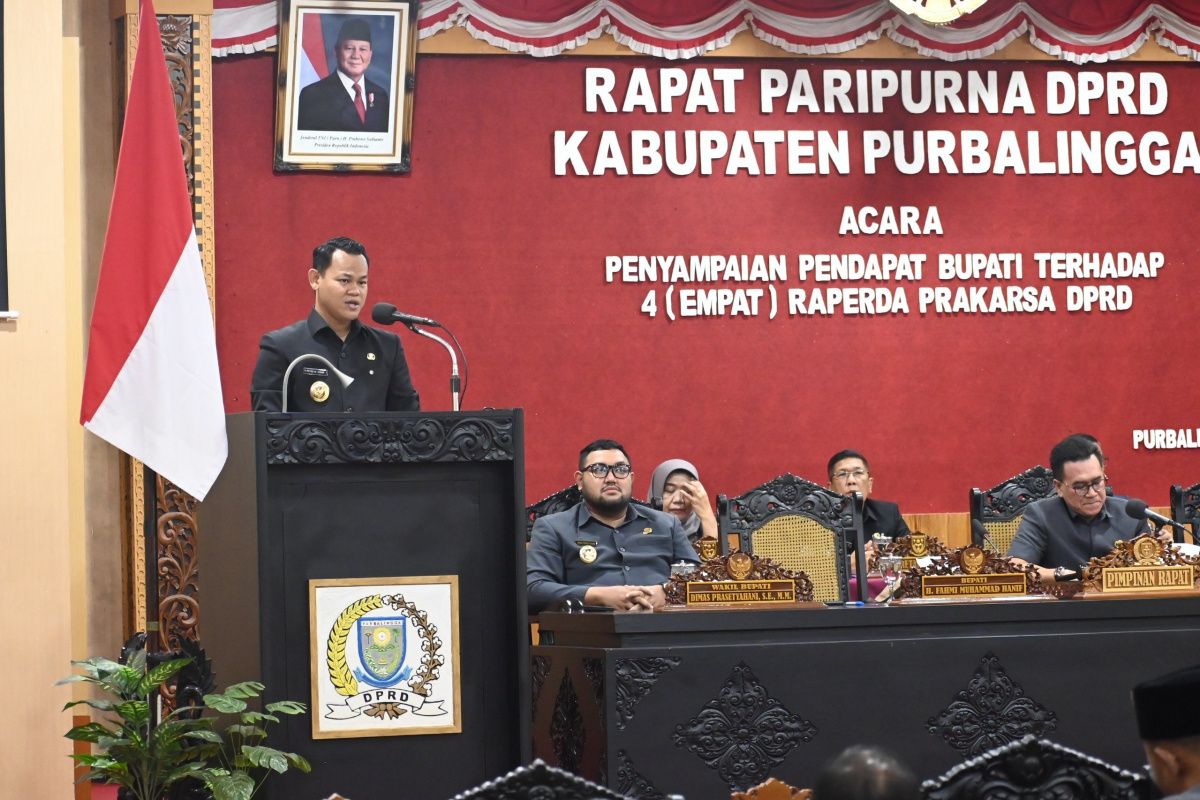
Purbalingga, Central Java — The Purbalingga Regency Government in Central Java supports four draft regional regulations (raperda) initiated by the local DPRD, requesting that several components be adjusted to align with recent legislative developments and regional requirements.
“In principle, the local government supports and appreciates these proposed draft regulations,” stated the Regent of Purbalingga, Fahmi Muhammad Hanif, during the Purbalingga DPRD Plenary Session on Monday.
The four DPRD-initiated draft regulations include the Draft Regulation on the Control and Supervision of Alcoholic Beverages, the Draft Regulation on the Arrangement of Shopping Centres and Supermarkets, the Draft Regulation on Labour Implementation, and the Draft Regulation on the Control of Passive Telecommunications Infrastructure.
Fahking stated that material adjustments are necessary to ensure that the established regulations not only comply with the hierarchy of laws and regulations but are also capable of addressing regional needs by accommodating local content.
Regarding the Draft Regulation on the Control and Supervision of Alcoholic Beverages, he noted that regulation is necessary to maintain public health, order, and tranquillity. He requested that the criminal provisions within the draft be aligned with Law Number 1 of 2023 concerning the Criminal Code and Law Number 1 of 2026 regarding Criminal Adjustment.
Meanwhile, the Draft Regulation on the Arrangement of Shopping Centres and Supermarkets needs to be synchronised with developments in trade regulations, including strengthening provisions regarding the considerations for establishing shopping centres and supermarkets.
“For the Draft Regulation on Labour Implementation, we request adjustments to the latest regulations, including Ministry of Manpower Regulation (Permenaker) Number 18 of 2024 concerning Domestic Manpower Placement,” he said. These adjustments are required because some materials still refer to Permenaker Number 39 of 2016 concerning Manpower Placement, which has been revoked and is no longer in effect.
As for the Draft Regulation on the Control of Passive Telecommunications Infrastructure, Fahmi noted that it is important to provide legal certainty while supporting spatial planning, the environment, and regional aesthetics. He also highlighted that certain types of passive infrastructure, such as fibre optic networks, have not yet been regulated, necessitating clarity for the local government, business actors, and the public.
According to him, such regulation could also serve as a basis for the local government to explore potential local original revenue (PAD) through utility network facilities provided by the local government, including fibre optic networks as an object for regional levies.
Fahmi added that the four draft regulations will subsequently undergo in-depth discussions with the DPRD, including clause-by-clause substantive reviews and manuscript formatting.