
Pupuk Indonesia's Profit Soars Amid Subsidised Price Cuts, Here's Why
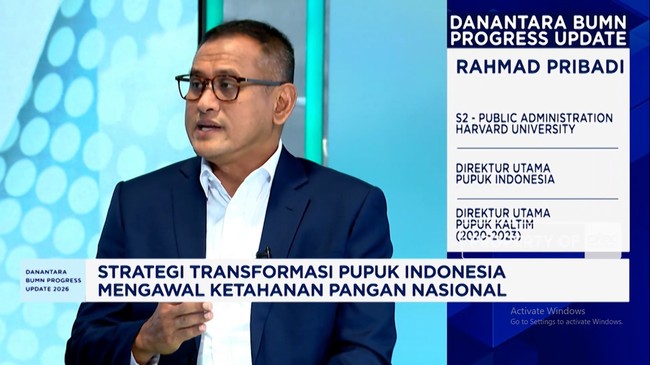
Jakarta, CNBC Indonesia - Amid the policy of reducing subsidised fertiliser prices, PT Pupuk Indonesia (Persero) has managed to improve its financial performance. What are the reasons?
President Director of Pupuk Indonesia, Rahmad Pribadi, explained that the company previously implemented a cost-plus scheme, but it was not sufficient to improve efficiency. Through the marked-to-market mechanism, Pupuk Indonesia is required to operate more efficiently in order to provide fertiliser at competitive prices.
“I want to explain first why cost plus became marked to market. Because marked to market is a rationality of how we run a business. The government today, as the shareholder of Pupuk Indonesia, and also the farmers as recipients of subsidised fertiliser, must be convinced that what we deliver to the government as shareholder and as customer can obtain fertiliser of good quality at a good price,” said Rahmad on Squawk Box CNBC Indonesia, Monday (24/8/2026).
He said the efficiency gained from the scheme change is not only visible for Pupuk Indonesia, but also felt by farmers. This can be seen from the farmers’ terms of trade.
“It means farmers’ profits increase, don’t they? They do. How? Because with that efficiency, we return it to farmers in the form of a 20% reduction in retail prices,” he continued.
According to Rahmad, this effort is a breakthrough by the government because farmers can obtain cheaper fertiliser while the industry remains healthy, making the national food sector stronger. Fundamentally, the stability of the fertiliser industry is key to domestic food security.
From the company’s perspective, the impact of the scheme change is visible in the growth of Pupuk Indonesia’s net profit after tax, which is higher than the increase in revenue. This reflects that the improvement in profitability comes not only from sales growth, but also from efficiency generated through changes in the business management system. This transformation is one of the factors making Pupuk Indonesia stronger in financial performance.
In addition, fertiliser export opportunities remain wide open for Pupuk Indonesia. Potential export markets for the company include Australia, the Philippines, Thailand, and India.
For information, Pupuk Indonesia is targeting the distribution of subsidised fertiliser allocation of 9.8 million tonnes for farmers and fish farmers, which is expected to be fully absorbed. To date, fertiliser distribution has reached 5.7 million tonnes. Thanks to this, Pupuk Indonesia recorded a net profit of Rp 8.5 trillion for the first half of 2026.
Ultimately, Rahmad emphasised that the company’s transformation will continue with the aim of not only strengthening Pupuk Indonesia’s performance, but also ensuring the fertiliser industry remains strong to support the needs of Indonesian farmers now and in the future.