
Pupuk Indonesia Targets 45% Emissions Cut by 2035 and Net Zero by 2050
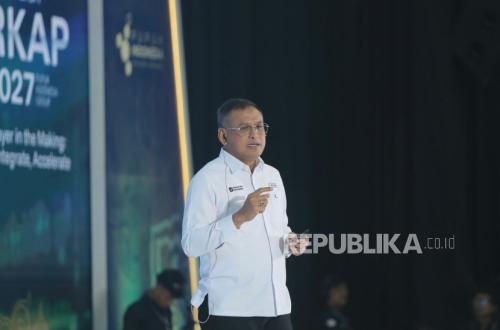
ANTALYA – State-owned fertiliser producer PT Pupuk Indonesia (Persero) is targeting a 45% reduction in carbon emissions by 2035 and net zero emissions by 2050. The company is preparing several strategies, from improving energy efficiency and utilising carbon dioxide (CO₂) to developing low-carbon ammonia.
Pupuk Indonesia President Director Rahmad Pribadi said the fertiliser industry faced the challenge of meeting food needs while reducing greenhouse gas emissions. Nitrogen fertiliser production, which uses ammonia, is vital to the global food system, but the process also generates carbon emissions.
“More than half of global food production is achieved with the help of nitrogen. However, we also understand that nitrogen, or ammonia and urea, contributes around 1–2% of emissions,” Rahmad said at a discussion at the Indonesia Pavilion during the 31st UN Climate Change Conference (COP31) in Antalya, Türkiye, on Monday (9 November 2026).
Rahmad said Pupuk Indonesia currently produces around 14.8 million tonnes of fertiliser, comprising seven million tonnes of ammonia and 9.4 million tonnes of nitrogen fertiliser. With this capacity, the company is one of the largest nitrogen-based fertiliser producers in the Asia-Pacific, Middle East and North Africa.
Global demand for ammonia is also expected to continue rising. By 2050, it is projected to reach 390 million tonnes. This presents both a challenge and an opportunity for Pupuk Indonesia to develop a more environmentally friendly business.
“For us, therefore, going green is not a cost. It is an opportunity as well as a strategy,” he said.
Rahmad said Pupuk Indonesia had prepared a phased emissions-reduction roadmap. The company says its emissions are already 12% lower than under a business-as-usual (BAU) scenario.
At the initial stage, the company will prioritise measures it considers the most economical, such as energy efficiency, heat integration in production processes and switching fuels. Pupuk Indonesia will then develop technologies to turn carbon dioxide into products with economic value.
One strategy is to establish a circular economy by using CO₂ generated during production. In the first phase, the carbon dioxide will be processed into liquid CO₂ and dry ice.
The next phase will involve developing production of soda ash and ammonium chloride. Pupuk Indonesia aims to use around 350,000 tonnes of CO₂ to produce approximately 600,000 tonnes each of soda ash and ammonium chloride.
Rahmad said the output could reduce Indonesia’s reliance on imports of both products. The planned soda ash production would be equivalent to around 50% of national import requirements, while ammonium chloride production is targeted to meet all of Indonesia’s current import needs.
“We are turning carbon dioxide that would otherwise be released into the atmosphere into more useful products, namely ammonium chloride and soda ash,” he said.
In addition to carbon utilisation, Pupuk Indonesia is developing carbon capture, utilisation and storage (CCUS) technology. It is intended to process emissions that cannot be used through the circular-economy scheme.
Rahmad said the company was also working with several Taiwanese companies and industrial partners to develop soda ash production technology using CO₂ and caustic soda. The technology has reportedly passed initial testing and will be developed to capture emissions from coal-fired power plants at the company’s facilities.
Source: jawawa.id (https://jawawa.id/newsitem/pupuk-indonesia-targets-45-emissions-cut-by-2035-and-net-zero-by-2050-1794275453)
Originally published by Republika (https://esgnow.republika.co.id/berita/to9gc6490/pupuk-indonesia-siapkan-penurunan-emisi-45-persen-pada-2035-bidik-nol-emisi-2050), translated from Indonesian