
Pupuk Indonesia Supports Agricultural Renewal by Recognising Innovation
National food security depends not only on the availability and affordability of fertiliser, but also on creating a strong and innovative agricultural ecosystem to ensure the sector’s sustainability.
Jakarta (ANTARA) – State-owned enterprise PT Pupuk Indonesia (Persero) is promoting agricultural renewal to help build Indonesia’s future. It says young people’s involvement in the sector needs to be supported by promising business opportunities, including by processing local agricultural commodities into higher-value products.
“National food security depends not only on the availability and affordability of fertiliser, but also on creating a strong and innovative agricultural ecosystem to ensure the sector’s sustainability,” Pupuk Indonesia secretary Yehezkiel Adiperwira said in a statement in Jakarta on Thursday.
In conjunction with Youth Pledge Day on 28 October 2026, Pupuk Indonesia is encouraging the agricultural sector to become a space for young people to innovate, expand business opportunities and improve community welfare, he said.
Beyond meeting national fertiliser needs, Pupuk Indonesia, as a state-owned food enterprise, continues to support the development of the agricultural ecosystem.
“We believe young people’s involvement in maximising downstream processing in farming can generate greater economic value for farmers. Farming will also be more attractive to young people if it offers promising economic prospects,” he said.
One expression of this commitment is the Svarna Bhumi Award 2026, which recognises agricultural practitioners making a tangible contribution to the sector.
Through the award, Pupuk Indonesia recognises and showcases young entrepreneurs who innovate and develop local potential, while inspiring others to do the same and contribute to the food sector.
The commitment of young people to developing the food sector is reflected in the work of Ella Rizki and Asri Saraswati. Their stories show how young entrepreneurs can draw on local potential and address issues in their communities, then take steps to create wider benefits.
Ella has developed coconut processing into export-value products, while Asri has turned village-grown spices into higher-value processed goods. Their initiatives show how young people’s enterprise can create more promising economic opportunities, particularly for those considering agriculture as a career.
Ella’s drive grew from recognising the potential of the coconut trees around her. From a family of coconut-sap farmers in Trenten village, Magelang regency, Central Java, she saw that coconuts could offer greater economic value than simply selling the harvest.
In 2015, she established the Nira Lestari Women Farmers’ Group (KWT) and began encouraging the processing of coconuts into products such as coconut sugar and virgin coconut oil. The business has since expanded to reach international markets.
For Ella, developing a business also means creating opportunities for the local community to grow together. Through KWT Nira Lestari, she has involved and trained more than 500 farmers in several regions. The initiative shows how downstream processing can broaden benefits and help improve the livelihoods of rural farmers.
“Coconuts that were once sold raw can now be made into products that reach export markets. This is one example of agricultural downstream processing that does more than turn raw produce into goods: it can also change the economic fortunes of local farmers. I hope more villages will dare to take similar steps,” Ella said.
A similar commitment is being pursued by Asri Saraswati Iskandar and her husband, Andhika Mahardika, through Agradaya. After moving from the city to the countryside in Yogyakarta, Asri developed Agradaya with a focus on empowering farmers and developing spice crops in the Menoreh Hills of Kulon Progo.
There, she saw that many farmers grew spices but had a limited role as suppliers of raw materials, while processing took place elsewhere.
Agradaya encourages farmers not only to produce spices but also to understand post-harvest processing and the quality standards required by the market.
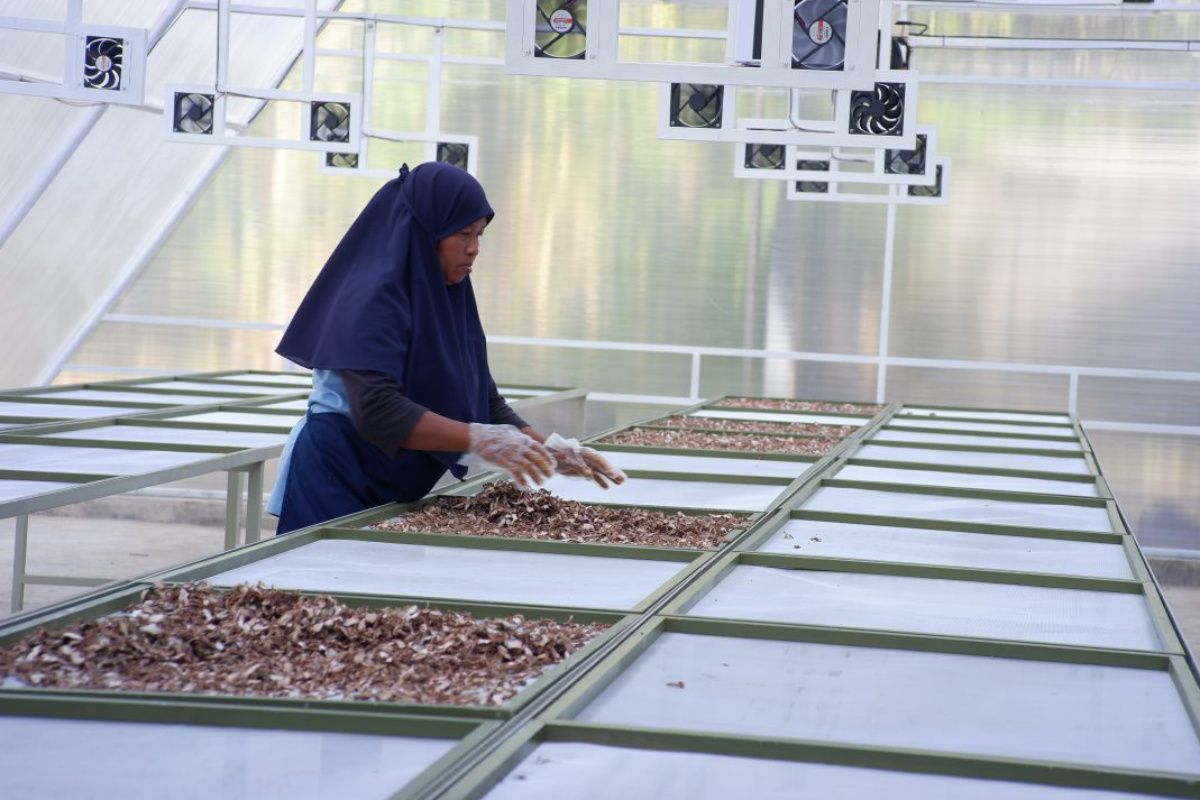
One of its innovations is a solar dryer house, which helps dry crops without relying on the weather. Agradaya now partners with more than 300 farmers and has reached international markets.
“For us, downstream processing is most effective when we do not just develop innovations in commodity processing, but also transfer knowledge so farmers can build the capacity to increase the value of their harvests, now and in the future,” Asri said.
Asri’s work shows how young people’s enthusiasm can be channelled into strengthening community capacity. Through processing and knowledge transfer, farmers are no longer merely suppliers of raw materials. That capacity can continue to grow and be passed on sustainably to the next generation.
For Pupuk Indonesia, Ella and Asri’s initiatives underline the importance of innovation and collaboration in encouraging agricultural renewal. They demonstrate how downstream processing can give farmers greater value, while knowledge transfer can develop local potential sustainably.
“We believe young people hold the key to strengthening the agricultural ecosystem. We hope more of them will have the courage to develop local potential, build businesses and share knowledge. Through sustained innovation and collaboration, young people can help farmers move up the value chain and strengthen Indonesia’s food security,” Yehezkiel Adiperwira added.
Source: jawawa.id (https://jawawa.id/newsitem/pupuk-indonesia-supports-agricultural-renewal-by-recognising-innovation-1793289251)
Originally published by Antara (Indonesian) (https://www.antaranews.com/berita/5820379/pupuk-indonesia-dukung-regenerasi-pertanian-lewat-apresiasi-inovasi), translated from Indonesian