
Pupuk Indonesia Relies on '7T' Principle to Support Food Self-Sufficiency Programme
The government continues its efforts to simplify the distribution of subsidised fertilisers to drive the food self-sufficiency programme, notably through Presidential Regulation No. 6/2025 regarding the management of subsidised fertilisers and increasing farmer access.
As an extension of the government, PT Pupuk Indonesia has transformed and committed itself to ensuring that farmers obtain fertiliser with the right quantity, right dose, right time, right place, right quality, right price, and right target (7T).
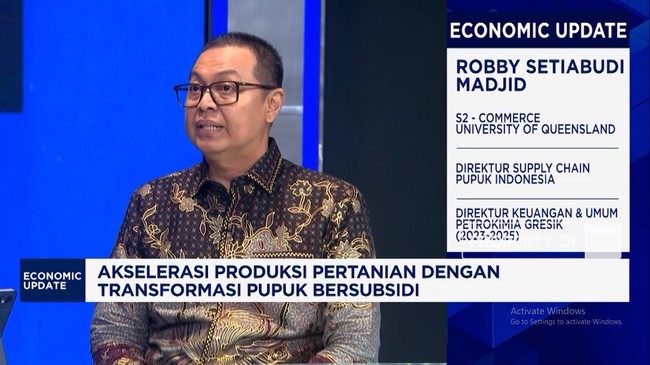
Director of Supply Chain at Pupuk Indonesia, Robby Setraguna Madjid, stated that the 7T principle is vital because precise and balanced fertilisation contributes to more than 60% of agricultural productivity.
“Therefore, through Presidential Regulation 6/2025 and Presidential Regulation 113/2025, we are responsible for distributing subsidised fertiliser up to the first delivery point across more than 26,000 locations throughout Indonesia,” he explained during an Economic Update.
According to him, the impact is highly felt by farmers, as fertilisers have been distributed and available for redemption since 1 January 2026. Furthermore, regarding availability, fertilisers are currently not stockpiled in factories but are distributed across all kiosks throughout Indonesia.
“The policy is very much in favour of farmers and fishermen, as the fisheries sector is now also receiving subsidised fertiliser,” he detailed.
This fertiliser transformation has accelerated the distribution of fertilisers available in 26,000 kiosks, with fertiliser absorption increasing by 13% (yoy) in 2025, which has resulted in an increase in corn and rice production in the range of 11%-13%. As of 28 June 2026, fertiliser distribution has reached 30% compared to last year.
“To achieve self-sufficiency in paddy and rice, many parties are contributing; we are only one of them. However, fertiliser is crucial because it is a production input factor contributing 62% to agricultural production. The policy is very appropriate; we only need to be trustworthy so that Indonesia can become a food granary in a short period of time,” he concluded.
For information, 4.8 million tonnes of Pupuk Indonesia fertiliser have already been absorbed by farmers. However, looking ahead, there are still factors to anticipate, such as weather, especially as the impact of El Niño has been felt in several countries. Moving forward, Pupuk Indonesia and agricultural stakeholders are expected to manage the effects of El Niño to ensure fertiliser absorption targets are met.
Source: jawawa.id (https://jawawa.id/newsitem/pupuk-indonesia-relies-on-7t-principle-to-support-food-self-sufficiency-programme-1782813128)
Originally published by CNBC Indonesia (https://www.cnbcindonesia.com/news/20260630154226-4-746898/dukung-program-swasembada-pangan-pupuk-indonesia-andalkan-jurus-7t), translated from Indonesian