
Pupuk Indonesia Prepares 1.9 Million Tonnes of Fertiliser for Planting Season
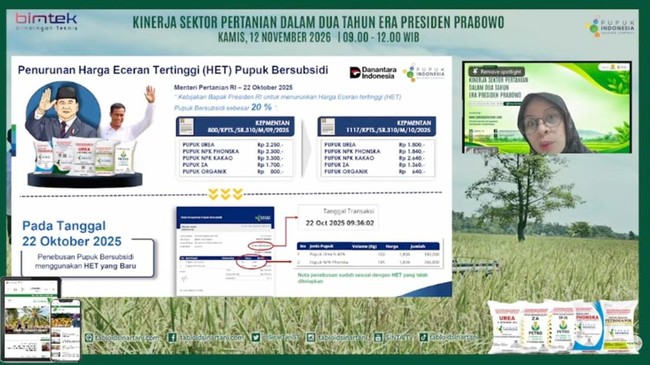
Jakarta – State-owned fertiliser company PT Pupuk Indonesia (Persero) had prepared a total of 1,936,505 tonnes of fertiliser stocks nationwide as of 10 November 2026 to meet farmers’ needs ahead of the planting season. Alongside this stock readiness, subsidised fertiliser distribution increased by 14% compared with the same period last year.
Anggy Fajar Maghfiroh, Pupuk Indonesia’s Vice President for Sales Planning and Billing for Public Service Obligations (PSO), said the situation was supported by improvements to the governance of subsidised fertiliser under President Prabowo Subianto’s administration, making distribution simpler and ensuring farmers receive the product more reliably.
“Previously, fertiliser distribution passed through several stages up to Line IV. Now, we are directly responsible for delivery to the handover point. With a simpler process, fertiliser availability at farmer level is more certain,” she said, as quoted on Thursday (12 November 2026).
Anggy said the company’s national stocks comprised 1,556,278 tonnes of subsidised fertiliser and 380,227 tonnes of non-subsidised fertiliser. Subsidised stocks included 909,600 tonnes of urea, 550,041 tonnes of NPK, 18,142 tonnes of cocoa NPK, 8,412 tonnes of SP-36, 3,906 tonnes of ZA and 66,176 tonnes of organic fertiliser.
Pupuk Indonesia’s non-subsidised stocks comprised 325,232 tonnes of urea, 20,723 tonnes of NPK and 34,273 tonnes of ZA.
“The stocks are distributed among Pupuk Indonesia’s factory warehouses and buffer warehouses in various parts of Indonesia. Based on average purchases of around 28,000 tonnes per day, subsidised stocks are expected to meet farmers’ purchase needs for the next 55 days,” Anggy said.
To ensure supplies remain available, she added, Pupuk Indonesia monitors stocks daily, including at district-level buffer warehouses. The monitoring is supported by a digital transformation programme and a Command Centre, which enables the company to track production, deliveries, vessel locations, stocks in each district and farmers’ fertiliser purchases.
Anggy said improvements to subsidised fertiliser governance and measures to make access easier for farmers had also boosted uptake. From January to 10 November 2026, distribution reached around 7,709,711 tonnes, up 14% from approximately 6,789,854 tonnes over the same period in 2025.
“The fertiliser industry has long been complex to manage because it involves many regulations issued by various ministries and agencies. Before President Prabowo’s administration, 145 regulations governed subsidised fertiliser. These rules have now been simplified through more integrated policies,” she said.
The changes are based on Presidential Regulation No. 6/2025 on the Governance of Subsidised Fertiliser and its implementing rules, including Agriculture Ministerial Regulation No. 15/2025. Under these policies, state-owned fertiliser companies are responsible for distributing subsidised fertiliser to the handover point, or recipient.
Agriculture Ministry Secretary-General Suwandi said government policies on fertiliser were benefiting farmers and national agricultural development. Problems frequently raised by farmers, including limited volumes, high prices and shortages, were now being addressed through policy improvements, he said.
He said the government had cut the ceiling retail price for subsidised fertiliser by 20% without increasing the burden on the state budget. At the same time, the volume of subsidised fertiliser had risen by as much as 700,000 tonnes.
The government also plans to build several new fertiliser plants, with five targeted to be inaugurated before 2029.
A change to the payment mechanism for raw materials—from payment after production to advance payment—has also improved efficiency in the fertiliser industry, Suwandi said.
He added that easier access to affordable fertiliser had contributed to improved agricultural performance. Productivity had risen, farmers’ welfare had improved and, ultimately, the agricultural sector had become stronger.
“Agriculture’s gross domestic product growth rose from 0.83% in 2024 to 5.74% in 2025. The Farmers’ Terms of Trade also increased from 124 to 132 over the same period,” Suwandi said.
Source: jawawa.id (https://jawawa.id/newsitem/pupuk-indonesia-prepares-1-9-million-tonnes-of-fertiliser-for-planting-season-1794484351)
Originally published by CNBC Indonesia (https://www.cnbcindonesia.com/news/20261112180244-4-784774/sambut-musim-tanam-pupuk-indonesia-siapkan-19-juta-ton-stok-pupuk), translated from Indonesian