
Public Works Ministry Targets 100 Km Travel Time at Just 2.1 Hours
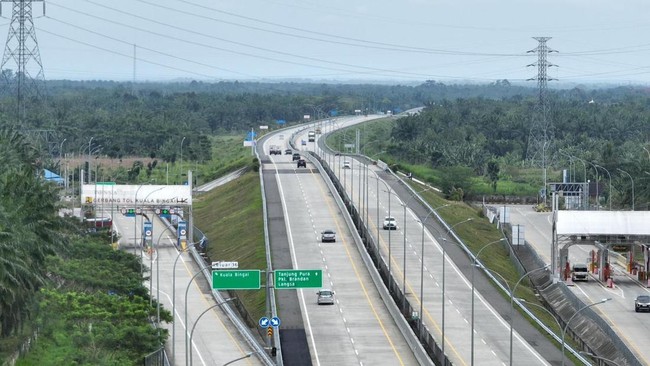
The Ministry of Public Works (PU), through its Directorate General of Highways, has affirmed that connectivity on both main and regional routes across Indonesia will continue to be improved. This is in line with the 2025-2029 National Medium-Term Development Plan (RPJMN).
Director General of Highways at the Ministry of Public Works, Roy Rizal, stated that the priority scope of work focuses on improving road connectivity on main corridors and accessibility for underdeveloped and border regions. These priority works are intended to support national economic growth and equity, underpinned by specific targets and indicators.
In this context, the government is targeting a travel time of 1.80 hours per 100 kilometres on the main corridors of the national road network. Furthermore, the target for the stable condition of national roads is set at 97%, while provincial roads are targeted at 73%, district roads at 61%, and city roads at 83.60%.
"The road accessibility index for main corridors in underdeveloped and border areas is 2.67 km per 100 square kilometres. Meanwhile, the output indicator targets for 2027 include 113 km of cumulative urban road infrastructure built and 2,353 km of cumulative toll roads in operation. The travel time and operational toll road targets are achieved through toll road construction carried out via investment and toll road support from the State Budget (APBN)," he explained during a hearing with Commission V of the House of Representatives (DPR RI) on Wednesday (1/7/2026).
Rizal said that efforts to improve the quality of provincial, district, and city roads are being implemented by the government through the Presidential Instruction (Inpres) on Regional Roads. Furthermore, the Directorate General of Highways also oversees the connectivity infrastructure programme with the strategic goal of improving the service performance of road connectivity.
This performance improvement is measured by a travel time indicator, with a 2027 target of 1.8 hours per 100 km for main transit corridors. The travel time indicator for the national road network is 2.10 hours per 100 km.
In more detail, the programme is focused on three main objectives. First, improving national road service performance through the construction and preservation of national roads, with an accessibility index target of 2.67 km per 100 square kilometres, a road infrastructure condition level of 95.53%, 113 km of urban road infrastructure built, and 80% of national roads meeting safety standards.
Second, improving toll road service performance, management, and supervision, with a target of 2,383 km of toll roads in operation by 2027.
Third, improving regional road service performance through guidance and support for regional road development, with a performance achievement target of 100% for regional road connectivity improvement, the implementation of which depends on the additional budget received by the Directorate General of Highways in the current plan year.
Rizal continued that the ministry has prepared the 2027 Government Work Plan (RKP) as the third year of the 2025-2029 RPJMN implementation, which carries the theme of accelerating quality growth through productivity, investment, and industry. The Directorate General of Highways’ contribution is directed towards supporting various priority programmes, such as providing reliable and integrated road connectivity to open access between regions, facilitate the smooth flow of goods and services, and accelerate efficient and sustainable population mobility.
The achievement of national priorities, particularly in the productivity, investment, and industry agenda, is carried out through eight National Priority Work Programme (PKPN) clusters. The PKPN is a sharpening of the government’s strategic programmes focusing on eight main clusters to accelerate economic growth, productivity, investment, and industry, consisting of food sovereignty, energy and water independence, education, health, poverty reduction, downstreaming and industrialisation, infrastructure, housing, and disaster resilience, and the people’s economy and villages.
Of the eight PKPN clusters, the Directorate General of Highways contributes to the food sovereignty cluster through the development of integrated food zones. Additionally, it is involved in the infrastructure, housing, and disaster resilience cluster through the Giant Sea Wall, post-disaster rehabilitation and reconstruction in Sumatra, and the development of the national railway network, as well as the people’s economy and villages cluster through the acceleration of development in underdeveloped, frontier, and outermost (3T) regions.