
Public Works Minister to rebuild public service facilities in Flores, NTT
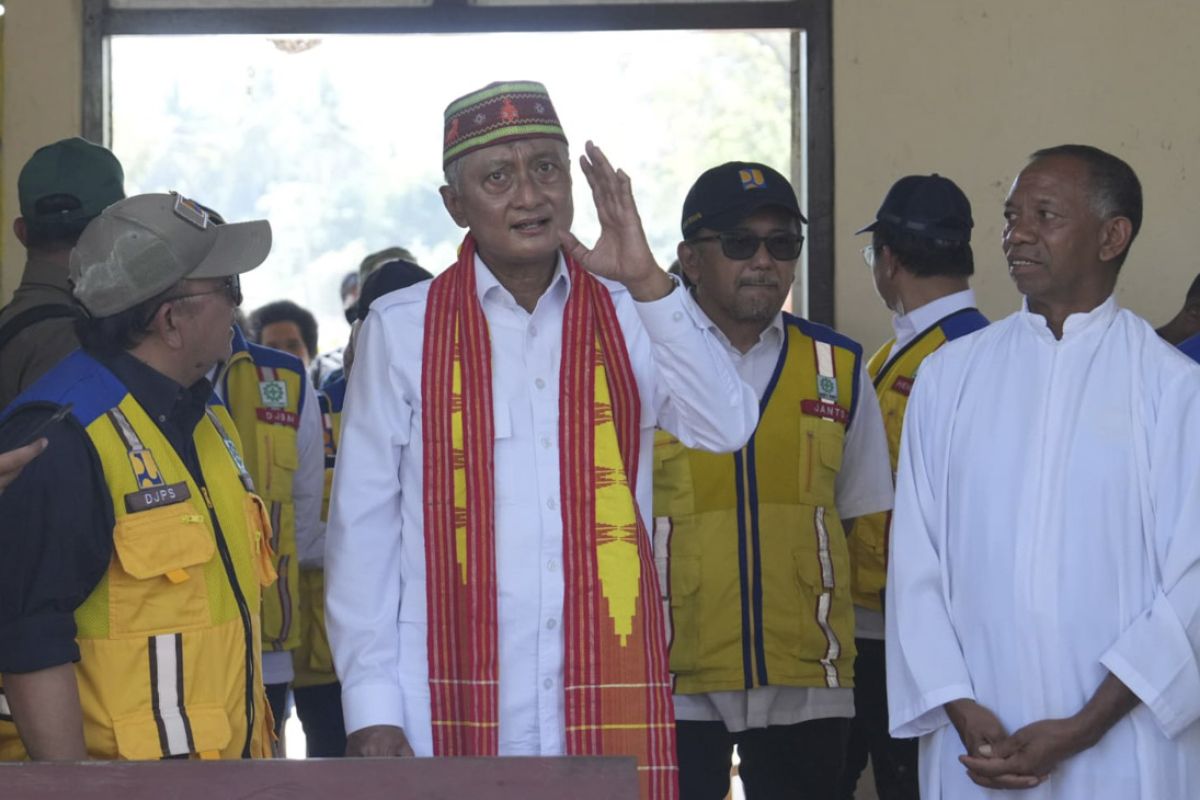
Public Works Minister Dody Hanggodo has emphasised that the handling of public service buildings affected by the earthquake on Flores Island, East Nusa Tenggara, must be carried out quickly and appropriately according to the level of damage, while still paying attention to local wisdom and the needs of the local community.
“If we rebuild a building, local wisdom must be preserved wherever it is. So we must coordinate with those who use or manage the building,” Dody said in a statement in Jakarta on Saturday.
He personally inspected the Santo Petrus dan Paulus Dampek Church and the Nurul Huda Reo Mosque in Manggarai Regency. The visit was part of efforts to ensure that the condition of affected buildings has been recorded and inspected so that the necessary handling can be determined precisely, whether through repair or reconstruction for buildings that suffered severe damage.
Dody requested that the assessment results serve as the main basis for determining the form of intervention. Buildings with damage levels that can still be repaired will be handled through rehabilitation, while buildings that suffered severe damage may be rebuilt with stronger construction standards suited to earthquake-prone conditions.
The data collection and inspection of affected buildings is being carried out by the Ministry of Public Works through relevant technical units, including the Directorate General of Human Settlements and the Directorate General of Strategic Infrastructure.
“There is a mosque here, and it was severely damaged so it has to be completely demolished. The church in Dampek is the same,” Dody said.
Dody instructed that the handling be carried out in coordination with relevant parties, including the priest, parish administrators and the Diocese of Ruteng. The Santo Petrus dan Paulus Dampek Church, which has stood since 1979, was one of the buildings inspected by Minister Dody.
“For a church, we coordinate with the priest. Its local wisdom must not be lost,” he said.
The same applies to other places of worship. In handling the Nurul Huda Reo Mosque, coordination with the takmir or mosque administrators is necessary so that the rebuilt structure remains in line with the needs of the community that uses it.
According to Minister Dody, applying local wisdom does not mean reducing building safety standards. On the contrary, all buildings that are repaired or rebuilt must be strengthened to withstand potential future earthquakes.
“The buildings must be strengthened because this is an earthquake zone. So the buildings must be able to adapt to their natural conditions,” said Minister Dody.
This approach is in line with the build back better principle, namely rebuilding with better quality, greater safety and greater resilience to disaster risks. In addition to considering technical aspects and local wisdom, Minister Dody also requested that the rehabilitation and reconstruction process involve the surrounding community. Community involvement is expected to accelerate the recovery process while ensuring that economic activity and residents’ livelihoods continue during the rehabilitation and reconstruction period.
“It is mandatory to involve the local community, so that local people do not lose their livelihoods. They can regain their livelihoods by participating in all rehabilitation and reconstruction processes in the most affected areas,” he said.