
Public Works Minister: Strengthening Pumping Systems is the Solution to Combat Drought in Paddy Fields
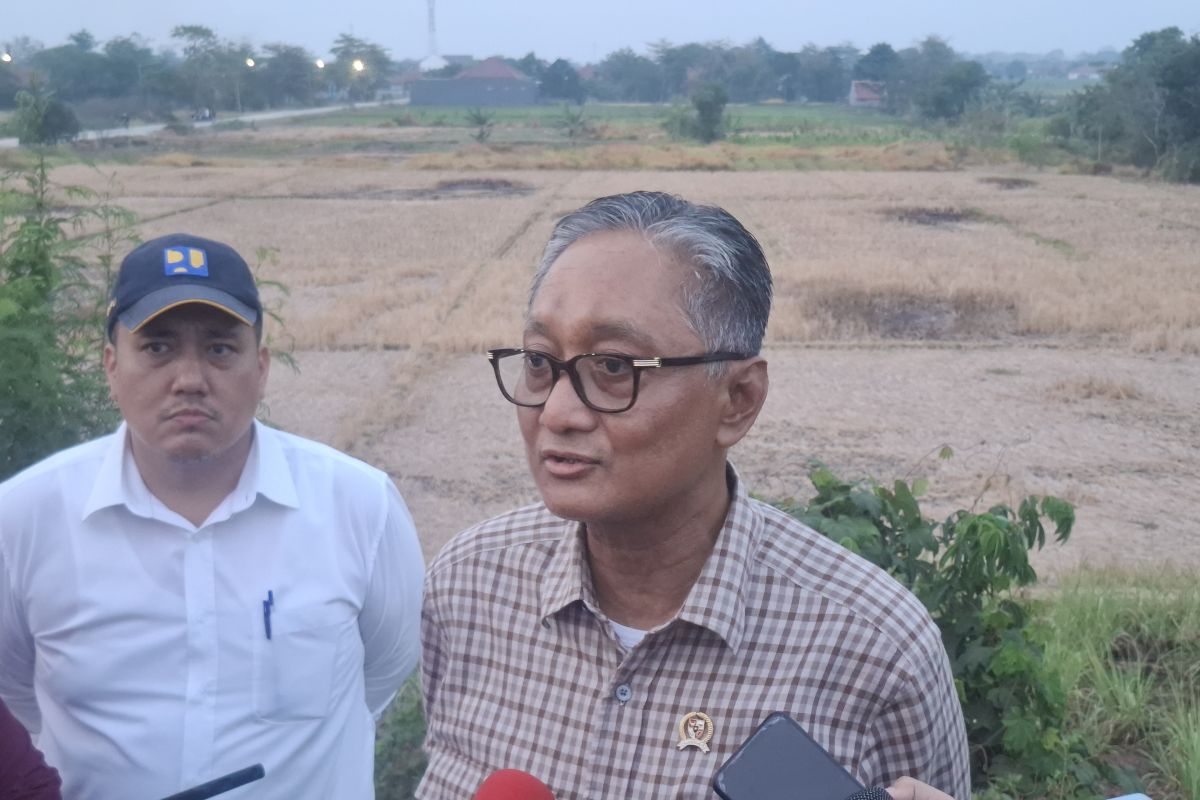
The Minister of Public Works (PU), Dody Hanggodo, stated that pumping intensification and the strengthening of irrigation networks are the solutions for delivering water to paddy fields still affected by drought amidst a prolonged El Niño.
“The water sources exist; there are rivers, and those rivers are not dry,” said Dody following an inspection of four paddy field sites in Bekasi and Cirebon, West Java, on Saturday.
He explained that the findings from the inspection of several points show that the problem is not always caused by a lack of water sources, but rather by the failure to distribute water from available sources to agricultural land.
According to Dody, in such conditions, river water can be pumped and directed into secondary and tertiary irrigation channels to ensure it reaches the fields.
One such condition was found in Kedongdong Village, Cлоbon, West Java. Following the inspection, Dody noted that the water source in the village is positioned lower than the paddy fields, making gravity-fed irrigation impossible.
He assessed that electric-powered pumps could be a viable option since the electricity grid is available near the location. Dody also noted that using electricity could reduce the financial burden on farmers compared to using diesel-powered pumps.
“I see many electricity poles there, so electricity can be used. Just install electric-powered pumps,” he said.
The pumped water can then be distributed through pipes to existing secondary channels. Meanwhile, tertiary networks that deliver water closer to the agricultural land still need to be constructed.
Dody stated that the construction of simple tertiary channels can be carried out by involving farmers. “Invite the farmers to build them together. It is inexpensive; it is not costly,” Dody remarked.
As an example, through this pumping and network scheme, he estimates that almost 400 hectares of paddy fields in the inspected area of Kedongdong could receive a steady water supply. “Almost 400 hectares can be easily irrigated,” he said.
For long-term solutions, Dody mentioned that the construction of boreholes or small reservoirs (embung) could be considered for areas that continuously face difficulties in transporting water from lower sources. For the 400-hectare area in Kedongdong, Dody estimated that two or three boreholes could be one option.
An alternative would be the construction of reservoirs in locations where available land permits. However, he noted that permanent solutions must be further studied according to the specific conditions of each region. “As for the future strategy, we indeed need time to study it more deeply,” he added.
The Ministry of Public Works noted that as of 24 September 2024, drought management has been implemented in 3,288 locations nationwide, including 358 locations in paddy field areas. This agricultural sector intervention covers approximately 141,440 hectares of paddy fields.
Previously, the Ministry of Public Works also reported that agricultural interventions include pumping river water to fields, normalising main and secondary irrigation channels, creating emergency channels, regulating water rotation, channel optimisation, and pipe installation.