
Public Works Minister Optimistic 2026 Food Self-Sufficiency Target Remains Achievable
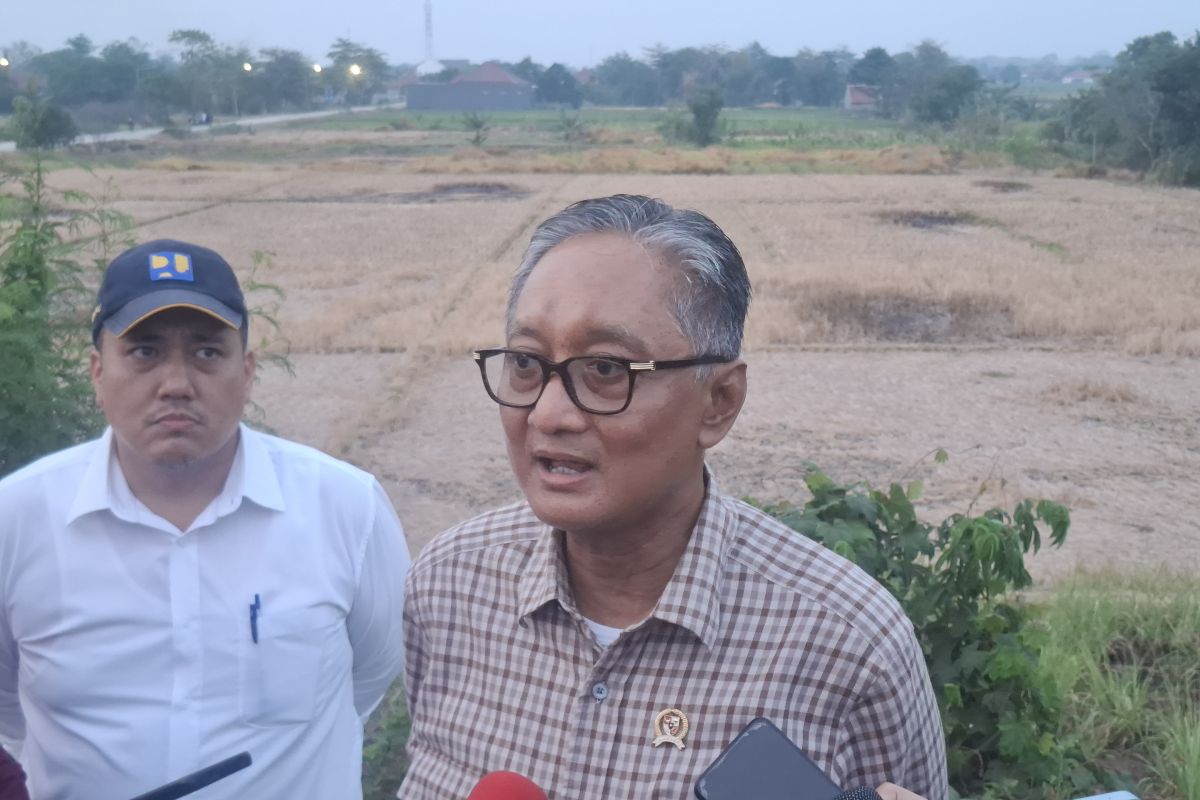
Cirebon (ANTARA) - The Minister of Public Works (PU), Dody Hanggodo, is optimistic that the 2026 food self-sufficiency target will still be achieved, despite finding several rice fields lacking sufficient water during an inspection of four sites in Bekasi and Cirebon, West Java, on Saturday.
“God willing, it will still be achieved. (The 2026 food self-sufficiency target) will be achieved,” said Dody following the inspection.
He stated that the Ministry of Public Works will increase its focus on drought management, particularly in regions serving as national food granaries, to maintain water availability for agricultural land.
“Places that are indeed national food granaries will be our priority,” he said.
According to Dody, West Java, Central Java, and East Java are currently the regions facing the most severe drought while simultaneously serving as the primary areas for national food production.
He noted that similar field inspections would likely be expanded to other food centres, including Sulawesi, Lampung, and Jambi, to ensure water availability for agriculture.
Dody mentioned that the results of the inspection in West Java showed that some rice fields are still experiencing water shortages, suggesting that field conditions are not yet fully reflected in the Ministry of Public Works’ internal data.
“Our dashboard shows everything in green, with no red indicators, but it can be proven that this is not entirely accurate, as several points are still experiencing drought,” he said.
Consequently, he has requested the Directorate General of Water Resources to strengthen field data with information from Water User Farmer Associations (P3A) and Farmer Group Unions (Gapoktan).
Dody stated that the Ministry of Public Works also possesses funding sources to address water availability issues for agriculture, including budgets from Presidential Instructions regarding irrigation and regular irrigation budgets.
“There is Inpres irrigation funding, and there is also regular irrigation funding,” he said.
Previously, the Ministry of Public Works reported that it had addressed the impacts of drought in 2,200 locations as of 7 September 2026. Of that number, 240 locations were irrigation areas or rice fields, with the total area of handled farmland reaching 53,052 hectares.
Management of agricultural land is being carried out through methods such as pumping water from rivers to fields, the normalisation of primary and secondary irrigation channels, the construction of emergency channels, the regulation of water rotation patterns, channel optimisation, and the installation of pipes.
Meanwhile, the Central Bureau of Statistics (BPS) projects that rice production for public consumption throughout January–September 2026 will reach 28.71 million tonnes, a slight increase of 0.01 per cent compared to the same period the previous year.
BPS noted that potential rice production for July–September 2026 is estimated to reach 9.36 million tonnes, or a decrease of 0.88 per cent compared to the same period last year. This projection remains subject to change due to drought, flooding, pest attacks, and changes in harvest timing.
Furthermore, the Ministry of Agriculture, in its 2026 food balance projection, estimates that national rice production will reach 34.77 million tonnes, while national demand is set at 31.10 million tonnes, resulting in a projected surplus of approximately 3.67 million tonnes.
Source: jawawa.id (https://jawawa.id/newsitem/public-works-minister-optimistic-2026-food-self-sufficiency-target-remains-achievable-1790438318)
Originally published by Antara (Indonesian) (https://www.antaranews.com/berita/5760105/menteri-pu-optimistis-swasembada-pangan-2026-tetap-tercapai), translated from Indonesian