
Public Under Pressure, Economist Doubts Government's Growth Figures
Economist from Airlangga University (Unair) Rahma Gafmi argued that the positive economic growth figure is questionable amidst claims of a weakening economy on the ground. “On the surface, this figure above 5 percent looks solid and aligns with the government’s psychological target. However, there are several fundamental reasons why this figure feels contradictory to the reality in the field,” Rahma told Republika on Wednesday (5/8/2026).
“Why does the 5.29 percent figure feel unconvincing? Because of a slowdown trend,” she stated. Rahma explained that although it remains above 5 percent, the 5.29 percent growth represents a deceleration compared to the first quarter of 2026, which recorded 5.61 percent year-on-year. This slowdown raises questions about the economy’s driving force going forward, especially amidst tight banking liquidity and interest rate dynamics that continue to challenge the real sector. Furthermore, she noted a contradiction with real public purchasing power.
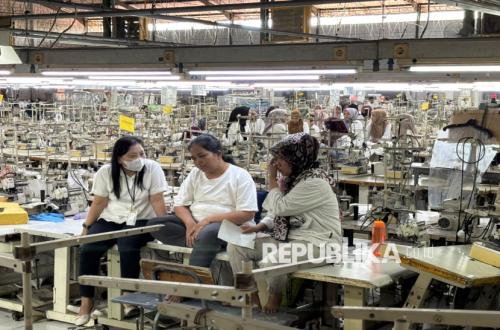
“At the grassroots level, pressure on the lower-middle class is genuinely felt due to price transitions, living costs, and the post-Idulfitri seasonal normalisation, which typically dampens money circulation,” she said. Rahma explained that there is a dependency where growth is often sustained by large-scale sectors or capital-intensive investments, meaning the trickle-down effect is not evenly felt by labour-intensive sectors.
It was recorded that the main indicators forming the Gross Domestic Product (GDP) in the second quarter of 2026 saw the household consumption expenditure component remain the largest contributor to GDP, although its dynamics are heavily influenced by inflation stability and the purchasing power of the middle class. Meanwhile, Gross Fixed Capital Formation (GFCF) or investment became one of the main drivers, propelled by investment realisation from both strategic projects and the private sector throughout the first half of 2026. “Looking at the realisation in the second quarter of 2026 at 5.29 percent, which represents a slowdown from the previous quarter (5.61 percent), the government must accelerate significantly in the second half of 2026 for the full-year average to reach 6 percent, but this will be very difficult,” she concluded.