
Public Trust Seen as Key Asset for Police to Secure Indonesia's Golden Vision 2045
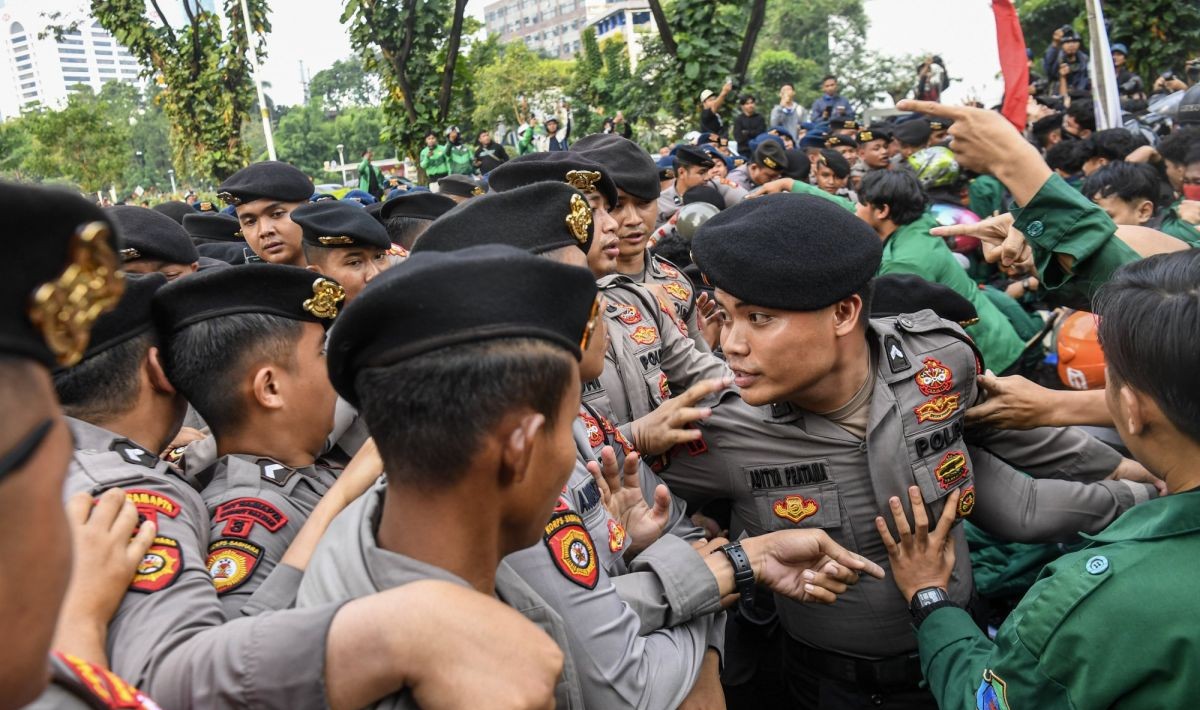
As it enters its 80th year, the Indonesian National Police (Polri) is considered to have successfully undergone an institutional transformation, prioritising a more humanistic approach and focusing on public service. This change is seen as part of the force’s effort to adapt to the ever-evolving dynamics of security challenges.
Intelligence, defence, and security analyst Ngasiman Djoyonegoro stated that Polri’s eight-decade journey demonstrates the institution’s role not only as a law enforcer but also as an integral part of the nation’s journey. “This 80-year milestone is clear proof that Polri is part of the Republic’s DNA. From the era of armed struggle for independence, through the reform era, social conflicts, counter-terrorism, to today’s fast-paced cyber warfare, Polri has been continuously forced to adapt,” he said.
Simon, as he is familiarly known, assessed that Polri’s orientation is now much closer to the community. He believes the theme “Polri for the Community” for the 80th Bhayangkara Day anniversary should be a policy direction realised through tangible service, not just a slogan. He stressed that public trust can only be built through consistent, fast, transparent, and fair resolution of public issues.
“The people think simply. They need a police force that is easy to contact, quick to arrive when there is a problem, solution-oriented, transparent, and fair. If field performance is consistently good, public trust will naturally follow. We can see this transformation through programmes like Polri Presisi, the Electronic Traffic Law Enforcement (ETLE) system, digitalisation of vehicle document services, and breakthroughs like Polri RW and Bhabinkamtibmas, which allow police officers to sit down with residents to solve local issues,” he added.
According to Simon, Polri’s role has also expanded through involvement in key government programmes, such as supporting the free nutritious meal programme through the Nutrition Fulfilment Service Unit (SPPG) and strengthening food security by assisting farmer groups in various regions. “When police officers go into the fields to assist farmers and secure food supplies, they are essentially strengthening the national safety belt. A well-fed populace and a conducive social situation are the most basic capital for economic stability and development. Safeguarding food supplies reaps security,” he said.
He also highlighted the results of a Kompas Research and Development survey released at the end of June 2026, which recorded public satisfaction with Polri at 80.6 percent. According to him, this achievement is an invaluable social asset for the police institution. “That 80.6 percent public satisfaction figure is a strategic asset of immense value. It cannot be bought with a budget. But remember, this level of trust is not the finish line. Trust is built with sweat and integrity over years, but it can be shattered in seconds. Therefore, every personnel member in the field must be aware that they are the face of Polri in the eyes of the public,” he stated.
Facing technological advancements, Simon assessed that future security challenges will become increasingly complex with the emergence of artificial intelligence-based threats, cyber-attacks, and hybrid crimes that transcend national borders. “In the future, criminals won’t need to break down doors; they will use AI, cyber tools, robotics, and data manipulation. That is why the future Polri must be data- and analytics-based. But no matter how sophisticated the technology gets, the human factor remains number one. Machines do not have empathy, conscience, or wisdom. Only humans possess those,” he said.
To address these challenges, Simon proposed the concept of a ‘Security Belt’ (Sabuk Kamtibmas), a collaborative security model involving the government, academia, the business sector, media, and the community, with Polri acting as the main coordinator. “The police of the future cannot work alone anymore. Future security is a matter of mutual cooperation. Polri must embrace the government, universities, businesspeople, the media, and citizens. This multi-stakeholder collaboration is what I call the Security Belt. If all these elements are synergistic, we will have an adaptive security immune system,” he explained.
He revealed that this idea is currently being compiled into a book titled ‘Sabuk Kamtibmas’, presented as a reflection and intellectual gift for the 80th Bhayangkara Day commemoration. “I am currently finalising a book titled ‘Sabuk Kamtibmas’. This is my intellectual contribution for the 80th Bhayangkara Day. Its contents offer a modern security architecture concept for a new era, based on technology and total collaboration. My hope is that this book can become a valuable reference so that Polri becomes more professional, humanistic, and technologically literate in the future. Most importantly, so that Polri remains beloved by the people as the main capital towards a Sovereign, Just, and Prosperous Indonesia,” he concluded.