
Public Trust and Satisfaction in Prabowo Administration Remain High
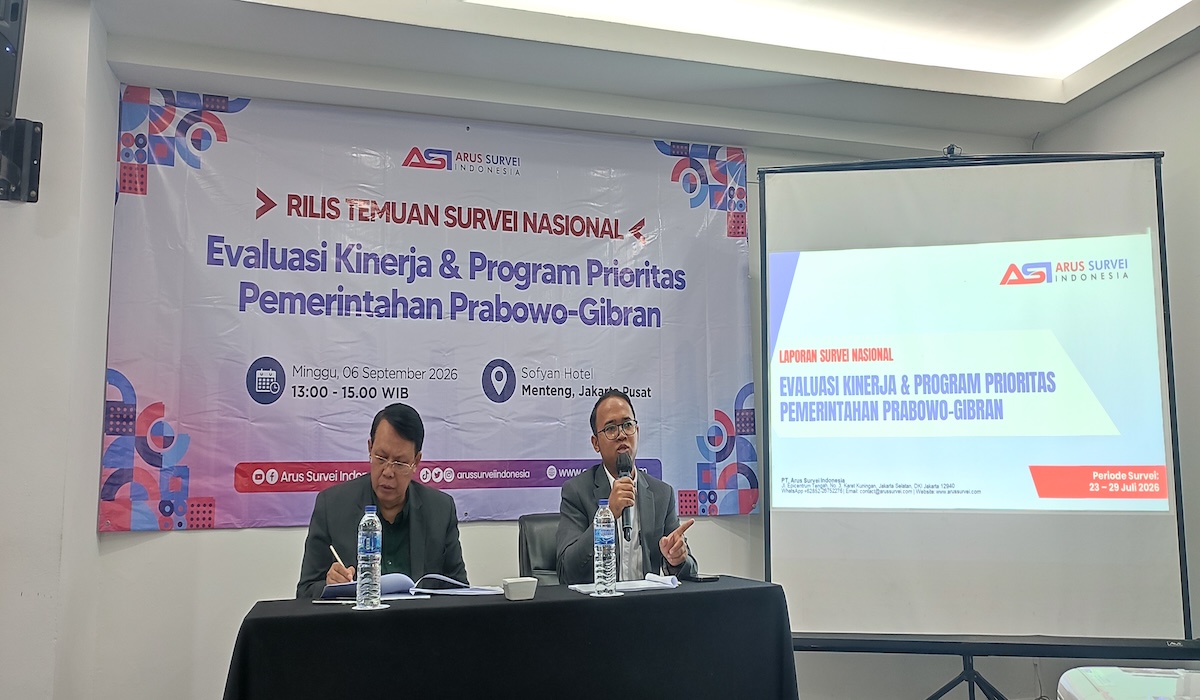
Public support for the administration of President Prabowo Subianto remains above 60%. One of the government’s priority programmes, the Free Nutritious Meals (MBG) scheme, also continues to enjoy majority public support, even showing a positive response among Gen Z and Millennials.
The findings emerged from a national survey by Arus Survei Indonesia (ASI) titled ‘Evaluation of the Performance and Priority Programmes of the Prabowo-Gibran Administration’. The survey shows that 61.4% of the public still trust the Prabowo-Gibran administration, while 57.6% express satisfaction with President Prabowo’s performance.
‘If we look at the level of trust, the figure reaches 61.4%. This means that, in general, the majority of the public still places trust in the Prabowo-Gibran administration,’ said Arus Survei Indonesia Executive Director Ali Rif’an during the national survey release in Jakarta on Sunday (6/9).
The trust level comprises 9.1% of respondents who strongly trust and 52.3% who fairly trust the administration. Conversely, 35.9% expressed distrust, consisting of 29.9% who somewhat distrust and 6% who strongly distrust. A further 2.7% of respondents did not know or did not answer.
Regarding satisfaction with President Prabowo’s performance, 57.6% of respondents expressed satisfaction. In detail, 9% were very satisfied and 48.6% fairly satisfied. Meanwhile, 40.6% expressed dissatisfaction and 1.8% did not know or did not answer.
According to Ali, the difference between the level of trust in the administration and satisfaction with the president’s performance indicates that public perception remains broadly positive, although there are segments of society that are not yet satisfied or do not yet trust the government.
‘If we distinguish between the two, trust in the administration stands at 61.4%, while satisfaction with President Prabowo’s performance is 57.6%. This shows that public perception in general remains positive, although there are groups in society who are not yet satisfied and do not yet trust the government,’ he said.
One government programme that continues to enjoy public support is MBG. A total of 51.5% of respondents agreed that the programme should be continued, comprising 12.3% who strongly agreed and 39.2% who fairly agreed.
This support is only narrowly ahead of the group that disagrees with continuing MBG, which stands at 45.4%. Some 29.6% somewhat disagreed and 15.8% strongly disagreed, while 3.3% did not know or did not answer.
‘Looking at the survey results, the majority of the public still agrees that the Free Nutritious Meals programme should be continued. The margin is indeed not very wide, but public support remains above the level of opposition,’ said Ali.
Interestingly, support for MBG appears quite strong among younger generations. Based on cross-tabulation by age, 54.6% of Gen Z respondents, or those aged 17–23, expressed satisfaction with the implementation of MBG.
Among Millennials aged 24–39, the satisfaction level also exceeded 50%, at 50.4%.
‘This is interesting because when we look at it by age group, the satisfaction level of Gen Z reaches 54.6% and Millennials 50.4%. This means that in these two generational groups there is a tendency towards a positive assessment of the MBG programme,’ said Ali.
According to him, the positive response from younger age groups shows that MBG is relevant to the needs of the public. The programme, which directly addresses nutritional fulfilment, also has the potential to become one of the government’s assets in maintaining public support.
However, Ali cautioned that support for MBG does not mean the government can ignore evaluation. With the relatively narrow gap between support and rejection, the quality of implementation is an important factor in determining whether public acceptance of the programme can be sustained.
‘What matters is not only that the programme is continued, but how well it is implemented. When the public genuinely feels the benefits, support for the programme will certainly grow stronger,’ he said.
The same applies to the level of public trust in the government. Ali said that the trust, which currently stands above 60%, must be viewed as both an asset and a basis for evaluation by the government.
‘Public trust is certainly not something permanent. Therefore, this figure should be read as both an asset and an evaluation. The government needs to maintain what has been appreciated by the public and make improvements on matters that are still considered lacking,’ he said.
The ASI survey was conducted on 23–29 July 2026 across 38 provinces in Indonesia through face-to-face interviews with 1,200 respondents. The sample was drawn using the Multistage Random Sampling method, with a margin of error of plus or minus 2.9% at a 95% confidence level.